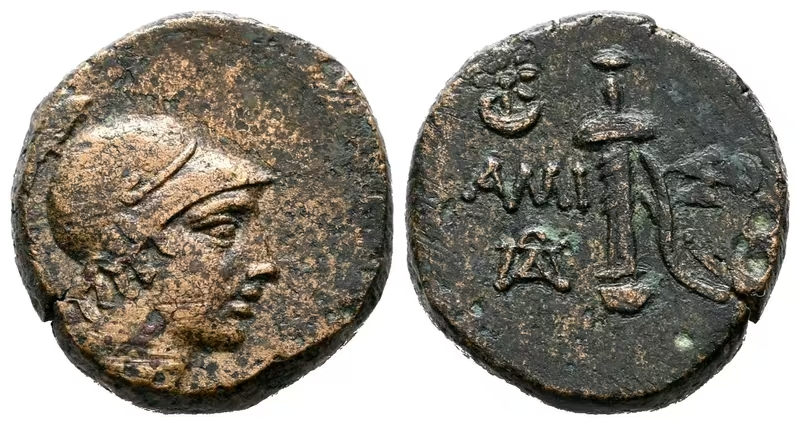
Ares
Ares is the Greek god of war, embodying its wild, violent and destructive side. In ancient mythology he is associated with bloodshed, the chaos of battle and warlike frenzy, in contrast to Athena, who represents strategy and disciplined defence.
Ares belongs to the twelve Olympian gods, yet in the Greek imagination he never attained as unequivocally positive a standing as some of the other deities. The Greeks knew war and waged it frequently, but at the same time perceived it as a state that was dangerous, destructive and morally ambiguous. For precisely this reason Ares is portrayed in myths as a force that unleashes violence and conflict, sometimes appearing more as the personification of martial fury than as a "noble" protector of the community.
In the mythological stories Ares is the son of Zeus and Hera and often appears alongside the goddess of strife Eris and other figures associated with combat. His relationship with Aphrodite, the goddess of love, is one of the most famous motifs of ancient literature: it unites the opposites of creation and destruction, while at the same time showing that the divine world is full of passions that go beyond simple rules. Ares is often depicted as a warrior in armour, with a spear and shield, sometimes accompanied by animals and symbols expressing aggression and ferocity.
History
In Greek religion Ares had a cult, but it was not as strong or as widespread as that of deities associated with fertility, the city or order. In the area of military ideology Greek communities often gave preference to Athena as a symbol of rational protection of the polis, or to Apollo as a god of order and measure. Ares was rather a reminder of what war can do when it gets out of hand. This attitude is reflected even in the myths, where Ares is not invincible and sometimes is even mocked or defeated, in sharp contrast to his "terrifying" image.
The significance of Ares changes, however, in later cultural contexts. In the Roman world he is identified with Mars, who had a far more prestigious standing as protector of the state and ancestor of the Romans. With this, the interpretation of the war god also shifts: from chaos and violence he becomes in part "discipline" and state ideology. In the Greek setting, however, Ares remains above all a reminder of the raw side of war, which though sometimes inevitable is never without consequences.
Symbolism and depictions
Ares is recognisable in iconography as an armed warrior, often with a helmet, spear and shield. His symbols tend to be linked with combat and aggression; in ancient art he may appear as an ideal of masculine strength but at the same time as a warning of what happens when strength turns into untamed violence. In stories and artistic representations Ares thus often appears where dramatic conflict, passion and destruction need to be emphasised.
In everyday speech, Ares has become shorthand for "warlike" energy, sometimes also for inclinations to aggression or conflict. At the same time he reminds us that ancient mythology was not merely a set of pleasant tales but also a way of explaining human behaviour and social phenomena. Ares as the god of war is therefore not merely a figure from legend but a symbol of force that can swiftly destroy what has long been built.
In our auction and shop
- Code: BB-HGC0007Recommended
Mithradates VI. Eupator, Pontos, AE, Amisos, HGC 7,241
Mithradates VI. Eupator (120 - 63 př.n.l.), Pontos mincovna Amisos, Ares s helmou doprava / meč v toulci, HGC 7,241 ,
Skladem 1 ks