Jacobin Trials
The Jacobin trials were political trials conducted by the Revolutionary Tribunal during the Jacobin Terror of 1793–1794 in the French Revolution. They were characterised by simplified proceedings without the right to defence and the mass sentencing of alleged enemies of the Revolution to death by the guillotine.
The Revolutionary Tribunal (Tribunal révolutionnaire) was established by the National Convention on 10 March 1793 as an extraordinary judicial body intended for trying political crimes against the Revolution. The tribunal was housed in the Palais de Justice on the Île de la Cité in Paris and became the principal instrument of the Jacobin Terror led by Maximilien Robespierre and the Committee of Public Safety.
The key figure in the trials was the public prosecutor Antoine Quentin Fouquier-Tinville, nicknamed "the purveyor of the guillotine". From March 1793 to August 1794 he headed the prosecution and personally took part in sentencing more than two thousand people to death. Fouquier-Tinville lived directly in the building of the Conciergerie prison, where he resided with his family among the condemned inmates.
As early as October 1793, Fouquier-Tinville complained to the Convention about the slowness of the trials and asked why witnesses were even needed, since "the whole of France accuses those whose trial is in progress". The Law of 22 Prairial Year II (10 June 1794) granted his demands and drastically curtailed the rights of the accused. The accused lost the right to counsel, the court could pass sentences without questioning witnesses, and the only possible verdicts were acquittal or death.
History
Among the most significant trials was the trial of Queen Marie Antoinette in October 1793, a two-day trial concluded with a death sentence. The queen was accused of high treason, collaboration with the enemy and even of indecent conduct towards her own son. In March 1794 a trial was held with the Hébertists, a radical faction demanding the extension of the terror. A month later, the so-called Indulgents, led by Georges Danton and Camille Desmoulins, who on the contrary called for an easing of repression, stood before the tribunal.
Danton's trial became one of the most dramatic. Danton defended himself with vigour, and his oratorical abilities alarmed the prosecutor and the jury alike. On Robespierre's instruction the Convention passed a decree permitting the exclusion from the trial of accused persons who "insult justice", thereby denying Danton further space for defence. He was executed on 5 April 1794 together with his followers. His famous saying "The Revolution devours its own children" became a symbol of the self-destructive nature of the terror.
The period of terror ended with the Thermidorian Reaction of 27 July 1794, when Robespierre himself was arrested and executed the following day. Fouquier-Tinville was arrested in August 1794 and brought before the same tribunal he had previously served. He was executed on 7 May 1795 as the last victim of the Revolutionary Tribunal.
Course and victims
The trials proceeded at an accelerated pace, sometimes with several dozen people condemned in a single day. The accused were brought from the neighbouring Conciergerie prison directly into the courtroom. The prosecution often relied on anonymous denunciations gathered by the Committee of General Security. Being labelled an "enemy of the Revolution", a "suspect" or an "aristocrat" was sufficient for an indictment.
Estimates of the total number of victims of the Jacobin Terror range between 16,000 and 40,000 executed across France. In Paris alone the revolutionaries sent more than 2,500 people to the guillotine. In addition, some 300,000 people were imprisoned, many of whom died in prison. Outside Paris, mass executions took place without proper trials — in Nantes in the winter of 1793–1794 up to 5,000 people were drowned in the River Loire, in Lyon the condemned were shot en masse with grapeshot.
Among the most notable executed, besides the royal family, were leading Girondins, generals suspected of treason, clergy refusing to swear an oath to the revolutionary constitution, nobles and ordinary citizens. The victims of the terror also included the Czech Jacobins, the brothers Junius and Emmanuel Frey, executed on 5 April 1794 together with the Dantonists.
In our auction and shop
- Code: ZSMAD-94F2009
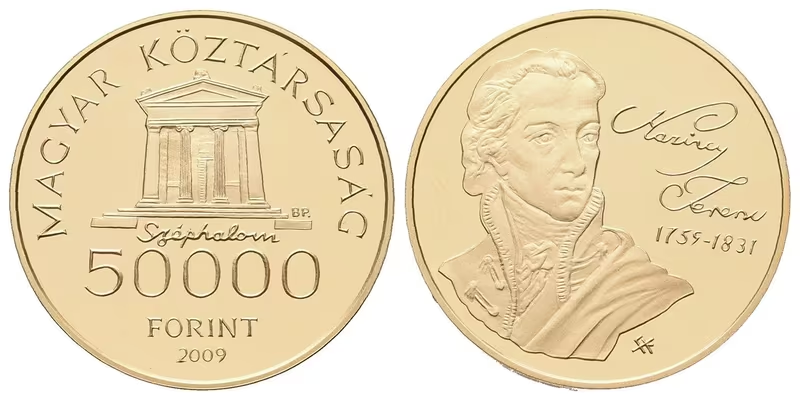
Maďarsko, 50 000 Forint 2009 - Kazynczy Ferenc, PROOF
Maďarsko 50 000 Forint 2009 - 250. výročí narození Kazynczy Ference Au 0,986, 23 mm (10 g), vyraženo pouze 10 000 ks, cerifikát, PROOF Kazynczy Ferenc (1759 - 1831) - Byl uherský šlechtic a jazykovědec. Odstartováním jazykové reformy se zasloužil o vznik…
Skladem 1 ks