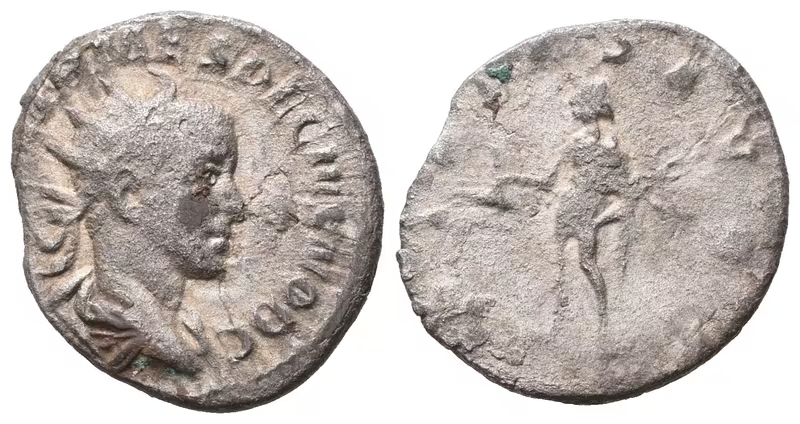
Mercury
Mercury is the Roman god of commerce, profit, journeys and messenger of the gods, who tends to be identified with the Greek Hermes. In the Roman tradition he protected merchants and markets, oversaw safe travel and in mythology appeared as a swift intermediary between gods and humans.
The cult of Mercury developed in Rome together with the growth of urban commerce and the increasing need for a "guarantor" of fair exchange and safe transport. Whereas some older Roman deities were associated rather with the agricultural cycle and family cults, Mercury naturally attaches to the urban environment, marketplaces, warehouses and long-distance travel. In Roman thinking, commerce was important but at the same time suspect: profit could be perceived as something that required oversight and order. Mercury thus symbolically ensured that exchange had its rules, that weight, measure and trust could be relied upon — without these the market would not function.
The Romans moreover very often adopted and linked their gods with Greek models. Mercury is therefore from an early period closely associated with the Greek Hermes, whose functions of messenger, protector of roads and guide of souls to the underworld fitted well into the Romans' own religious practice. The identification with Hermes also influenced the iconography: Mercury acquired the form of a young man in motion, with attributes of speed and message. His role expanded also to include wit, skill and the ability to negotiate, because commerce and diplomacy require not only strength but also dexterity.
History
In the periods of the republic and the empire, Mercury became one of the most frequently venerated gods in cities that lived from commerce. His cult spread throughout the empire, especially along the routes of communication and in ports, where people of different languages and customs met. On the frontiers and in the provinces a typical Roman syncretic practice manifested itself: Mercury was sometimes identified also with local deities associated with travel, exchange and protection, so that his cult adapted itself to regional traditions. In some parts of the empire Mercury thus functioned as a "universal" god capable of combining Roman order with the local conception of protection and prosperity.
Mercury is usually recognised in art by several attributes. Typical is the caduceus (a staff with serpents), a symbol of message, negotiation and "peace", as well as winged sandals and sometimes a winged cap, which emphasise speed. A purse also often appears, a clear sign of commerce and profit. His iconography therefore reads very intelligibly: even without an inscription it is clear that this is a deity associated with travel, speed and exchange.
Attributes, symbolism and numismatic context
In numismatics Mercury appears as a motif on ancient coins, particularly in the period of the Roman empire. His depiction could emphasise prosperity, the safety of the routes of communication and the support of commerce — themes that rulers liked to communicate. On coins Mercury tends to be depicted standing or walking with the caduceus and a purse, sometimes also in a more dynamic pose that underlines his role as messenger. For collectors this motif is attractive also in that it links economic significance with clear symbolism: Mercury is in the Roman world one of the most frequent "icons" of commerce and prosperity.
In our auction and shop
- Code: SZ-NEJ-RAK-1856
Stříbrná známka - Rakousko Uhersko - 6 Kreuzer Merkur - 1856 -Ag 5g 999/1000
Stříbrná známka - Rakousko Uhersko - 6 Kreuzer Merkur - 1856 -Ag 5g 999/1000,
Skladem 1 ks - Code: BE081-0142
Herennius Etruscus, antoninián, Řím, RIC 142b
Herennius Etruscus (250 - 251) mincovna Řím, stojící Merkur držící caduceus a měšec, PIETAS AVGG, RIC 142b
Skladem 1 ks