
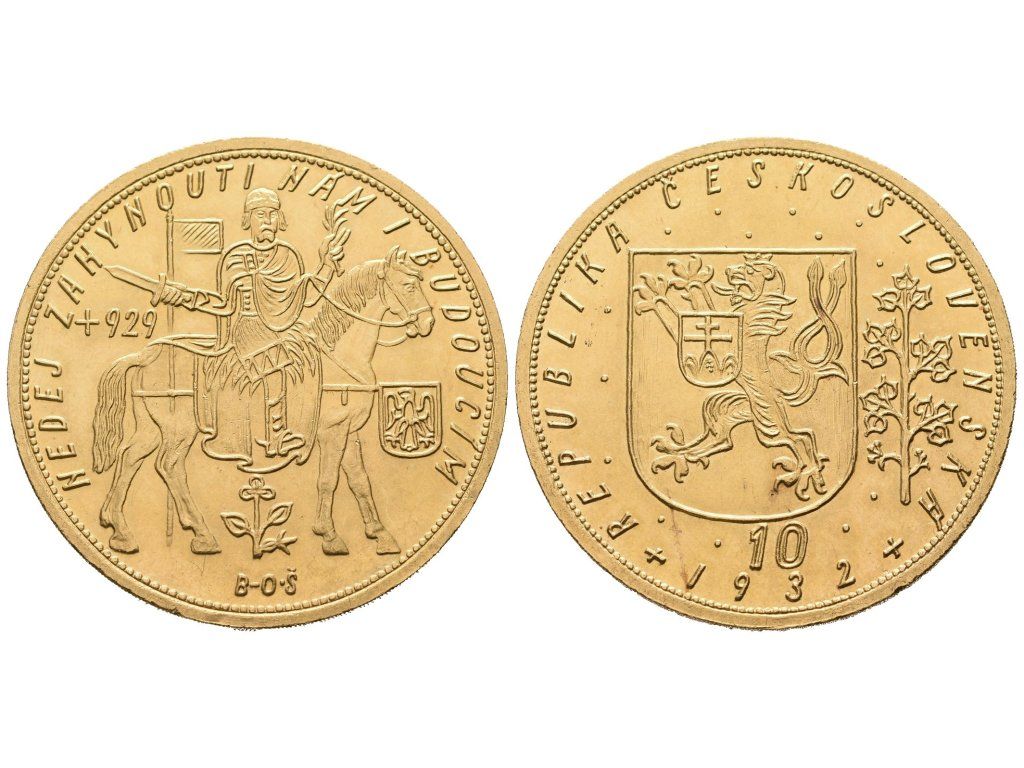
Why the 10-ducat is so exceptional
The St Wenceslas ducat draws on an older European tradition of ducat gold, yet feels distinctly Czechoslovak. The obverse with St Wenceslas was designed by Jaroslav Benda; the reverse with the state coat of arms was created by Otakar Španiel. That combination makes it not only investment gold but a culturally powerful and instantly recognisable national strike.
The years where the price breaks
With the St Wenceslas 10-ducat it is not enough that it is gold. The specific year is decisive. Differences between individual years are enormous, and low mintages push selected pieces into the million-koruna category.
| Year | Mintage | Note |
|---|---|---|
| 1937 | 34 pieces | The holy grail of Czechoslovak numismatics — million-koruna prices |
| 1936 | 626 pieces | A very rare year with exceptional demand |
| 1933 | 1,780 pieces | Strong collector premium and high liquidity |
| 1932 | thousands of pieces | A more accessible entry to the series, still a strongly investment piece |
| 1931 | thousands of pieces | An entry-level year for collectors of the ducat series |
| 1929 | thousands of pieces | The first year of issue, with major historical significance |
Technical specifications
The 10-ducat is a technically and visually representative strike. Compared with ordinary circulation coins, we are in a completely different category of material, size and auction handling.
| Parameter | Value |
|---|---|
| Diameter | 42 mm |
| Weight | 34.9 g |
| Material | Ducat gold |
| Fineness | 986/1000 (Au 986) |
| Obverse | Jaroslav Benda — St Wenceslas |
| Reverse | Otakar Španiel — state coat of arms |
| Period of issue | 1929–1937 |
Authenticity, grade and why they matter absolutely
On the St Wenceslas ducats every detail counts. Where more ordinary coins tolerate small contact marks, on the 10-ducat a difference in grade means a dramatic price swing.
- Lustre — Original mint lustre in the deep lines of the relief is essential.
- Detail sharpness — Both St Wenceslas and the state coat of arms must look crisp without any soft impression.
- Surface — Aggressive cleaning or polishing can hurt the price more than a small circulation trace.
- Authenticity — On stronger pieces a precise check of weight, diameter, alloy and provenance is standard.
- Grading — On top examples professional certification makes a great deal of sense.
We are no longer talking only about a gold coin but about competitive collector material. That is why an expert opinion on the 10-ducat is so important.
Why it holds value in a changing market
The investment strength of the 10-ducat stands on two legs: the gold itself and the numismatic premium. On rare years the second component is far stronger than the metal value alone.
- Intrinsic gold value — The coin contains roughly 32 g of pure gold.
- Numismatic premium — Year rarity, grade, provenance and story raise the price several times above bullion.
- Liquidity — The top Czechoslovak gold coins have a stable audience of both collectors and investors.
- Cultural status — This is a piece that is immediately legible outside the narrow circle of specialists.
That combination makes the St Wenceslas 10-ducat one of the most resilient and most representative coins on the entire Czech market.
Do you own a St Wenceslas ducat, or are you considering one?
On a piece like this it pays not to rush. We are glad to help with authenticity, valuation and choosing the best sales route.
Next step
Need to value or sell a St Wenceslas 10-ducat?
Send us a photo of the obverse and reverse. We are glad to help with identification, appraisal, and placing it in an auction.