Gold
Gold is a yellow precious metal with extraordinary chemical stability, thanks to which it does not corrode and preserves its appearance and value over the long term. In coinage and investment it is used for coins and bars because it is easy to work, rare and has for centuries served as a recognised 'store of value'.
Gold is among the oldest metals deliberately sought out and worked by man. It often occurs in nature in its native form, so it could be collected as early as prehistory and used for ornaments and ritual objects without complex smelting. It was precisely the natural lustre, rarity and resistance to decay that made it a symbol of prestige and power long before it became part of monetary systems.
As a monetary metal, gold asserted itself gradually. In antiquity silver and electrum (a natural mixture of gold and silver) were also widely used alongside it, but gold coins became an important instrument especially for higher payments, state finances and long-distance trade. Gold was ideal where it was necessary to convey great value in small volume – for example in army payments, in international trade or in storing wealth.
In mediaeval Europe gold once again gained importance in large-scale circulation with the development of towns and trade. Famous gold coins, such as the florins and later the ducats, became a 'currency of trust' across borders. The ducat especially, thanks to its high fineness and stable parameters, maintained a reputation as a reliable standard, so it was accepted even where the local currency suffered debasement. In the Czech lands gold has a marked imprint not only in gold strikings but also in how gold coins were used as a stored reserve, dowry, gift or means of settling great obligations.
History
In the modern period gold became firmly linked to state monetary systems. Alongside traditional gold denominations more modern systems appeared, where gold coins were part of a broader monetary framework and their rate rested on a defined gold content. Gold was thus not only a 'coin' but also an accounting anchor against which the value of other means of payment was measured. This culminated in the concept of the gold standard, when the currency was directly tied to a certain quantity of gold and the state usually guaranteed convertibility for the metal according to firmly set rules. This model strengthened trust and facilitated international trade, but was at the same time sensitive to crises and to the availability of gold in times of war or economic upheaval.
In the 20th century gold gradually disappeared from ordinary circulation. The modern economy moved to paper and later cashless money, while gold retained its role as a reserve asset and an investment metal. Central banks hold it as part of reserves, investors regard it as protection against uncertainty and inflation, and collectors value gold coins for their historical significance, rarity and beauty of striking. A strong tradition of modern investment coins also arose, which are produced in a standardised weight and high fineness and are traded mainly according to metal content and current demand.
Gold is malleable and easy to work, yet in its pure form it is relatively soft. For this reason many historical circulation coins used alloys (for example with copper or silver), which increased hardness and resistance to wear. In the modern world the fineness of gold is commonly given in thousandths (for example 999/1000) or in carats, where 24 carats corresponds practically to pure gold. For investment bars and bullion coins a high fineness is typical, whereas with older circulation strikings one encounters various standards depending on period and country.
Properties, fineness and use in coins and investments
For investors it is important to distinguish between 'numismatic' and 'metal' value. Investment coins and bars are valued mainly according to weight and fineness, while historical gold coins may be more valuable because of rarity, year, mint and state of preservation. With collector pieces the originality of the surface is key – careless cleaning or polishing may reduce the value even of gold, because it removes the natural appearance and leaves traces. Although gold does not corrode like silver, it is sensitive to scratches and dents, so proper storage in capsules or frames is essential.
In practice gold is most often sold in the form of bars and standardised coins, where the parameters are easy to verify. With more expensive pieces certification and verified provenance also help, particularly with historical strikings, which may be the target of counterfeits. Gold thus functions in three roles at once: as a material with intrinsic value, as a bearer of the historical story on coins, and as a long-recognised reserve that retains its significance even in the age of modern currencies and digital payments.
Frequently asked questions
Questions from our knowledge base related to “Gold”. Full answers can be found in Frequently asked questions.
Jak určit hodnotu mince?
Hodnota mince se určuje podle několika faktorů. Mezi ně se řadí stáří mince, kov, ze kterého je vyražena a náklad (vzácnost). Množství typů a nominálů mincí je rozsáhlé a existují tak i tisíce let staré mince se zanedba…
Read full answerJak investovat do zlatých a stříbrných mincí?
Začněte cílem, rozpočtem a investičním horizontem. Běžné investiční mince, například Krugerrand, Wiener Philharmoniker nebo Maple Leaf, se obchodují hlavně podle obsahu kovu, ryzosti a aktuální ceny zlata či stříbra. Ry…
Read full answerJak investovat do zlatých mincí?
U zlatých mincí sledujte hlavně ryzost, hmotnost, likviditu a prémii nad aktuální cenou zlata. Pro čistě investiční nákup dávají smysl známé a snadno obchodovatelné mince; u historických kusů se k ceně kovu přidává sběr…
Read full answerJak se hodnotí investiční mince?
Na základě několik faktorů. Prvním z nich je obsah drahého kovu a ryzost (v naprosté většině jsou mince ve váze tzv. trojské unce 31,1 gramu a ryzosti 999/1000). Existují také moderní investiční mince ražené v menším ná…
Read full answerJak se pozná zlato?
Existuje několik způsobů, jak poznat zlato: 1. Test kyselinou a spektrometrem: Často používaná metoda, kde se zlato testuje pomocí speciálních kyselin, které reagují pouze se zlatem dané ryzosti . Spektrometr zkoumá vzo…
Read full answer
In our auction and shop
- Code: ZN-PRUX1913.P
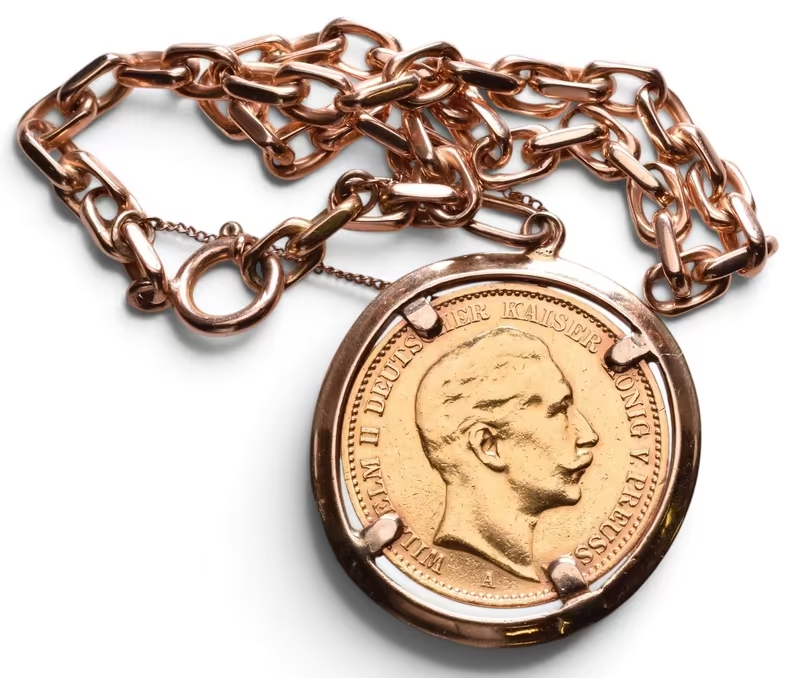
Prusko, 20 Marka 1913 A - přívěsek s řetízkem
Prusko, Wilhelm II. (1888 - 1918) 20 Marka 1894 A, J. 252, zasazena ve zlatém rámečku se závěsem a řetízkem Au 0,900, 22 mm (7,965 g), Au 0,585 (12,1 g), celková hmotnost 20,06 g (14,18 g ryzí zlato)
Skladem 1 ks - Code: ZN-PRUX1894.P
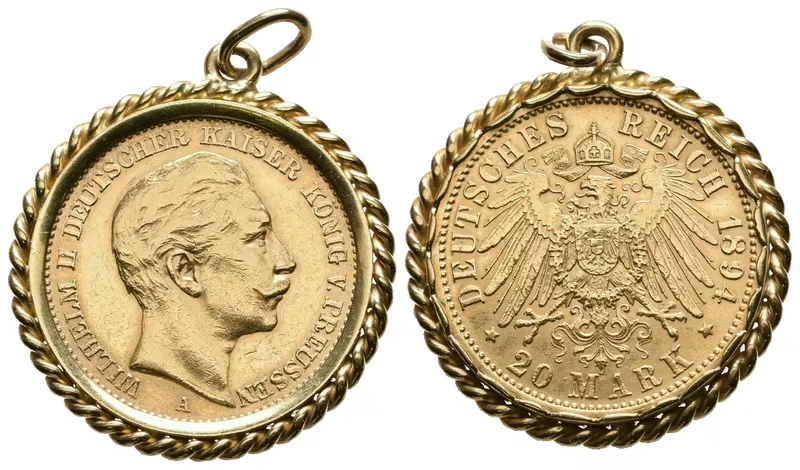
Prusko, 20 Marka 1894 A - přívěsek
Prusko, Wilhelm II. (1888 - 1918) 20 Marka 1894 A, J. 252, zasazena ve zlatém rámečku se závěsem Au 0,900, 22 mm (7,965 g), Au 0,585 (3,185 g), celková hmotnost 11,15 g (9,03 g ryzí zlato)
Skladem 1 ks - Code: FUSA-ZSW
USA, Stříbrný Odznak pro ponorkové důstojníky
United States of America / Spojené státy americké The Submarine Warfare Insignia (Odznak ponorkového loďstva pro důstojníky), značeno GEMS CO N.Y., STERLING a 1/20 Karat Gold Filling Stříbro 925/1000 a Zlato 417/1000 (13,35 g)
Skladem 1 ks - Code: Z98C-1914.1Back in stock
Dukát 1914
František Josef I. (1848 - 1916) Dukát 1914, Ves. 53, krásná zachovalost, ražební lesk v celé ploše, drobné rysky Au 0,986 (3,49g)
Skladem 1 ks