Silver
Silver is a white, lustrous precious metal with the chemical symbol Ag, which has for millennia been used for the minting of coins, the production of jewellery and as a store of value. Thanks to its good malleability and rarity, silver currency formed the backbone of many monetary systems from antiquity to the modern era.
Silver belongs among the most important metals in the history of money. In the early periods of trade, payment was often made in weighed metal, but it was precisely silver that proved itself to be an ideal material for standardised coins: it is rare enough to have significant value, yet at the same time more available than gold, and it therefore made it possible to create denominations suitable for everyday exchange. Its physical properties - especially good malleability and ductility - facilitated processing and repeated striking, so that silver coins quickly spread in the Mediterranean world and later also in central and northern Europe.
Among the oldest European silver coins are considered to be the strikes of the Greek world, for example the didrachms and staters of the island of Aegina in the 6th century BC. It is precisely on these that one can see how early the principle of the coin as a guaranteed piece of metal asserted itself. From antiquity onwards, silver became a material that connected economy, state and trust: the ruler or city guaranteed the weight and quality, and in return the market accepted the coin without constant weighing. Silver coins thus turned into an everyday instrument of trade and tax collection and at the same time into a bearer of symbolism - marks, titulature and propaganda.
In medieval Europe the significance of silver was even more pronounced. In many countries silver currency formed the basis of the monetary system, and the quality of silver strikes became an indicator of the stability of the state. In our territory, silver was projected into a whole series of key types: from the oldest Czech denarii through bracteates to groschen and thaler strikes. Especially with the large silver coins of the modern era, it is evident how silver responded to the needs of long-distance trade: larger denominations facilitated higher payments and became internationally comprehensible currency where small coins were not enough.
Pure silver, however, was rarely used for minting. From the Middle Ages onwards it was commonly alloyed in a prescribed ratio with copper to make the coins more resistant to wear and to better hold the shape of the relief. In more recent times, other metals such as nickel or zinc have sometimes been added to coinage silver, especially to increase mechanical resistance and chemical stability. In practice this means that a silver coin may have very different properties depending on its fineness and alloy: one will last a long time in circulation and preserve detail, another will wear down more quickly or change appearance.
History
In connection with coinage, it is also important how silver was valued and measured in various periods. Today, fineness is most often expressed as a fraction of one thousand (for example 999/1000), but historically the lot system was also used. Pure silver corresponded to 16 lots, with ten-lot silver having a fineness of 625/1000 and eight-lot silver 500/1000. These values are not just a tabular figure: when fineness drops below 500/1000, the metal loses its typical silvery colour, and at a fineness lower than 400/1000, copper colouring is already visually evident. Such thresholds had great significance in practice, because people judged coins not only by face value but also by appearance and experience of how they behaved in circulation.
Silver thus functioned in history as a metal of trust. When the state maintained a stable standard of weight and fineness, coins spread and trade prospered. When, by contrast, the standard fluctuated, the market responded by raising prices, sorting coins and sometimes even rejecting worse pieces. Today's collecting builds on this history: on a single silver coin one can often read not only the ruler's name and the mint but also the story of the contemporary economy, the technique of striking and how society perceived the value of money.
Silver has the chemical symbol Ag (argentum), a density of approximately 10.5 and a relatively low melting point of around 961°C, which contributed to its good workability. For coinage, however, what is mainly key is that pure silver is usually used only exceptionally: most historical and modern strikes are made of an alloy, most often with copper. The alloy increases resistance to wear and helps to maintain a sharp relief, which is essential for currency. In more recent times, other metals (for example nickel or zinc) may also be added to improve mechanical resistance and surface stability.
Today fineness is expressed in thousandths, but historically it was often expressed in lots (16 lots = pure silver). For collectors it is useful to know the rough conversion: 10 lots corresponds to 625/1000, 8 lots to 500/1000. Below 500/1000, the coin loses its typical silvery colour, and at a fineness lower than 400/1000, a coppery tone may show through, which is a good visual signal in a quick assessment of the material. With more valuable pieces, it is of course advisable also to work with weight, dimensions and expert identification, because appearance itself can be influenced by the surface.
Fineness, alloys and care of silver coins
Silver coins are over time covered with patinas and films that can be collectorly desirable. In a dry environment, a noble dark blue patina often forms, arising from the action of atmospheric influences. Silver at the same time reacts with sulphur compounds and may form layers with a wide range of shades from violet to dark grey. These manifestations are natural and with many coins increase aesthetic and collector value, provided that they are not disrupted by rough cleaning.
For long-term storage, it pays to protect silver against scratches and unsuitable chemicals. Suitable is storage in a breathable case (often paper) or on a soft surface, so as to minimise contact with hard surfaces and to allow air to reach both sides of the strike. Cleaning is always a sensitive topic: aggressive interventions can destroy the original surface and reduce the value of the coin even with an otherwise nice piece. With collector coins, therefore, it holds true that it is better to preserve the natural state than to chase a polish at the cost of losing authenticity.
Frequently asked questions
Questions from our knowledge base related to “Silver”. Full answers can be found in Frequently asked questions.
Jak určit hodnotu mince?
Hodnota mince se určuje podle několika faktorů. Mezi ně se řadí stáří mince, kov, ze kterého je vyražena a náklad (vzácnost). Množství typů a nominálů mincí je rozsáhlé a existují tak i tisíce let staré mince se zanedba…
Read full answerJak investovat do zlatých a stříbrných mincí?
Začněte cílem, rozpočtem a investičním horizontem. Běžné investiční mince, například Krugerrand, Wiener Philharmoniker nebo Maple Leaf, se obchodují hlavně podle obsahu kovu, ryzosti a aktuální ceny zlata či stříbra. Ry…
Read full answerJak investovat do stříbrných mincí?
Investování do stříbrných mincí je podobné jako u zlatých mincí. Stříbrné mince mohou být více atraktivní vzhledem k jejich nižší ceně. Také se razí mnohem více druhů a motivů. Je důležité také přihlédnout k nákladu. Ně…
Read full answerJak se pozná stříbrná mince?
Podobně jako u zlatých mincí, i stříbrné mince mohou být ověřeny několika způsoby: 1. Váha a rozměry: Stříbrné mince mají specifické váhy a rozměry, které by měly být konzistentní s oficiálními údaji. Ryzí stříbro má hu…
Read full answer
In our auction and shop
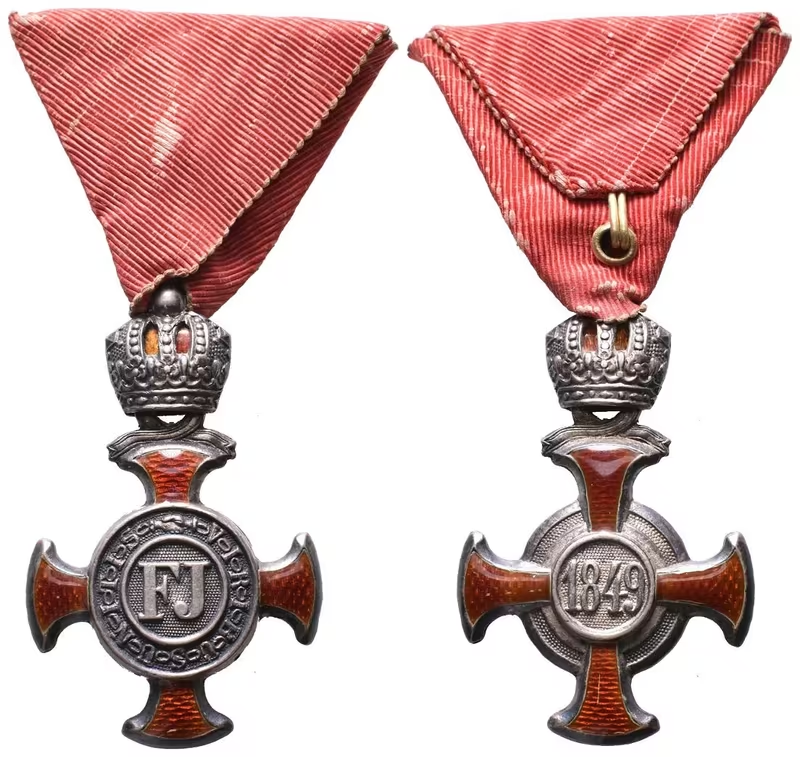
- Code: FA-140CVKE
Záslužný kříž, stříbrný s korunou na civilní stuze v etui
Rakousko - Uhersko / Rakouské císařství Záslužný kříž, stříbrný s korunou na civilní stuze, stříbro, smalty, smalt v koruně, značeno WILH. KUNZ WIEN X, puncováno, Marko.140c Kříž v krásné zachovalost, stuha opotřebovaná, etue lehce poškozená, značeno…
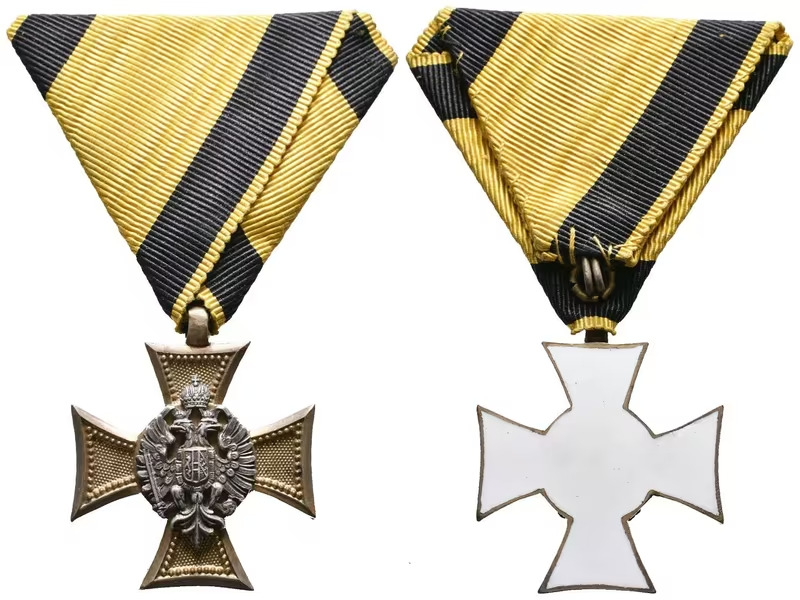
Skladem 1 ks - Code: FA-371D
Vojenský služební odznak pro poddůstojníky a mužstvo, kříž III. třídy
Rakousko - Uhersko / Rakouské císařství Vojenský služební odznak pro poddůstojníky a mužstvo, kříž III. třídy za 25 let služby, vydání 1890 - 1918, bronz zlacená, stříbro, neznačeno, na Rv. bílý smalt, Marko 371d Krásná zachovalost, patina
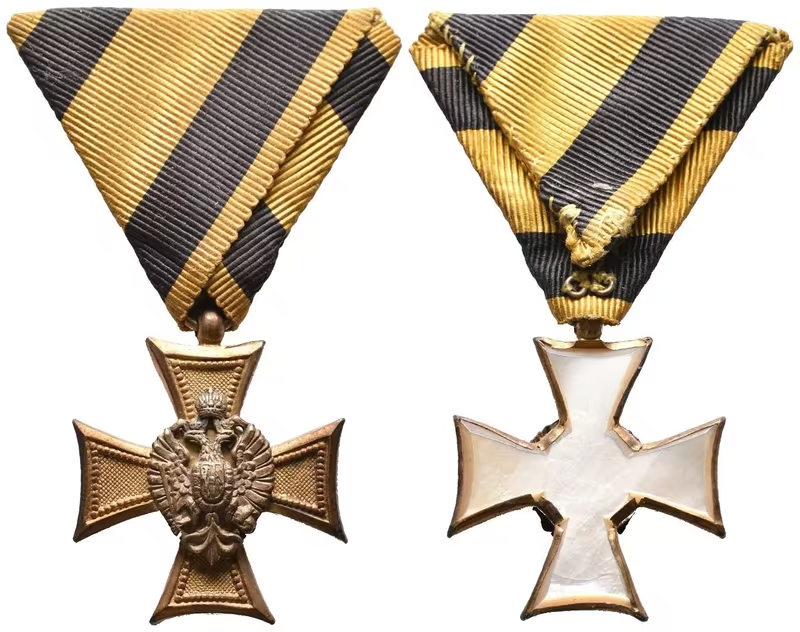
Skladem 1 ks - Code: FA-371B
Vojenský služební odznak pro poddůstojníky a mužstvo, kříž III. třídy
Rakousko - Uhersko / Rakouské císařství Vojenský služební odznak pro poddůstojníky a mužstvo, kříž III. třídy za 25 let služby, vydání 1890 - 1918, bronz zlacená, stříbro, neznačeno, na Rv. perleť, Marko 371a Velmi pěkná zachovalost, patina, drobná vada…
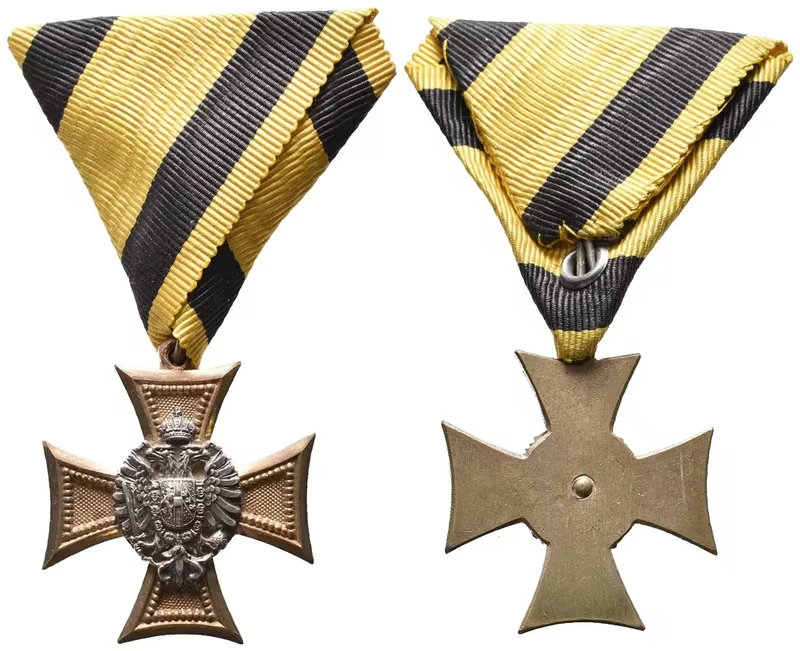
Skladem 1 ks - Code: FA-371A
Vojenský služební odznak pro poddůstojníky a mužstvo, kříž III. třídy
Rakousko - Uhersko / Rakouské císařství Vojenský služební odznak pro poddůstojníky a mužstvo, kříž III. třídy za 25 let služby, vydání 1890 - 1918, bronz zlacená, stříbro, neznačeno, větší orlice, Marko 371a Velmi pěkná zachovalost, patina, drobné rysky
Skladem 1 ks