Fineness
Fineness is the share (content) of precious metal in an alloy, that is, how much pure gold, silver, platinum or other precious metal is actually contained in a given item. It is most often expressed as a fraction in thousandths (e.g. 999/1000), indicating the ratio of pure metal to total weight.
Fineness became a key concept at the moment when precious metals began to be used systematically for coins, jewellery and later also for investment purposes. In coinage, fineness was of fundamental importance for trust in the currency: traders and inhabitants needed to know that a coin corresponded to the set standard and that its value was not merely "for show". Therefore, mints and sovereigns from the Middle Ages onwards determined what the fineness of the coin alloy should be, and at the same time introduced control procedures so that metal of unsuitable composition would not enter the strike.
Pure precious metal (theoretically 1000/1000) was historically used in practice only exceptionally, because entirely pure gold or silver is soft and poorly withstands wear. For this reason, admixtures (for example, copper) were added to alloys, which improved mechanical properties and extended the lifespan of coins in circulation. Fineness thus represents a long-term compromise between the "value of the metal" and the practical need that coins not break, deform or fail to withstand frequent handling.
History
In the modern period, with the development of more precise metallurgy and testing methods, fineness began to be stated and controlled more systematically. Various ways of recording fineness also arose - alongside thousandths, the carat system for gold took hold in jewellery, and in older sources you will encounter other units used regionally. In modern times, the concept of fineness has become a standard not only in coinage but also in investment metals and industrial applications of platinum or palladium, where the precise content of metal is essential for both price and technological properties.
Fineness is most often written as a fraction in thousandths. The value 999/1000 means that of 1000 mass parts of the alloy, 999 parts are pure precious metal and 1 part admixture. The number 500/1000, on the other hand, denotes an alloy that contains half precious metal and half admixtures. This way of expression is commonly used for gold, silver and platinum (and similarly for other precious metals).
How Fineness Is Expressed and What It Means in Practice
An older method that is still widespread for gold is expression in carats: 24 ct corresponds to a fineness of 999/1000 (in practice, 999.9/1000 is also used), 18 ct corresponds to 750/1000. With silver, in older terminology you may encounter a unit called the lot, which was used to express the proportion of silver in an alloy in some historical systems.
In numismatics, fineness is important for determining the actual content of precious metal, for comparing issues and for reading the monetary policy of a given era. A change of fineness in coins often signals a reform, a shortage of metal, or the state's effort to modify the parameters of circulating currency. With investment ingots and coins, on the other hand, fineness is one of the main data points, because it directly determines how much pure metal the buyer actually receives.
Frequently asked questions
Questions from our knowledge base related to “Fineness”. Full answers can be found in Frequently asked questions.
Jak určit hodnotu mince?
Hodnota mince se určuje podle několika faktorů. Mezi ně se řadí stáří mince, kov, ze kterého je vyražena a náklad (vzácnost). Množství typů a nominálů mincí je rozsáhlé a existují tak i tisíce let staré mince se zanedba…
Read full answerJak investovat do zlatých mincí?
U zlatých mincí sledujte hlavně ryzost, hmotnost, likviditu a prémii nad aktuální cenou zlata. Pro čistě investiční nákup dávají smysl známé a snadno obchodovatelné mince; u historických kusů se k ceně kovu přidává sběr…
Read full answerJak se hodnotí investiční mince?
Na základě několik faktorů. Prvním z nich je obsah drahého kovu a ryzost (v naprosté většině jsou mince ve váze tzv. trojské unce 31,1 gramu a ryzosti 999/1000). Existují také moderní investiční mince ražené v menším ná…
Read full answerJak se pozná zlato?
Existuje několik způsobů, jak poznat zlato: 1. Test kyselinou a spektrometrem: Často používaná metoda, kde se zlato testuje pomocí speciálních kyselin, které reagují pouze se zlatem dané ryzosti . Spektrometr zkoumá vzo…
Read full answerJak se pozná zlatá mince?
Pro určení pravosti a hodnoty zlaté mince je třeba zvážit několik aspektů: 1. Váha a rozměry: Každá zlatá mince má specifickou váhu a rozměry. Odchylky mohou naznačovat falzifikát. 2. Ryzost: Ryzost zlaté mince (obvykle…
Read full answer
In our auction and shop
- Code: SKAN90-N2014VB
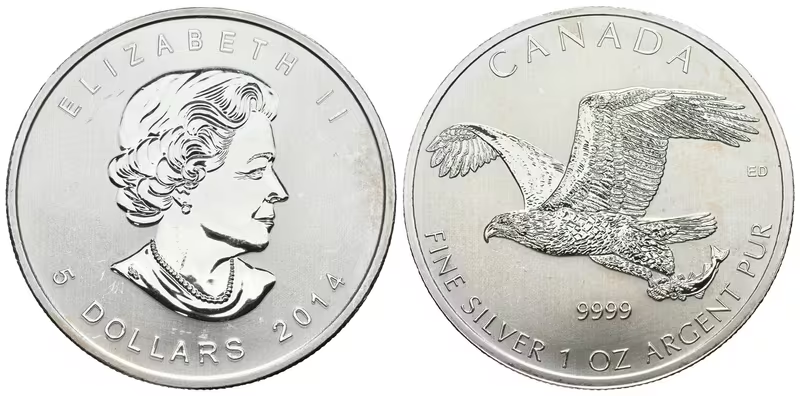
Kanada, 5 Dollars 2014 - Maple Leaf - Orel
Elizabeth II. (1952 - 2022) 5 Dollars 2014 - Maple Leaf - Bald Eagle. Ag 0,9999, 38 mm (31,1 g), 1 Oz, běžná kvalita Stříbrná mince Maple Leaf je od roku 1988 ražena v Královské kanadské mincovně (Royal canadian mint - RCM). Označení se vztahuje k…
Skladem 2 ks - Code: SKAN90-N2014VA
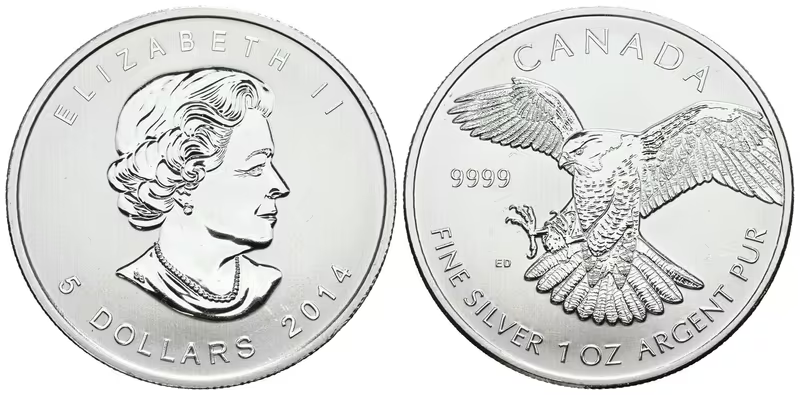
Kanada, 5 Dollars 2014 - Maple Leaf - Sokol
Elizabeth II. (1952 - 2022) 5 Dollars 2014 - Maple Leaf - Peregrine Falcon. Ag 0,9999, 38 mm (31,1 g), 1 Oz, běžná kvalita Stříbrná mince Maple Leaf je od roku 1988 ražena v Královské kanadské mincovně (Royal canadian mint - RCM). Označení se vztahuje k…
Skladem 2 ks - Code: SKAN90-N2017V
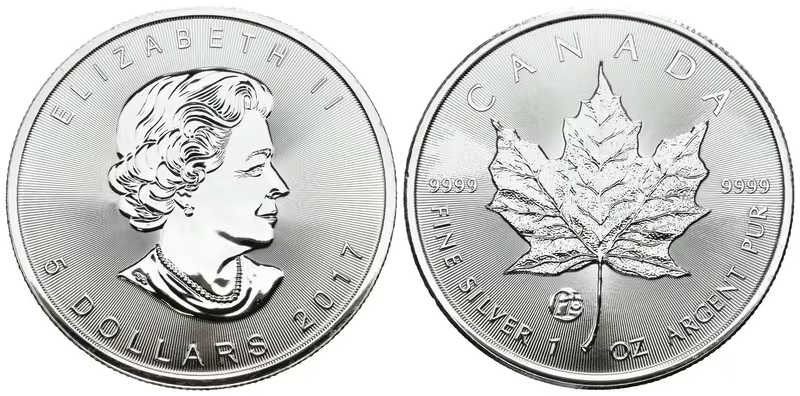
Kanada, 5 Dollars 2017 - Maple Leaf
Elizabeth II. (1952 - 2022) 5 Dollars 2017 - Maple Leaf, značka "F15" na Rv. Ag 0,9999, 38 mm (31,1 g), 1 Oz, běžná kvalita Stříbrná mince Maple Leaf je od roku 1988 ražena v Královské kanadské mincovně (Royal canadian mint - RCM). Označení se vztahuje k…
Skladem 2 ks - Code: SKAN90-N2016
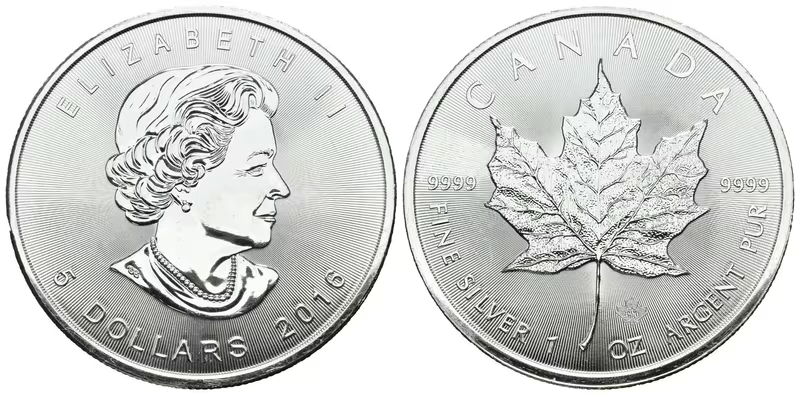
Kanada, 5 Dollars 2016 - Maple Leaf
Elizabeth II. (1952 - 2022) 5 Dollars 2016 - Maple Leaf Ag 0,9999, 38 mm (31,1 g), 1 Oz, běžná kvalita Stříbrná mince Maple Leaf je od roku 1988 ražena v Královské kanadské mincovně (Royal canadian mint - RCM). Označení se vztahuje k javorovému listu,…
Skladem 3 ks