Bullion bar
A bullion bar is a standardised cast of precious metal manufactured to a precisely set weight and purity for investment or industrial use. Most often it is a bar of gold, silver, platinum or palladium, stamped with the manufacturer's mark, data on weight and purity and a unique serial number.
Bullion bars belong among the oldest forms of storing value in human civilisation. The earliest documented use of gold and silver bars comes from ancient Mesopotamia, around 3000 BC. In ancient Egypt gold bars served mainly as means of payment in large trading transactions between rulers and temples. These early forms of bars had various shapes and were not yet standardised by a uniform weight.
A significant development in the manufacture of bars came in the period of ancient Greece and Rome, where the first attempts at their standardisation appeared. The Romans created a system of marking bars with stamps that guaranteed their origin and quality. After the fall of the Western Roman Empire the centre of trade in bars shifted to Byzantium and later to the Arab world, where the Baghdad Caliphate introduced strict standards for the manufacture of gold and silver bars.
In mediaeval Europe bars were an important means of international trade. Venetian and Genoese merchants used silver bars for trade with the Orient. In the period from the 13th to the 15th century the centre of bar production became the German mining regions, especially Saxony and the Harz. Here the first guild regulations governing the manufacture and marking of bars arose.
History
The Industrial Revolution brought fundamental changes in the manufacture of bars. In the 19th century international standardisation of weights and purities took place. The first specialised refineries arose, producing bars to precise standards. In 1919 the London Metal Exchange introduced a standard for trading gold bars, known as Good Delivery, which is still in force today.
The twentieth century brought further development of bar-making technologies. After the abandonment of the gold standard in the 1970s, bars became chiefly an investment instrument available to a wider public. Modern refineries today produce bars in a wide range of weights, from one gram up to standard exchange bars weighing 400 troy ounces of gold or 1,000 troy ounces of silver.
Modern bullion bars are made by two basic methods. Cast bars are formed by pouring molten metal into a mould, while minted bars are made by pressing from metal strips or plates. Every bar must bear obligatory marking: the manufacturer's name or logo, weight, purity of the metal and a unique serial number for identification.
Properties and manufacture of bars
The purity of bars is given in parts per thousand or in carats. Investment gold bars have a standard purity of 999.9 parts per thousand (24 carats), meaning a purity of 99.99 per cent. Silver bars achieve a minimum purity of 999 parts per thousand. Platinum and palladium bars are produced at a purity of 999.5 parts per thousand.
The weight of bars is given in grams, kilograms or troy ounces. The most common investment sizes are 1, 5, 10, 20, 50, 100, 250, 500 and 1,000 grams. For institutional investors, bars weighing 12.5 kilograms of gold or 30 kilograms of silver are produced.
Major world manufacturers of bars must meet strict international standards. Among the most respected are the Swiss refineries PAMP, Valcambi and Argor-Heraeus, the German Heraeus, the Australian Perth Mint or the Canadian Royal Canadian Mint. In the Czech Republic investment bars are produced by Česká mincovna.
In our auction and shop
- Code: Z2-0005
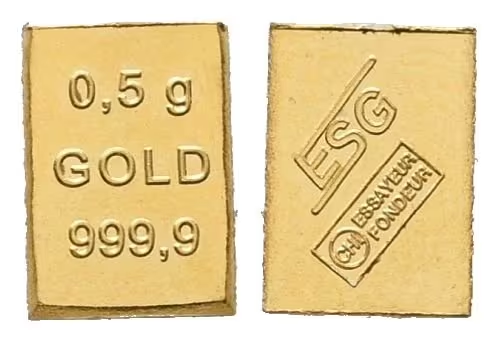
Investiční slitek, 999.9/1000 (0,5 g)
Investiční slitek, 999.9/1000, 8 mm x 5 mm (0,5 g), švýcarský výrobce ESSAYEUR FONDEUR
- Code: Z2-001
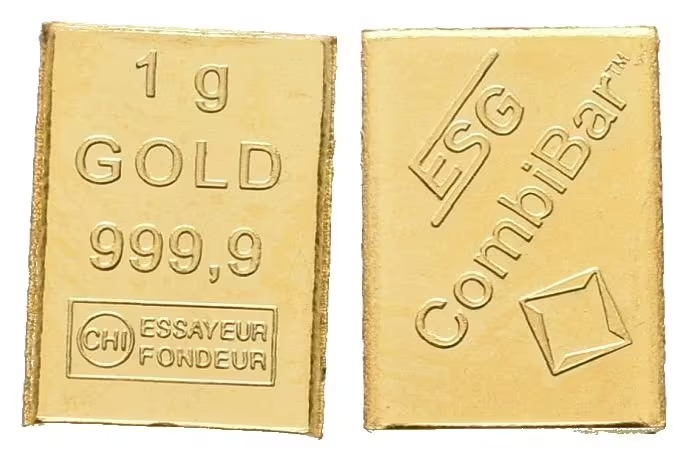
Investiční slitek, 999.9/1000 (1 g)
Investiční slitek, 999.9/1000, 11 mm x 8 mm (1 g), švýcarský výrobce ESSAYEUR FONDEUR