Antiquity
Antiquity is the longest period of human history, lasting from the rise of the first civilisations around 3500 BC to the fall of the Western Roman Empire in 476. This epoch witnessed the rise of writing, cities, states and coinage, which fundamentally changed economic relations.
Antiquity begins with the rise of the first urban civilisations in Mesopotamia, Egypt, the Indus Valley and China. The invention of writing made possible the recording of laws, commercial transactions and history. Before the invention of coins, various commodities served as means of payment — grain in Egypt, silver rings in Mesopotamia, cowries in China. Hammurabi's code from the 18th century BC already contained provisions on interest and debts. The development of long-distance trade required a standardised means of payment.
Classical antiquity begins in the 8th century BC with the rise of the Greek city-states. The invention of coins in Lydia around 650 BC revolutionised the economy. Athens, Corinth and Aegina struck silver coins which spread across the whole Mediterranean. Alexander the Great spread Hellenistic culture from Egypt to India. His tetradrachms became the first world currency. The Roman Republic and later the Empire created a unified economic space from Britain to Mesopotamia.
Characteristics of antiquity
Late antiquity from the 3rd century AD saw the crisis and transformation of the classical world. Economic decline, barbarian invasions and the spread of Christianity changed society. Diocletian and Constantine reformed the monetary system with the introduction of the solidus. The division of the Empire into Western and Eastern in 395 foreshadowed the end of antiquity. The fall of the Western Roman Empire in 476 traditionally brings antiquity to a close, although the Byzantine Empire continued for another thousand years.
The ancient civilisations created the foundations of the modern world. Roman law influences legal systems to this day. Greek philosophy and science laid the foundations of Western thought. Christianity, which arose in ancient Palestine, shaped European culture. Technologies such as concrete, aqueducts and roads made urbanisation possible. The ancient languages — Latin and Greek — remained the languages of learning into the modern period. Coinage invented in antiquity remained the basis of the money economy.
Ancient coinage
Coinage arose in Lydia under King Alyattes around 650 BC. The first coins, of electrum, a natural alloy of gold and silver, bore the impression of a lion's head. Croesus introduced a bimetallic system of gold and silver coins. Greek tetradrachms with the head of Athena and the owl became the most widespread coin of antiquity. Each polis struck its own types — the Pegasus in Corinth, the tortoise on Aegina, Arethusa in Syracuse. The artistic quality of Greek coins remains unsurpassed.
Roman coinage began with the bronze aes grave and the silver didrachms. The introduction of the denarius in 211 BC created a system that lasted 500 years. Augustus reformed the coinage with the introduction of the gold aureus. Imperial portraits on coins spread propaganda across the Empire. The antoninianus, solidus and follis document economic development. Ancient coins are primary historical sources providing information on rulers, events and the economy. The iconography of the coins influenced European coinage right up to modern times.
In our auction and shop
- Code: SKUB-O1997.1
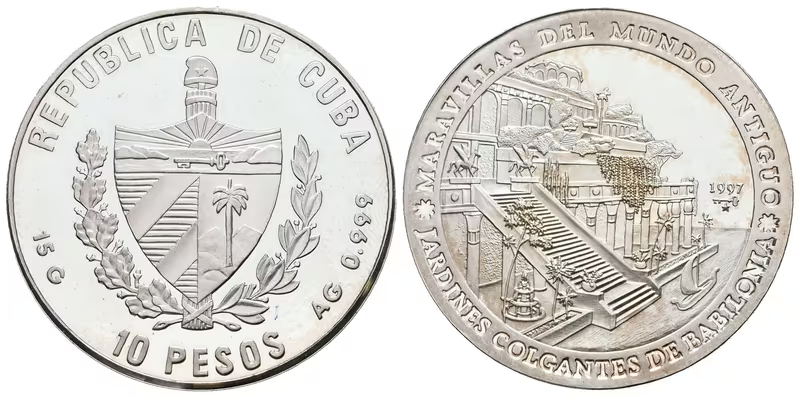
Kuba, 10 Pesos 1997 - Divy starověkého světa - Visuté zahrady babylonské
Kubánská republika 10 Pesos 1997 - Divy starověkého světa - Visuté zahrady babylonské, KM# 591 Ag (.999), 38 mm (20 g), BU, v kapsli. Stav mince odpovídá fotografii.
Skladem 1 ks - Code: XA-MOUS
Antické mince Balkánského poloostrova
Moushmov, H. M. Античните монети на Балканския полуостров и монетите на българските царе (Starověké mince na Balkánském poloostrově a mince bulharských carů) Sofie 1912 (reprint), 509 stran a 70 tabulek s vyobrazeními, vázané, pěkná zachovalost
Skladem 1 ks - Code: BC-SYLLOGE-10
SNG Czech Republic, Part 10 - Baktria and India
Sylloge Nummorum Graecorum Czech Republic, Volume I, Part 10 - Baktria and India (Early Baktria, Graeco-Baktrian and Indo-Greek Coins, Imitations, Indo-Scythians) The National Museum Prague Jiří Militký, Michal Mašek Hlavním cílem dlouholetého projektu…
Skladem 4 ks - Code: XB1920
Numismatika - peníze v českých zemích
Jiří Nolč Kniha obsahuje vyjímatelné kopie středověkých kovových mincí, papírových bankovek a státovek. Desítky dobových fotografií, obrazů a kreseb. Skvělé pro začínajícího numismatika. Krásná zachovalost, lehce použitá, lehce odřené rohy a ušpiněný obal
Skladem 1 ks