Portrait
A portrait is a depiction of a specific person capturing his or her characteristic features; in numismatics, primarily a profile or frontal depiction of a ruler on a coin or medal. Portrait strikes have become a basic element of coin iconography from antiquity to the present and represent a valuable historical source documenting the appearance of rulers a…
The history of the coin portrait begins in ancient Greece, where the first realistic depictions of living persons appeared on the coins of Persian satraps in Asia Minor around 400 BC. A breakthrough figure was Alexander the Great, whose idealised portrait, after his death in 323 BC, became the model for Hellenistic rulers. Alexander's successors, the Diadochi, struck coins bearing their portraits as legitimisation of power. Ptolemy I in Egypt was the first to introduce systematic portrait striking with his own likeness during his lifetime.
The Roman Republic long rejected the depiction of living persons on coins, which changed only in the period of the civil wars. Julius Caesar in 44 BC was the first living Roman to gain the right to strike coins with his portrait. After his death the portrait became a standard component of Roman coins. Emperor Augustus created an elaborate system of propaganda through coin portraits, which spread his idealised likeness throughout the empire. Roman coin portraits achieved exceptional realism, capturing individual features including wrinkles, baldness or a double chin, as the portraits of Emperors Vespasian or Nero attest.
In the Middle Ages portrait striking faded. Byzantine coins depicted stylised frontal portraits of emperors with haloes and Christian symbols. In Western Europe schematic depictions of rulers with crown and sceptre prevailed. Only under Charlemagne did attempts at a more realistic portrait with a laurel wreath after the ancient model appear on denarii. Czech denarii of the 10th to 13th centuries depicted stylised heads of rulers, often reduced to geometric shapes. The bracteates of the 13th century brought simple frontal portraits with a crown.
History
A genuine return of portrait art in coinage was brought by the Renaissance. Italian medallists such as Pisanello or Matteo de' Pasti created in the 15th century realistic portraits on medals inspired by ancient models. The first modern realistic portrait on a European coin was created by Louis XII of France in 1514 on a gold écu. In Bohemia portrait striking was introduced by Louis Jagiellon on Prague groschens around 1520. His successor Ferdinand I Habsburg established the portrait as standard on all denominations from the kreuzer to the ducat.
The peak of portrait art is represented by strikes of the 16th and 17th centuries. Masters such as Antonio Abondio, Jacopo da Trezzo or Alessandro Cesati created portraits of exceptional artistic quality. At the court of Rudolf II in Prague worked excellent medallists who captured the likeness of the emperor and leading personalities of the Rudolfine era. The Baroque period brought dramatic portraits with rich wigs and ornate garments. Leopold I, Charles VI and Maria Theresa were depicted in representative portraits emphasising the majesty of the Habsburg Monarchy.
The Classicism of the end of the 18th century brought a return to ancient simplicity. Joseph II struck coins with a simple profile without wigs and ornaments. The Napoleonic period meant the peak of the classicist portrait, Napoleon Bonaparte had himself depicted with a laurel wreath as a Roman imperator. In the 19th century the photographic faithfulness of the portrait prevailed. Franz Joseph I was depicted on coins in various phases of his life from a young emperor to an old man with side-whiskers. Modern coinage of the 20th and 21st centuries combines the realistic portrait with artistic stylisation. Czechoslovak and Czech coins depict portraits of Tomáš Garrigue Masaryk, Charles IV, St Agnes of Bohemia and other personalities in modern artistic interpretation.
Types and techniques of portrait striking
Numismatic portraits are classified by depiction into profile, three-quarter and frontal. The profile portrait, most common in antiquity and the modern period, depicts the head from the side. It may be oriented to the right or to the left, the orientation often having symbolic significance. The frontal portrait, typical of Byzantine and medieval coins, depicts the figure from the front. The three-quarter portrait, rare in numismatics, shows the head at a slight turn.
According to the extent of depiction we distinguish a portrait of the head, the bust or the full figure. The head includes only the face and hair; the bust adds the shoulders and part of the torso with garments; the full figure is typical of medieval enthronement scenes. Technically portraits were created by engraving the die in negative, from the 16th century by means of punches, and in modern times by computer modelling and laser engraving.
In our auction and shop
- Code: RX-Z-024New
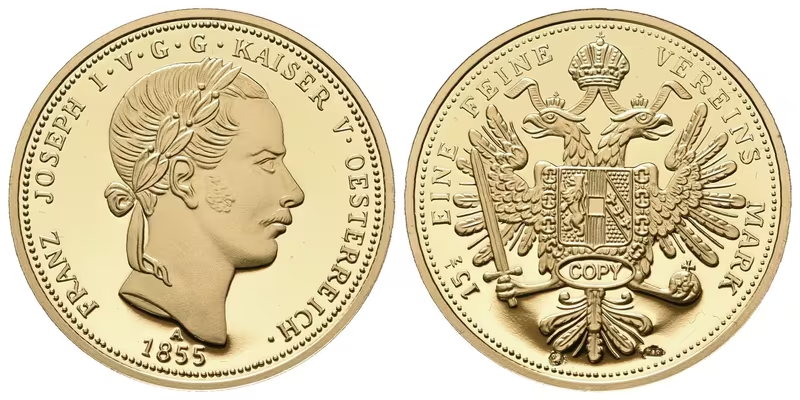
Rakousko, 1 Vereinsmark 1855 - Portrét Františka Josefa I., dvouhlavý orel s habsburským erbem, replika
Rakouské císařství (1804-1867) 1 Vereinsmark 1855 - Portrét Františka Josefa I., dvouhlavý orel s habsburským erbem Ag (.925), 25 mm (10 g), v kapsli. Stav mince odpovídá fotografii. Jedná se o druhotný prodej. (Možná oxidace, atd.. ! - VIZ FOTOGRAFIE !)
Skladem 1 ks - Code: RX-Z-007
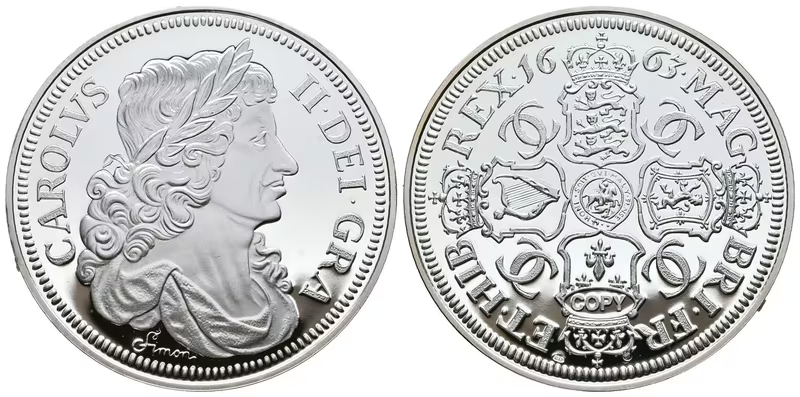
Velká Británie, Crown 1663 - Portrét Karla II., Petition Crown Thomase Simona, replika
Království Anglie - Karel II. (1660-1685) Crown 1663 - Portrét Karla II., Petition Crown Thomase Simona Ag (.925), 40 mm (20 g), v kapsli. Stav mince odpovídá fotografii.
Skladem 1 ks - Code: RX-Z-012
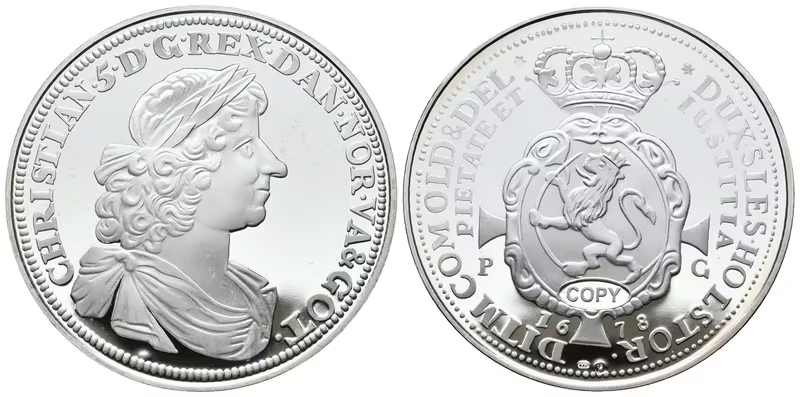
Dánsko, Speciedaler 1678 - Portrét panovníka / Korunovaný dánský lev, replika
Dánské království - Kristián V. (1670-1699) Speciedaler 1678 - Portrét panovníka / Korunovaný dánský lev Ag (.999), 40 mm (20 g), v kapsli. Stav mince odpovídá fotografii.
Skladem 1 ks - Code: RX-Z-013
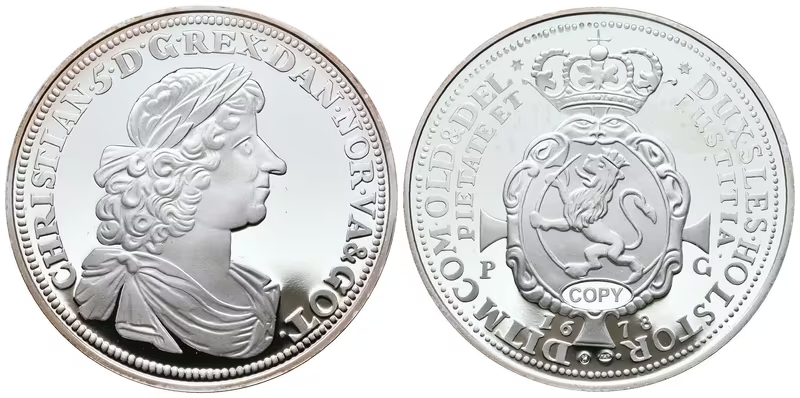
Dánsko, Speciedaler 1673 - Portrét Christiana V., dánský státní znak, replika
Dánské království - Kristián V. (1670-1699) Speciedaler 1673 - Portrét Christiana V., dánský státní znak Ag (.999), 40 mm (20 g), v kapsli. Stav mince odpovídá fotografii.
Skladem 1 ks