Middle Ages
The Middle Ages is a historical period of European history lasting approximately from the fall of the Western Roman Empire in 476 to the discovery of America in 1492, characterised by feudal organisation of society, the dominance of the Christian Church and the gradual formation of national states. Over a thousand years, this epoch created the foundations…
The early Middle Ages of the 5th-10th centuries, sometimes called the Dark Ages, began with the disintegration of Roman administration and the migration of peoples. Germanic tribes created new kingdoms on the ruins of the Western Roman Empire - the Franks in Gaul, the Visigoths in Spain, the Lombards in Italy. The economy reverted to barter, towns declined and literacy survived only in monasteries. Benedictine monasteries preserved ancient knowledge and spread Christianity. Charlemagne united Western Europe and restored the imperial title in 800; his Carolingian Renaissance brought a cultural revival.
The high Middle Ages of the 11th-13th centuries meant economic and cultural flourishing. The Crusades opened trade routes to the East, towns with craft production and markets arose. The Romanesque style created mighty cathedrals and castles; the Gothic aimed towards the heavens with its slender towers. The first universities arose in Bologna, Paris and Oxford as centres of scholastic learning. Charlemagne's coinage reform introduced the silver denarius as a universal means of payment; from the 13th century it was complemented by the Prague groschen and Italian gold coins.
In the Czech lands, the Middle Ages shaped national identity. Great Moravia of the 9th century accepted Christianity from Byzantium through Cyril and Methodius. The Přemyslid state gradually developed from a princedom to a kingdom; the Golden Bull of Sicily of 1212 confirmed the hereditary nature of the royal title. Under Přemysl Otakar II, Czech power reached from the Baltic to the Adriatic Sea. Charles IV made Prague the centre of the Holy Roman Empire, founded a university and launched the minting of Prague groschen as an international currency.
History
Society was organised according to the feudal system of three estates - the clergy prayed, the nobility fought, the subjects worked. Feudal relations created a hierarchy of vassal obligations from the king through the high nobility to the knights. Serfdom bound peasants to the land they cultivated for the feudal lords. Town privileges provided burghers with personal freedom and self-government. Guild organisations of craftsmen regulated production and trade.
The late Middle Ages of the 14th-15th centuries brought crises and transformations. The plague epidemic of 1348-1350 wiped out a third of the European population, causing economic decline and social unrest. The Hundred Years' War between England and France, the Papal Schism and the Hussite Wars shook the traditional order. At the same time, the Renaissance in Italy heralded a new epoch. The invention of printing democratised knowledge. Ottoman expansion and the fall of Constantinople in 1453 ended the Byzantine Empire. The discovery of America in 1492 symbolically closed the Middle Ages.
Christianity permeated all aspects of medieval life. The Church provided education, social care and spiritual consolation. Monasteries were centres of learning, economic innovation and artistic creation. Pilgrimages to the Holy Land, Rome or Santiago de Compostela connected Europe. Cathedral schools taught the seven liberal arts. Scholasticism synthesised Aristotelian philosophy with Christian theology, culminating in the work of Thomas Aquinas.
Medieval culture and economy
Medieval coinage underwent development from decline after antiquity to the creation of sophisticated monetary systems. The Carolingian reform established the pound system - one pound = 20 solidi = 240 denarii. From the 12th century, growing trade demanded coins of higher value - groschen (12 denarii) and gold coins. The Venetian ducat, the Florentine florin and the Hungarian ducat became international means of payment. The Czech Prague groschen of Wenceslas II dominated central Europe. Coin images depicted rulers, patron saints and heraldic symbols.
The economy was based on agriculture with the three-field system and feudal rent. From the 11th century, internal colonisation extended the cultivated land. Towns became centres of craft production organised in guilds. Long-distance trade was controlled by the Hanseatic League in the north and the Italian cities in the south. The fairs of Champagne connected trade routes. Banking was developed by Italian bankers; the Templars financed the Crusades. Technical innovations - the watermill, the heavy plough, the horse collar - increased productivity.
In our auction and shop
- Code: XB1325
Uherské středověké dukáty od r. 1325
Marek Budaj - Luboš Polanský, Uherské středověké dukáty. Ze sbírky národního muzea Zlaté ražby od Karla Roberta z Anjou po Jana I. Zápolského (1325 - 1540) Publikace představuje 446 uherských středověkých dukátů ze sbírky Národního muzea. Soubor je nejen…
Skladem 4 ks - Code: XD1325
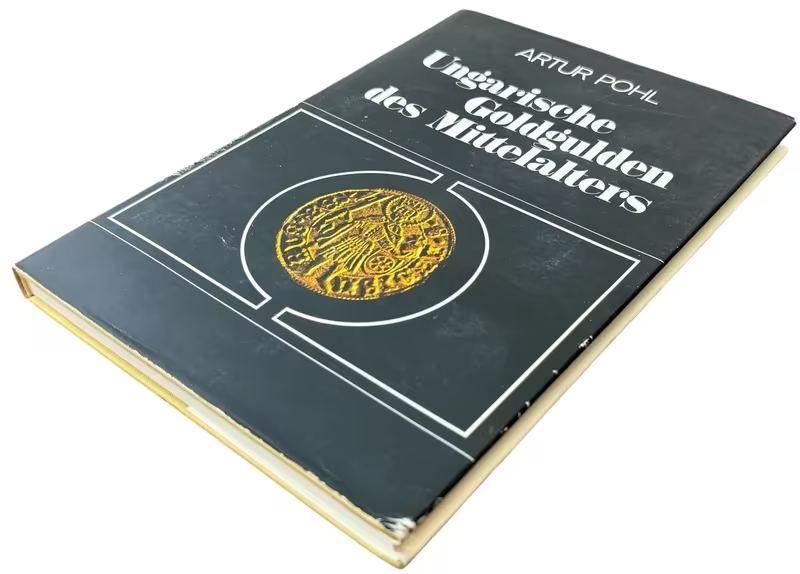
Uherské Zlaté mince středověku
Pohl, Artur Ungarische Goldgulden des Mittelalters (1325-1540) Graz 1974, 50 stran a 51 tabulek s vyobrazeními, vázané, papírový přebal, velmi pěkná zachovalost
Skladem 1 ks - Code: XB1290-LOTNew
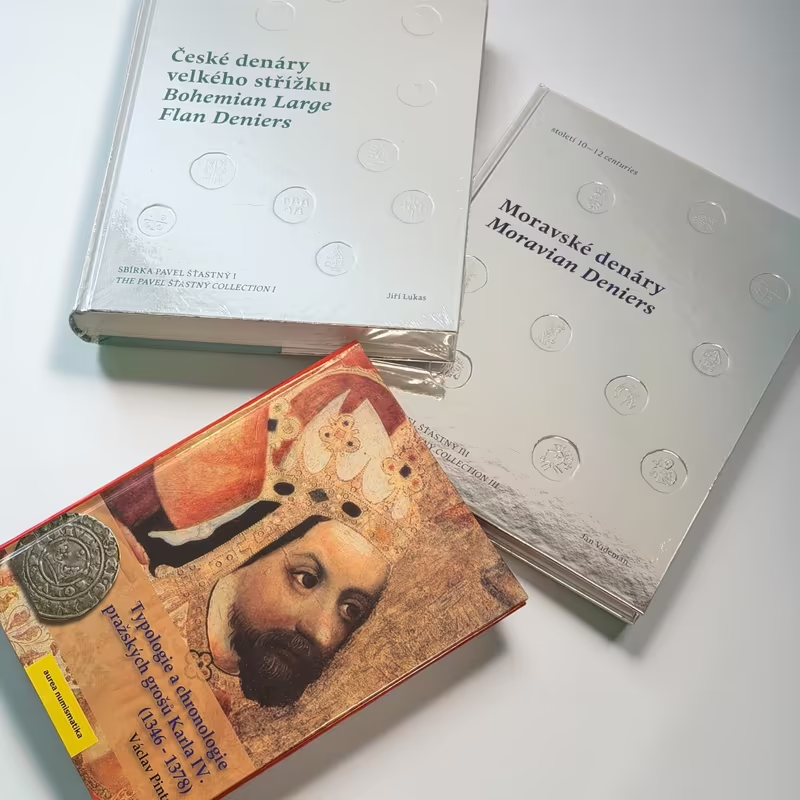
Sbírka denárů Pavla Šťastného, I. a III. díl + Pražské groše Karla IV. (dárek k nákupu)
Sbírka denárů Pavla Šťastného, I. a III. díl + Pražské groše Karla IV. (dárek k nákupu) Nabízíme vám dva zatím vydané díly čtyřsvazkové edice proslulé sbírky českých denárů a brakteátů Pavla Šťastného. Sbírka představuje nejúplnější komplet českých raně…
Skladem (>5 ks) - Code: XB1290-3
Moravské denáry - Pavel Šťastný, III. díl
Moravské denáry 10. - 12. století ze sbírky Pavla Šťastného - III. díl Nabízíme vám exkluzivně čtyřsvazkovou edici proslulé sbírky českých denárů a brakteátů Pavla Šťastného. Sbírka představuje nejúplnější komplet českých raně středověkých mincí 10. -…
Skladem (>5 ks)