Numismatics
Numismatics is a discipline that deals with the study of coins, medals and other means of payment from the point of view of history, production, circulation and symbolism. It helps in understanding the history of states and monarchs, the development of currency and trade relations, because coins often bear dating, signs of power and information about the…
Numismatics has its roots in collecting, which already developed in the Middle Ages, but more markedly in the Renaissance, when scholars and monarchs began to take a directed interest in ancient relics. Ancient coins were prized as tangible evidence of the classical world - they bore portraits of rulers, inscriptions and symbols of cities, which could be connected with literary sources. Gradually, from mere "collecting for beauty" study also developed: coins began to be classified, compared and used as historical evidence.
In the 17th and 18th centuries numismatics developed alongside the growth of museums, coin cabinets and systematic research. Collectors and scholars began to realise that coins are not only artistic objects but above all historical sources. They make it possible to date the reigns of monarchs, follow changes in titulature, examine propaganda and sometimes also clarify events that are not well described in written sources. At that time, too, the first catalogues and specialist works asserted themselves, attempting to create order in the enormous quantity of types and variants.
In the 19th century numismatics took on a more modern form. The development of archaeology and systematic finds brought an enormous quantity of material that needed specialist processing. Coin hoards and find assemblages were of great significance, because they show which coins actually circulated in a given place and time. Numismatics thus increasingly relied on context: it is not just a matter of an individual coin, but of where and with what it was found, what traces of circulation it bears, and how it fits into the broader development of currency.
History
In the 20th century the discipline became further professionalised. Specialised institutions, museum collections, academic departments and descriptive standards arose. Numismatics began to be more closely connected with economics, the history of administration and the technology of production. At the same time the "practical" side of collecting also developed: the coin market, auctions, preservation grade scales and the need to verify authenticity. Modern numismatics thus rests on two pillars: scientific research and collecting practice, which complement one another.
In the Czech environment, numismatics has a long tradition connected with museum collections and an interest in domestic coinage - from early medieval denarii through Prague groschen to early modern strikes of the Habsburg monarchy and modern coins. Catalogues and typological works also play an important role, enabling more accurate identification. In recent decades, moreover, the availability of information and photographs has expanded, which makes it easier for collectors to compare types, but at the same time increases the importance of critical assessment, because forgeries and problematic modifications also appear on the market.
Numismatics deals with a range of themes. It follows monetary systems and denominations, mint reforms, the technique of striking and the organisation of mints. It examines iconography - that is, the motifs on coins - and their meaning: portraits of monarchs, symbols of cities, religious symbols or propaganda slogans. Metrology is also important, that is the weight and dimensional parameters, and metallurgy, which is interested in the composition of the metal and fineness. Precisely these data help to distinguish types, reveal the debasement of currency and understand the economic pressures of the time.
What numismatics investigates and how it is used in practice
In practice, numismatics is based on comparison: coins are identified according to types, legends, mint marks and style. With older periods it is common for inscriptions to be partly illegible or garbled, and therefore the overall composition and artistic style also play a role. The find context is essential particularly for archaeological assemblages, because it makes it possible to date the circulation and to track trade contacts. With early modern and modern coins, on the other hand, the advantage is better documentation, so years, variants, mint marks and mintages are more often considered.
For collectors, numismatics is also a practical aid in avoiding errors. It helps to recognise what is common and what is rare, what an original surface looks like and what interventions may diminish a coin. In recent years the question of authenticity is also important: with more valuable pieces, weighing, measuring, the magnetic test, the sound test, and sometimes metal analysis are used. Reliable provenance and quality photographs are often as important for correct identification as the coin itself.
Numismatics is also attractive in that it connects "big history" with a small object. A single coin can reflect a change of monarch, a monetary reform, a wartime crisis and state propaganda. It is therefore suitable not only for collectors but also for anyone who wants to understand the past more concretely: a coin is a small but extraordinarily eloquent historical document.
Frequently asked questions
Questions from our knowledge base related to “Numismatics”. Full answers can be found in Frequently asked questions.
Jak začít sbírat mince?
Srdečně každému novému sběrateli doporučujeme studovat problematiku, než se pustí do samotného sbírání. Numismatika a notafilie je složitá a rozsáhlá disciplína a je proto nutné se nejprve seznámit se základy. Literatur…
Read full answerJaké knihy o numismatice doporučujete?
Pro sběratele mincí a zájemce o numismatiku je k dispozici mnoho kvalitních knih, které poskytují podrobné informace o historii, hodnocení a katalogizaci mincí. Některé z u nás dostupných a kvalitních publikací jsou: 1.…
Read full answer
In our auction and shop
- Code: XB1920
Numismatika - peníze v českých zemích
Jiří Nolč Kniha obsahuje vyjímatelné kopie středověkých kovových mincí, papírových bankovek a státovek. Desítky dobových fotografií, obrazů a kreseb. Skvělé pro začínajícího numismatika. Krásná zachovalost, lehce použitá, lehce odřené rohy a ušpiněný obal
Skladem 1 ks - Code: XH092
- Code: XH096
- Code: XH101
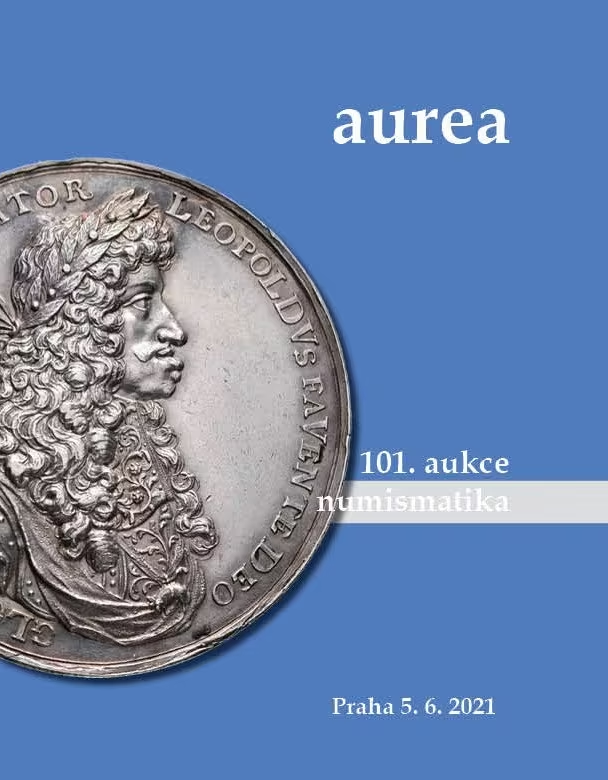
101. Aukce - numismatika
Aurea Numismatika 101. Aukce - numismatika Praha - 05.06.2021
Skladem (>5 ks)