Alloy
An alloy is a metallic material formed by combining two or more elements, at least one of which is a metal, and which behaves as a single whole after solidification. In coinage it allows adjustment of the hardness, durability and colour of coins and at the same time reduces costs while maintaining the required properties.
The alloy is among the most important technological inventions of metallurgy, because it makes it possible to "tune" the properties of metal by purposefully adding another element. Pure metals often have high chemical purity and a striking appearance, but in practical terms they can be too soft, too brittle, or conversely too expensive. Already the early cultures therefore discovered that by mixing metals one can obtain a material that casts better, machines better and tolerates everyday use more readily. The classic example is bronze, an alloy of copper with tin, which gave its name to an entire epoch — the Bronze Age. Compared with pure copper, bronze is harder and more durable while retaining good workability.
For the history of money, alloys have been essential from the very beginning of coinage. The earliest coins from the Asia Minor environment are usually associated with electrum, a natural or deliberately adjusted alloy of gold and silver. It was alloys that made it possible to produce coins on a large scale, give them a reasonable lifespan in circulation and at the same time grade their value. In antiquity, alongside the precious metals, copper-based alloys were also used — various kinds of bronze and brass — because copper alloys offered a suitable combination of hardness, colour and price. Roman and later European coinage then revealed another aspect of alloys: the ability to alter the proportion of precious metal and thereby manage the real value of a coin, whether for fiscal, military or crisis reasons.
In the Middle Ages and the early modern period, silver alloys with an admixture of copper came strongly to the fore. The addition of copper increased hardness and resistance to wear, which was key for circulation, but it also made it possible to "dilute" the precious metal. In periods of financial pressure, debased strikes of lower fineness appeared, sometimes designated as billon (an alloy with a trace to low silver content). Such interventions had significant economic consequences: they could provide short-term help in financing the state, but they also undermined confidence in the currency and led to the hoarding of higher-quality coins. It is precisely on coins that one can clearly see how the "technical" notion of an alloy intersects with politics, trade and the everyday experience of people.
History
With the Industrial Revolution and the development of chemistry and the physics of metals, the understanding of alloys became more precise. Phase diagrams, melting points, crystal structure and the way admixtures influence mechanical properties began to be systematically studied. In coinage this led to the introduction of modern, stable materials with predictable behaviour. A typical example is cupronickel, which came into use for circulating coinage thanks to its durability, stable appearance and relatively good workability. In the 20th and 21st centuries multilayered and bimetallic coins were added, in which alloys of differing composition are combined for security features, machine readability and longer service life. From a historical perspective, alloys thus form the "invisible skeleton" of coinage: they determine how coins are struck, how they age and what kind of confidence they inspire over the long term.
From the perspective of materials science, an alloy can be homogeneous at the macroscopic level, but its internal structure is usually more complex: it may be a solid solution, a mixture of phases or the formation of intermetallic compounds. The exact composition determines hardness, elasticity, brittleness, corrosion resistance and surface colour. In coinage, the composition is chosen so that the coin endures long use, accepts relief well during striking and is at the same time not too hard for the dies (a hard material accelerates their wear). Stability of appearance is also important: some alloys tarnish more quickly, others retain their lustre longer, and some can develop blotching or tonal changes depending on the environment.
With investment coins and bars, high fineness is often preferred because it is easily understood and commercially transparent. With circulation coins, by contrast, it is common to use alloys with a lower proportion of precious metal or none at all. The typical motive is economic optimisation: the price of the metal must correspond to the nominal value and at the same time the coin must be durable. That is why with modern circulation strikes we often encounter alloys of copper, nickel, zinc or aluminium, or surface-treated materials. The choice of alloy can also have a security dimension: magnetic properties and electrical conductivity help vending machines recognise a genuine coin, while multilayered constructions make counterfeiting harder.
Properties and practical use
The production technology is also of practical importance. The alloy is typically melted and cast into strips or ingots, which are rolled to the required thickness and from which planchets are then punched. Annealing and cleaning follow, so that the material does not crack during striking and the relief fills evenly. Even small deviations in composition can change behaviour during striking and the final appearance, which is why tolerances and repeatability are monitored for coin alloys. From the perspective of value and identification, the alloy is thus a key, though at first glance hidden, parameter — it determines how a coin will look today and even decades later.
In our auction and shop
- Code: RC-SLAT1914
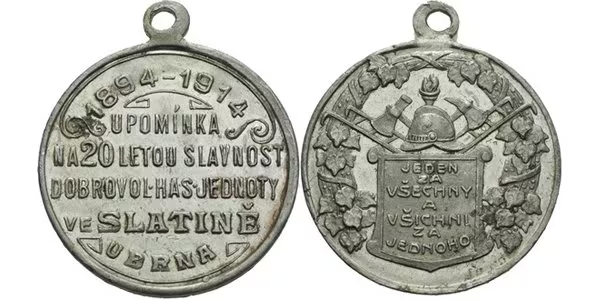
Slatina u Brna - Upomínka na 20-letou slavnost dobrovolného hasičského sboru
Hasičské dekorace AE Medaile 1914 - Upomínka na 20-letou slavnost dobrovolného hasičského sboru. 5-řádkový nápis, letopočty, okolo ozdoby / Štít s nápisem a hasičské nářadí ve věnci. Al 30 mm, pův. ouško, Šil.371
Skladem 1 ks - Code: XD2011
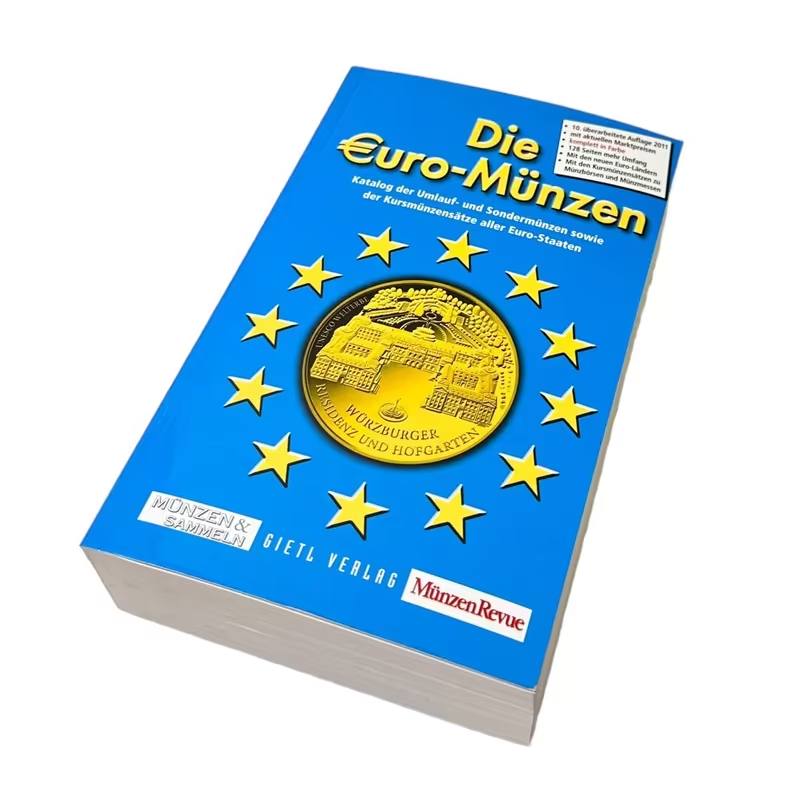
Die Euro - Münzen 2011
Die Euro Münzen, vydání 2011, 1328 stran, brožované Tento katalog je považován za standardní práci na téma euro. Obsahuje všechny oběžné a speciální mince i sady oběžných mincí ze všech zemí eurozóny. Uživatel katalogu nalezne informace o kovových…
- Code: XD2012
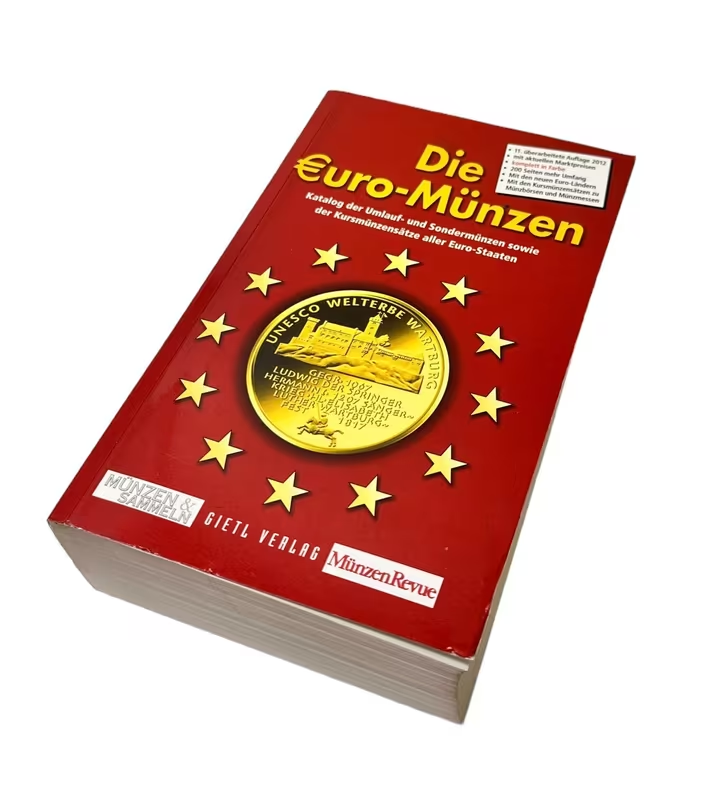
Die Euro - Münzen 2012
Die Euro Münzen, vydání 2012, 1536 stran, brožované Tento katalog je považován za standardní práci na téma euro. Obsahuje všechny oběžné a speciální mince i sady oběžných mincí ze všech zemí eurozóny. Uživatel katalogu nalezne informace o kovových…