Money
Money is a universal means of payment serving as a measure of value, a means of exchange and a store of wealth. From the first forms of barter exchange through metal coins and paper banknotes to today's digital currencies, money has undergone a long development reflecting the economic and technological progress of human civilisation.
Before the emergence of money, human society functioned on the principle of barter - direct exchange of goods for goods. This system was inefficient because of the need for a double coincidence of wants. Commodity money gradually developed - objects generally accepted as a means of payment. In various cultures these were cowrie shells, salt, cattle, grain or pieces of cloth.
The first true money in the form of standardised metal objects emerged in China around 1000 BC in the form of miniature bronze knives and spades. In parallel, in Lydia (present-day Turkey) around 650 BC the first coins emerged made from electrum - a natural alloy of gold and silver. These strikes with a stamped image of a lion represented a guaranteed weight and purity of metal.
The Greek city-states perfected the concept of coins by introducing two-sided striking with civic symbols. Athenian silver tetradrachms with the owl became the first international currency of antiquity. The Romans created a complex monetary system with the aureus (in gold), the denarius (in silver) and the as (in bronze), which influenced European coinage for millennia.
In medieval Europe, after the collapse of the Roman Empire, regional monetary systems emerged. Charlemagne introduced around 790 the pound system - from one pound of silver, 240 denarii were struck. In the Czech lands the first denarii appeared under Boleslav I around 965. These small silver coins were called peníze in Czech, which gave the name to all means of payment.
An important turning point is the emergence of paper money in China under the Song dynasty in the 11th century. In Europe the first banknotes appeared in Stockholm in 1661. Paper money originally represented a receipt for stored gold or silver, but gradually became independent as a fiduciary currency based on trust.
History
In the Czech lands the turning point was the year 1300, when Wenceslas II introduced the Prague groschen. This high-quality silver coin replaced the debased denarii and became an internationally recognised means of payment. The name groschen (from Latin grossus - large) designated a larger silver coin compared with the small peníze.
The early modern period brought the thaler era and the development of banking. The Jáchymov thalers struck from 1520 gave the name to the dollar. A system gradually evolved in which large-scale trade took place by means of bills of exchange, and only retail required physical money. Amsterdam, London and later New York became centres of international financial transactions.
The Industrial Revolution of the 19th century led to the introduction of the gold standard. The British pound backed by gold became the world's reserve currency. Most states including Austria-Hungary adopted a system in which banknotes were convertible into a precisely defined amount of gold. This system ensured currency stability and facilitated international trade.
The First World War ended the era of the gold standard. States printed unbacked money to finance the war, which led to hyperinflation. In Germany in 1923 a loaf of bread cost trillions of marks. Czechoslovakia introduced its own koruna in 1919, which underwent several monetary reforms reflecting political change.
The Bretton Woods system (1944-1971) established the US dollar backed by gold as the world's reserve currency. After its collapse money entered the era of fiat currencies - money unbacked by gold, whose value rests solely on trust in the issuing state. Central banks gained a monopoly on the issue of money and control of monetary policy.
Functions and forms of money
The digital revolution brought electronic money. The majority of transactions today take place cashlessly via payment cards and bank transfers. Since 2009 cryptocurrencies such as Bitcoin have existed - decentralised digital money independent of central authorities. Some central banks are experimenting with digital versions of national currencies.
Money fulfils four basic functions. As a means of exchange it enables the indirect exchange of goods and services. As a unit of account it provides a universal measure of value. As a store of value it allows the separation of the moment of sale and purchase. As a means of deferred payments it enables credit relationships.
We distinguish various forms of money. Commodity money has intrinsic value (gold coins). Fiduciary money is backed by trust (banknotes). Bank money exists as entries in accounts. Electronic money is held on electronic carriers. Cryptocurrencies make use of blockchain technology.
In the Czech language the word peníze has a specific etymology. It comes from Old Slavic pěnędzь, which was a corruption of the Latin denarius via the Germanic pending/pfennig. Historically it referred to small coins, gradually becoming generalised to all legal tender. The plural peníze is irregular - correctly peněz, not penězů.
In our auction and shop
- Code: XB-CRIB
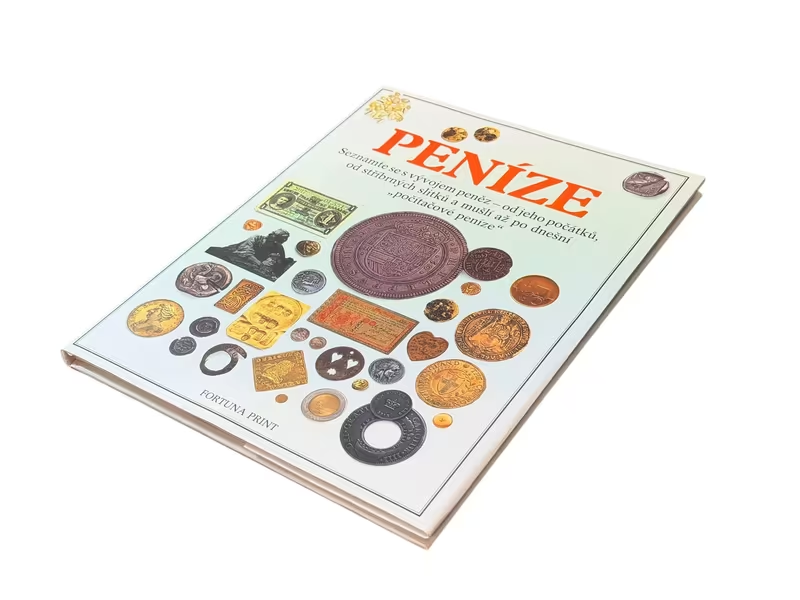
Peníze
Cribb, Joe Peníze - vývoj peněz od jeho počátků Fortuna Print 1990, 64 stran a vyobrazení, vázané, papírový přebal, jako nové
Skladem 2 ks - Code: XB-HLIRA
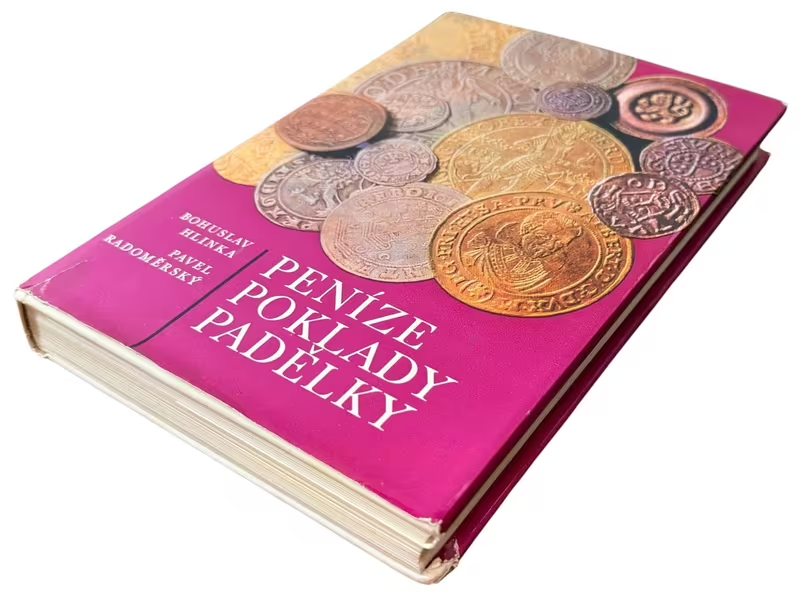
Peníze, poklady, padělky
Hlinka, Bohuslav a Radoměřský Pavel Peníze, poklady, padělky - mince a jejich nálezy na Československém území Praha 1975, 324 stran a vyobrazení, vázané, papírový přebal poškozený jinak pěkná zachovalost Ilustrační fotografie!
Skladem 3 ks - Code: XB1920-2
Peníze celého světa
Bohuslav Hlinka, Pavel Radoměřský Peníze celého světa Praha 1981, 247 stran, vázané, papírový přebal lehce poškozený Sborník měnových jednotek a platidel všech zemí světa od nejstarších dob po dnešek. Jeden z nejúspěšnějších titulů v edici Malé…
Skladem 1 ks - Code: XB1920
Numismatika - peníze v českých zemích
Jiří Nolč Kniha obsahuje vyjímatelné kopie středověkých kovových mincí, papírových bankovek a státovek. Desítky dobových fotografií, obrazů a kreseb. Skvělé pro začínajícího numismatika. Krásná zachovalost, lehce použitá, lehce odřené rohy a ušpiněný obal
Skladem 1 ks