Relief
Relief is the three-dimensionally raised design on a coin or medal, which rises above the level of the field and creates the impression of a third dimension. In coinage the relief may be low (typical for most mediaeval and modern coins) or high, which is more striking, but more demanding to produce and less resistant in circulation.
In coinage, relief has been a fundamental artistic and technical element since antiquity. A coin was never just a "flat disc" with information, but also a small artistic object intended to be recognisable at first glance. Three-dimensional modelling makes it possible to emphasise a portrait, an emblem, the figure of a deity or a symbol so as to be legible even in ordinary handling. Ancient coins are often valued precisely for the lively, plastic impression that can, even in a small format, create an expressive face and clear volumes.
During the Middle Ages and the early modern period, the form of relief changed according to technology and purpose. For coins intended for intensive circulation, a lower relief was more advantageous: the coin was easier to strike, the dies endured more blows, and the design did not so quickly wear away in use. Smaller denominations also tend to have a simpler and flatter execution, because there is little space on a small flan and too high a relief would impair the legibility of the legend and the overall stability of the strike. In modern times, moreover, demands on machine production and mass output have increased, which naturally favoured a low and standardised relief.
Alongside ordinary circulation coins, however, there also existed an area where relief could become a more pronounced means of representation. With certain ancient strikes and especially with cast or representative medals, one encounters high relief, which has a "sculptural" effect and allows for richer modelling. Such execution, however, is more demanding: it requires a high-quality die, precisely prepared material, and often repeated blows or a special technology so that the metal is pressed into the depths. For this reason, high relief was more often applied to objects not intended for long-term circulation, but rather for commemorative and presentational purposes.
History
The development of relief is thus a compromise between aesthetics and practicality. The higher the relief, the more impressive the plastic modelling, but at the same time the higher the risk of rapid wear and the greater the demands on production. For circulating coins, a lower relief therefore generally prevails, while for medals, commemorative strikes and certain "exhibition" issues the relief may be markedly richer. It is often by the relief that one can recognise whether an object was intended for everyday payment or rather for display and collector preservation.
In practice relief is described chiefly by the height and sharpness of the modelling. Low relief is flatter, easier to strike and tends to be more resistant in circulation; detail is legible rather through drawing and lines than through deep plastic volume. High relief creates a stronger plastic effect, but can be more sensitive to wear and requires more careful striking. With high relief, problems with underfilled areas also arise more often, because the metal may not fill the deepest parts of the die if the pressure or the preparation of the flan is not ideal.
When assessing coins, relief is also important for the evaluation of the state of preservation. Raised areas wear first, so the condition of a portrait, the tips of emblems or the raised parts of a figure often shows how long a coin has been in circulation. At the same time it is necessary to distinguish wear from a defect of striking: some coins may have "flat" details already from production, particularly if the striking was weaker or the dies worn. Relief is therefore always assessed together with the quality of striking, the condition of the surface and the legibility of the legend.
Height of the relief and its consequences
In numismatics, relief is therefore not only an aesthetic element but also a technical indicator. It tells us about the technology and purpose of the strike, about the demands of the mint and about how the coin behaved in circulation. For this very reason, in descriptions of coins it is often mentioned whether the relief is low or high and how well preserved it is – it is one of the properties that significantly influences the overall impression and value of the piece.
In our auction and shop
- Code: SMON-G2021
Mongolsko, 500 Tugrik 2021 - Mystic Wolf
500 Tugrik (Togrog) 2021 - Mystický vlk Ag 0,999, 38,61 mm (31,1 g), 1 Oz, Vysoký reliéf (Ulta High Relief), raženo pouze 2500 ks , etue, certifikát Jednouncová ryzí (99,9 %) stříbrná mince ve špičkové (proof) kvalitě s motivem mystického vlka ze série…
Skladem 1 ks - Code: SSAM-E2021ERecommended
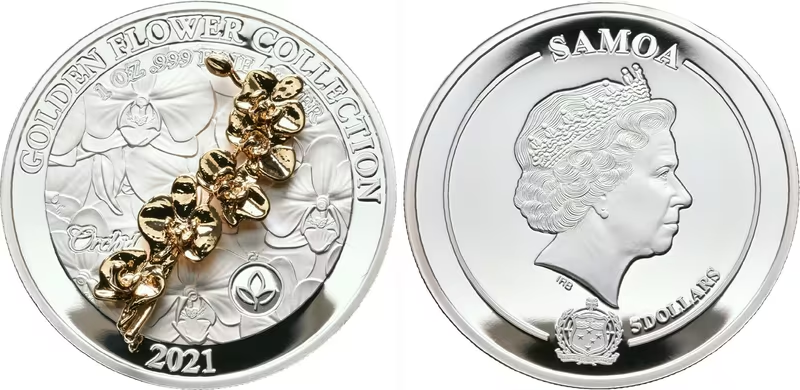
Samoa, 5 Dollars 2021 - Orchidej
Samoa, Elizabeth II. (1952 - 2022) 5 Dollars 2021 - Orchidej - ze série "Golden Flower Collection" Ag 0,999, 40 mm (31,1 g), pozlacená reliéfní orchidej, etue, certifikát, vyraženo 1500 ks
Skladem 1 ks - Code: RX-VEL2015
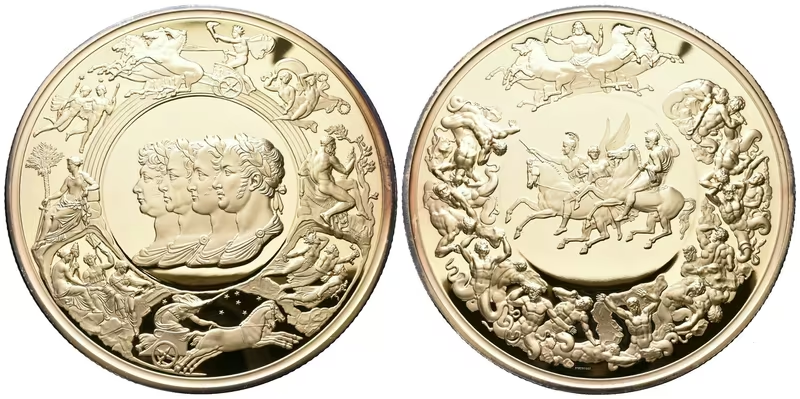
Velká británie - Bitva u Waterloo
Velká Británie AE Medaile 1815 - 2015 (B. Pistrucci) - Medaile na památku bitvy u Waterloo Bronz zlacený ryzím zlatem 88,9 mm (cca 400 g), číslováno na hraně, brožura s certifikátem a popisem bitvy, vojevůdci, historie vzniku medaile, etue, papírový…
Skladem 1 ks - Code: MCZ099-X
Pocta Jiřímu Harcubovi
Česká republika (1993 - ) Pocta České národní banky Jiřímu Harcubovi 100 Kč 2014 - 25. výročí 17. listopadu 1989, Ag 0,925, 31 mm (13 g), autor Jiří Hanuš Medaile s motivem 17. listopadu a Václava Havla, Ag 0,999, 34 mm (16 g), vydáno 4000 ks ve společné…
Skladem 2 ks