Legend (coin inscription)
A coin legend is the text on a coin or medal, usually placed in a circle along the rim, which serves to identify the issuer, title, place of striking or denomination. On older strikes it is generally in Latin, often in abbreviations and separated by small marks.
The legend (also called the inscription) belongs to the most important elements of a coin from the very beginnings of coinage. While the image on a coin can convey a symbol or a portrait, the legend bears "legible" information: the name and title of the monarch, the designation of the country or town, sometimes also the value or religious formulae. In the early and high Middle Ages the legend was at the same time a legal communication - confirmation that the coin issued from a recognised authority and was to be accepted in circulation. The text was therefore placed visibly in a ring around the motif, where it was protected by the edge of the planchet and at the same time could be easily "read around" the circumference.
The legend can be executed in one or, less often, in several concentric rings. If there are more than one, one speaks of an outer and inner legend. With small early medieval coins, however, the space is limited, and therefore the text is short, often simplified or shortened. Precisely with the oldest strikes, moreover, we encounter the fact that the legend can be poorly legible: dies were hand-engraved, the letters were not always uniform, and repeated striking led to wear. With some Bohemian denarii of the 10th-11th centuries the legends are even partially "corrupted" or garbled, which can be the consequence of errors by the engraver, imperfect striking and a gradual loss of orientation in the original form of the text.
In Czech coinage, with denarius strikes, the way in which the legend runs around the coin is also distinguished. According to the direction of the run and the orientation of the letters, the specialist typology lists four basic kinds: a normal legend (the text runs clockwise and the "feet" of the letters point to the centre), eccentric (also clockwise, but the feet of the letters point to the rim), mirrored (letters have feet to the centre, but the direction of the legend is counterclockwise) and mirrored-eccentric (feet of the letters to the rim and direction counterclockwise). On strikes of the 10th and 11th centuries all four kinds can be encountered, while in the 12th century the normal legend already as a rule prevails. From the groschen period in practice we encounter almost exclusively the normal legend, because the conventions of reading and of die production became established.
History
With coins bearing the portrait of the monarch, it is often stated in the Czech tradition that the legend on the obverse usually begins at the upper right by the head and continues around the circumference; on the reverse it then follows on from an analogous place. If there is no portrait on the coin (often with smaller denominations), the beginning of the legend may relate to the territorial arms (for example a lion) or to the crown, particularly with strikes of the Estates type. If a date is on the coin, it tends to be placed at the end of the legend, or divided into its conclusion so as to balance the rest of the text and motif compositionally.
The content of the legend changed over time according to what needed to be conveyed on the coin. With denarii the name of the prince often appears and sometimes also the name of the mint or the name of the mint official (monetarius). In the groschen and thaler period the texts expand to include longer titles and formulae, which led to the frequent use of abbreviations. So that the text could be read and would not get lost in a continuous row of letters, it was separated by punctuation marks - most often rings, a pair or a triple of rings one above another, various types of crosses (including the diagonal "St Andrew's"), as well as quatrefoils, rosettes and other marks. The choice of these marks can in some cases have a chronological significance, particularly with undated strikes.
From the linguistic point of view, Latin asserted itself for a long time in our lands: from the beginnings of coinage to the end of Habsburg rule it is typical on coins, with Hungarian also appearing after 1868 in the Austro-Hungarian framework. Czech text on older coins appeared rather exceptionally (and often only in the form of inscriptions), while on Czechoslovak coins Czech is already the standard. A special chapter is formed by the period of the Protectorate of Bohemia and Moravia, when the circulation strikes of 1940-1944 bore both Czech and German legends. All this shows that the legend is not just "text", but a sensitive source for political power, linguistic conditions and the coinage practice of a particular time.
The form of the legend and how it is read
The legend is usually read in the direction of its running around the rim of the coin. With most early modern and modern strikes the text is "normal", so that letters stand with feet to the centre and the legend runs clockwise. With early medieval coins, however, it is good to perceive two things: the direction (clockwise or counterclockwise) and the orientation of the letters (to the centre or to the rim). It is precisely the combination of these features that can help in identifying the type of denarius, and sometimes also in distinguishing dies within one issue.
In practice, legends often consist of abbreviations, particularly when there is a long titulature on the coin. Typical are abbreviated forms of names and titles, some of which may be separated by marks. Punctuation marks are not mere decoration: they help to structure the text, increase legibility and with some issues can be a guide for dating or for distinguishing variants. With undated coins, therefore, not only the content itself of the legend is followed, but also the form of the letters, the order of abbreviations, and precisely the type of separators (rings, crosses, rosettes and the like).
The legend can also be "more problematic" where the coin is small or where the die wore out quickly. With the oldest denarii one therefore encounters corrupted or garbled legends, and with bracteates the occurrence of continuous legends is rather exceptional. Even so, it is precisely the legend that often decides whether we are able reliably to assign a coin to a monarch, mint or period. In numismatics a simple rule thus applies: the image suggests, but the legend usually "confirms".
In our auction and shop
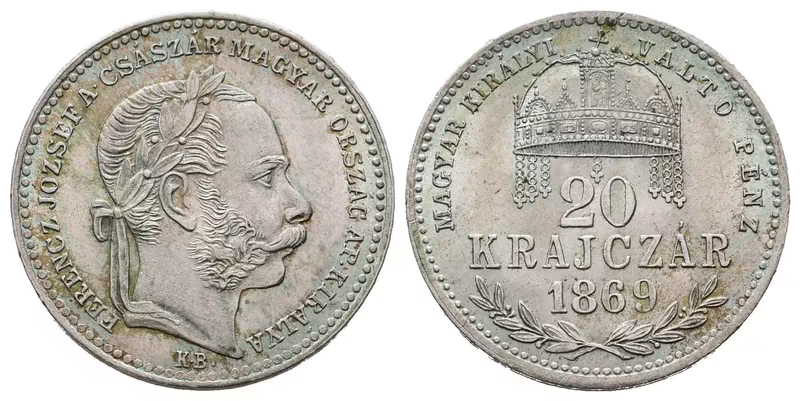
- Code: MA102-1869 KB
20 Krejcar 1869 KB - dlouhý opis
František Josef I. (1848 - 1916) 20 Krejcar 1869 KB, dlouhý opis MAGYAR KYRÁLYI - VÁLTO PÉNZ, Ves. 102, luxusní zachovalost
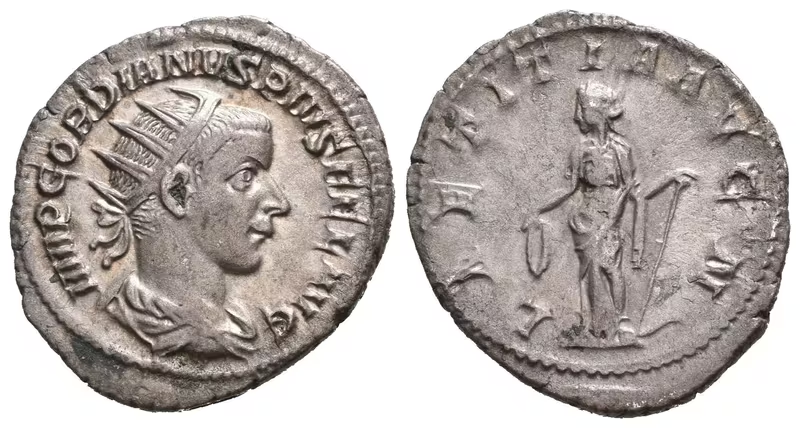
Skladem 1 ks - Code: BE072-0086.2
Gordianus III., antoninian, RIC 86
Gordianus III. (238 - 244) Antoninian, mincovna Řím, ražen 241-243 n.l., Rv. stojící Laetitia držící věnec a žezlo, opis LAETITIA AVG N, RIC 86
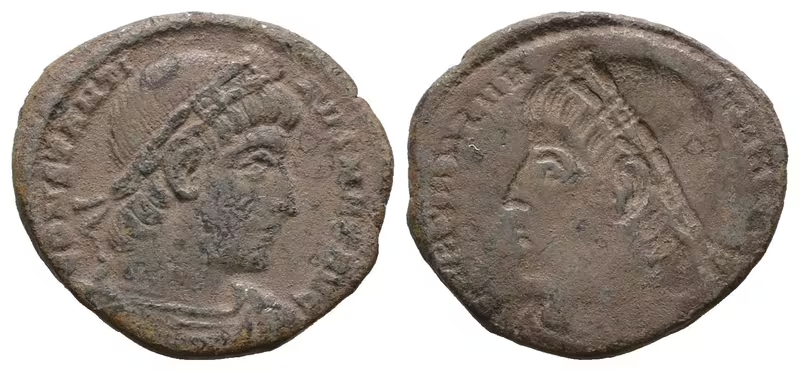
Skladem 1 ks - Code: BE136-040327
Constantinus I., follis (chyboražba)
Constantine I. (306 - 337) Follis, Hlava Constantina doprava , CONSTAVTINUS MAX AVG / hlava Constantina doleva, stejný opis zrcadlově, RIC.?, zajímavá inkusní chyboražba způsobená zaseknutým střížkem v razidle a srážkou s dalším podaným střížkem.
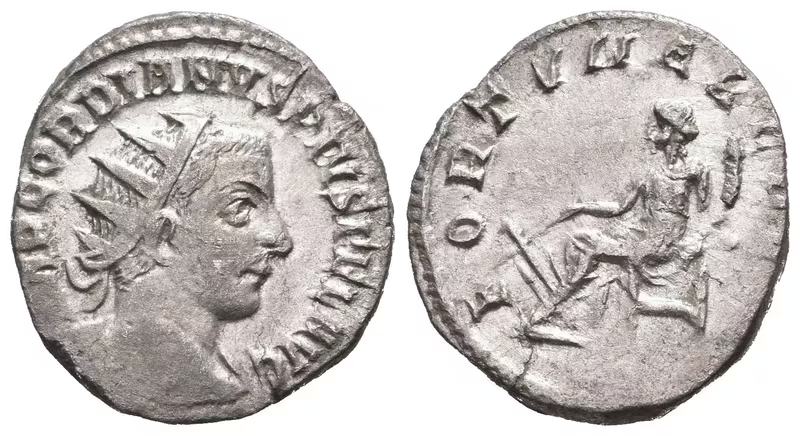
Skladem 1 ks - Code: BE072-0210
Gordianus III., antoninian, RIC 210
Gordianus III. (238 - 244) Antoninian, mincovna Antiochia, ražen 242-244 n.l., Rv. sedící Fortuna s kormidlem a rohem hojnosti, opis FORTVNA REDVX, RIC 210
Skladem 1 ks