Precious metals
Precious metals are rare metallic elements with a high economic value, characterised by chemical stability, malleability and a distinctive lustre. The main precious metals include gold, silver, platinum and palladium, which serve as investment instruments, industrial raw materials and material for the production of jewellery and coins.
The use of precious metals reaches into the Neolithic, when 8,000 years ago people in Anatolia began to work native gold and silver into simple ornaments. The oldest documented gold objects come from the Varna necropolis in Bulgaria, dated to 4600 BC - it contained 3,000 gold artefacts with a total weight of over 6 kilograms.
A fundamental breakthrough was the mastery of silver metallurgy around 3000 BC in Asia Minor. The separation of silver from lead by the cupellation method made possible mass production of this metal. Silver became the basis of the first monetary systems of Mesopotamia, where the shekel represented a unit of weight and of means of payment.
Ancient civilisations created a bimetallic standard based on gold and silver. The Lydian king Croesus struck the first coins from electrum (a natural alloy of gold and silver) around 650 BC. The Roman Empire established a ratio of gold to silver of 1:12, which, with modifications, survived into the early modern period.
The discovery of America in 1492 brought a revolution in the availability of precious metals. Spanish mines at Potosí and Zacatecas poured onto European markets thousands of tonnes of silver, which led to the "price revolution" of the 16th century. The Californian gold rush (1848) and discoveries in Australia (1851) doubled the world's gold reserves within a single decade.
History
Platinum joined the family of precious metals; Europeans "discovered" it in the 18th century in Colombia, although pre-Columbian cultures had known it for centuries. The industrial use of platinum began only in the 19th century. Palladium was discovered by William Hyde Wollaston in 1803 during the processing of platinum ore. Rhodium (1803) and osmium with iridium (1804) completed the group of platinum metals.
In the Bohemian lands the systematic mining of precious metals began in the 13th century. The silver mines at Jihlava supplied the mints of the Přemyslid kings. Kutná Hora became in the 14th century the "silver treasury" of Europe. The Jáchymov mines provided silver for thalers from 1516. Zlatá Koruna, Kašperské Hory and Roudný mined gold, albeit in limited quantities.
The modern era of precious metals begins with the abandonment of the gold standard. The Bretton Woods system (1944-1971) maintained the last link between currencies and gold. From 15 August 1971, when President Nixon ended the convertibility of the dollar into gold, precious metals became purely market commodities with freely floating prices.
Gold (Au) with a density of 19.3 g/cm³ is the most malleable metal - from a single gram a sheet of 1 m² can be beaten out. Chemical inertness ensures eternal durability. It is used in electronics (40%), jewellery (50%) and as an investment (10%). Annual mining reaches 3,300 tonnes; in total 205,000 tonnes have been mined.
Characteristics and uses
Silver (Ag) has the highest electrical and thermal conductivity of all metals. Industry consumes 60% of production (photovoltaics, electronics), jewellery 25%, investment 15%. Annual mining of 26,000 tonnes barely covers demand. The historical price ratio of gold/silver of 1:15 has changed to the current 1:80.
Platinum (Pt) with a melting point of 1768 °C withstands extreme conditions. Automotive catalysts consume 40% of production, jewellery 30%, the chemical industry 20%. Rarer than gold - annual mining is only 190 tonnes. South Africa produces 70% of the world's platinum.
Palladium (Pd) is experiencing a boom thanks to the automotive industry (85% of consumption). The price has surpassed both gold and platinum. Russia controls 40% of mining, which creates a geopolitical risk. Annual production of 210 tonnes does not meet demand.
Rhodium (Rh), ruthenium (Ru), iridium (Ir) and osmium (Os) are extremely rare with specialised industrial use. Rhodium reached in 2021 a price of CZK 800,000 per ounce, ten times the price of gold.
Investment and numismatic significance
Precious metals represent the ultimate store of value in times of economic uncertainty. Central banks hold 35,000 tonnes of gold as reserves. Investment products include bars, coins, ETFs and certificates. Physical ownership provides protection against systemic risk.
For numismatics, precious metals are essential. Historical gold and silver coins combine the value of the metal with a collector premium. Modern bullion coins (American Eagle, Krugerrand, Wiener Philharmoniker) are exempt from VAT. Czech mints produce ducats, thalers and commemorative strikes from precious metals.
Diversification of a portfolio by precious metals reduces volatility. The recommended allocation is 5-15% of wealth to gold and silver. Platinum and palladium are more speculative with links to industrial cycles. Physical ownership requires safe storage; an alternative is allocated accounts with specialised companies.
In our auction and shop
- Code: SSPAN90-B1800MZ
Španělsko, 8 Real 1800 FM
Španělsko, Carlos IV., 1788 - 1808 8 Reales 1800 FM, Mexico, KM.109, patina, škr. a hranky, Asijské kontramarky v ploše (Chopmarks), zajímavé! Španělské 8 Realy byly vyhledávaný a oblíbenými platidly v oblasti nového světa. Bylo to především pro stálost…
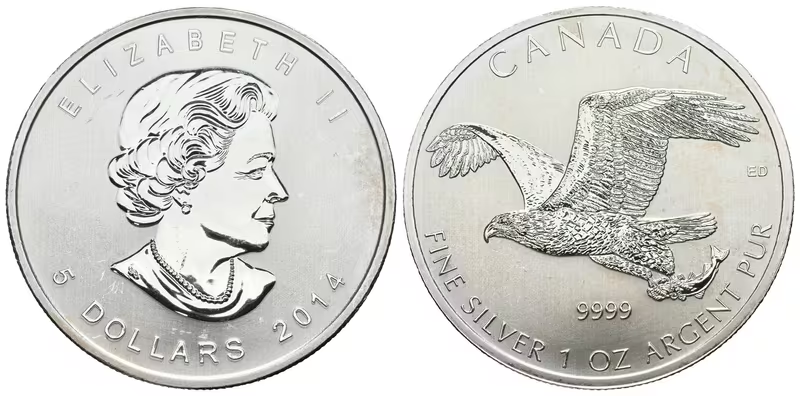
Skladem 1 ks - Code: SKAN90-N2014VB
Kanada, 5 Dollars 2014 - Maple Leaf - Orel
Elizabeth II. (1952 - 2022) 5 Dollars 2014 - Maple Leaf - Bald Eagle. Ag 0,9999, 38 mm (31,1 g), 1 Oz, běžná kvalita Stříbrná mince Maple Leaf je od roku 1988 ražena v Královské kanadské mincovně (Royal canadian mint - RCM). Označení se vztahuje k…
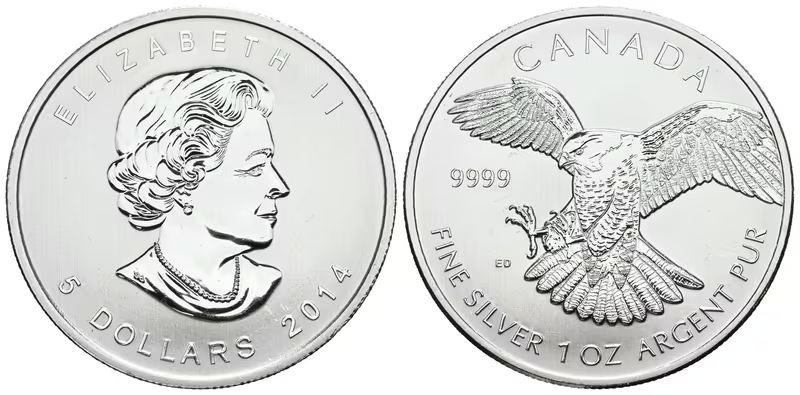
Skladem 2 ks - Code: SKAN90-N2014VA
Kanada, 5 Dollars 2014 - Maple Leaf - Sokol
Elizabeth II. (1952 - 2022) 5 Dollars 2014 - Maple Leaf - Peregrine Falcon. Ag 0,9999, 38 mm (31,1 g), 1 Oz, běžná kvalita Stříbrná mince Maple Leaf je od roku 1988 ražena v Královské kanadské mincovně (Royal canadian mint - RCM). Označení se vztahuje k…
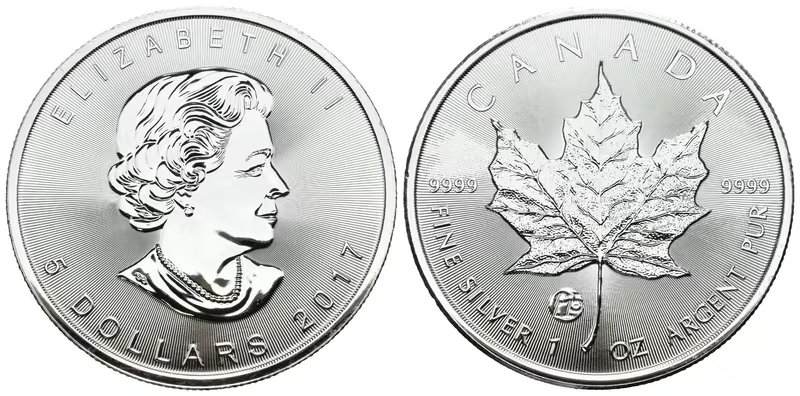
Skladem 2 ks - Code: SKAN90-N2017V
Kanada, 5 Dollars 2017 - Maple Leaf
Elizabeth II. (1952 - 2022) 5 Dollars 2017 - Maple Leaf, značka "F15" na Rv. Ag 0,9999, 38 mm (31,1 g), 1 Oz, běžná kvalita Stříbrná mince Maple Leaf je od roku 1988 ražena v Královské kanadské mincovně (Royal canadian mint - RCM). Označení se vztahuje k…
Skladem 2 ks