Thaler
The thaler is a large silver coin of the early modern period, which spread in Central and Northern Europe from the 16th century and for a long time became a pillar of monetary circulation. The name arose from the designation of the Jáchymov "Joachimsthaler" and also gave rise to the word "dollar".
The roots of the thaler are linked to the transformation of European coinage at the turn of the 15th and 16th centuries. Growing trade needed a coin of higher value than that offered by the small groschen and kreuzers, and at the same time new sources of silver opened up in Central Europe. An important role was played by the mining area in the Ore Mountains (Krušné hory), where large-scale extraction began and where demand arose for a stable, "large" silver coin suitable for long-distance trade and the storage of value.
The direct predecessor of the thaler is considered to be the large silver coins of the guldengroschen type (sometimes also "guldiner"), which were struck as early as around 1500 in the German lands. The real breakthrough, however, came with the coinage in Jáchymov (German: Joachimsthal) in the Kingdom of Bohemia. From 1519/1520 a large silver coin began to be struck there, which became known as the Joachimsthaler — literally the "coin from the valley of Joachim". It was precisely from this name, by abbreviation, that the word thaler (German Taler) developed, and from it later "dollar" in a number of languages.
The success of the thaler was due to the combination of three things: an abundance of silver, a practical size, and reputation. Thaler coins were an intelligible means of payment for higher sums, looked impressive, and thanks to their higher value were better suited to wholesale, tax collection and army wages. Once the market grew accustomed to such a coin, other countries and regions began to strike it too — often with their own iconography, but of a similar size and roughly comparable silver content.
History
In the Holy Roman Empire, an effort towards a more unified standard gradually asserted itself. An important milestone was the Reichstaler, recognised in 1566 as the imperial thaler coin and becoming the reference point for conversions. In practice, however, a distinction was often made between the "coin" thaler piece (an actual coin of a particular standard) and the "accounting" thaler concept, since regional currencies differed and exchange ratios changed over time. In the 17th and 18th centuries, moreover, there were frequent monetary shocks and the debasement of small coins, so that more stable large silver denominations gained even greater importance.
In the Habsburg lands, and hence in the Czech lands too, the thaler long ranked among the most important silver coins. Various thaler standards and derivative denominations gradually emerged, reflecting reforms and treaties between states. In the 19th century the word "thaler" in the German space was also used for a currency unit (for example in the Prussian and later all-German contexts), before being supplanted by modern currencies. The thaler thus represents not only a specific coin but also a long tradition of the "large silver unit" that shaped European monetary history.
With ordinary historical thalers the diameter is roughly around 40 mm and the weight often around 28–29 g (depending on the mint and the period). The imperial Reichstaler standard of 1566 was defined by a content of approximately 25.984 g of pure silver, which made the thaler a trustworthy "large" silver coin for trade and the storage of value.
Form, properties and collector use
The thaler is typical for its large diameter and rich decoration. The obverse often bears a portrait of the ruler or the territorial coat of arms; the reverse bears heraldry, titulature, and sometimes also the year and the mint mark. It is precisely the space provided by the thaler that allowed detailed engraving and a striking propaganda of power — thaler portraits are among the finest examples of coin art of the early modern period. With a number of thalers one also encounters edge inscriptions, which were intended to limit the clipping of silver.
In numismatic practice, "thaler" can refer both to a precise standard (for example the imperial thaler) and, more generally, to a large silver coin with a similar function. Therefore, when identifying a specific piece, it is important to follow: the ruler and title, the mint, the year, the type (portrait, coat of arms, special issue) and also the parameters — especially the weight and fineness, which differed over time and between countries. With historical thalers, uneven striking and wear at the highest points of the relief are common, which can affect the resulting assessment of the preservation grade.
For collectors, thalers are among the most sought-after coins: they combine high historical value, attractive appearance and often good traceability in the literature. Many types exist in rare years or variants, where small differences in the legend, in mintmasters' marks or in the form of the portrait are decisive. In the Czech setting, the connection to Jáchymov is also especially prized — the place that gave the thaler its name and inscribed the Czech lands into the world history of money.
In our auction and shop
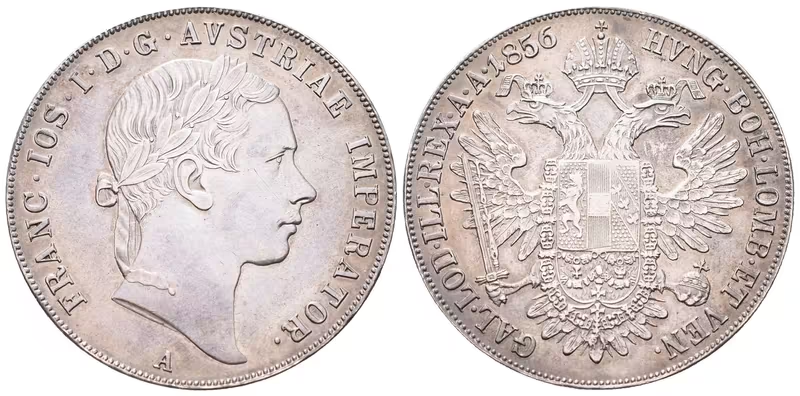
- Code: MA003-1856A.1
Tolar 1856 A
František Josef I. (1848 - 1916) Tolar 1856 A, Vídeň, Ves. 3 Velmi pěkná zachovalost, zbytky lesku, patina, rysky a zcela nep. hranky
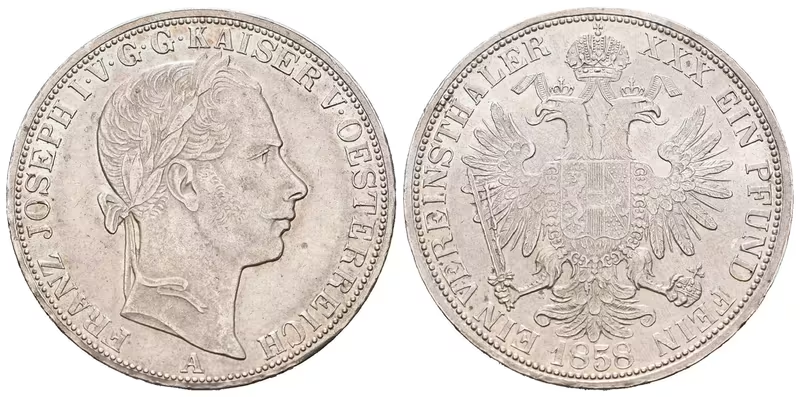
Skladem 1 ks - Code: MA039-1858A.3
Tolar spolkový 1858 A
František Josef I. (1848 - 1916) Tolar spolkový (Vereinsthaler) 1858 A - Vídeň, Ves. 39, krásná zachovalost, téměř plný ražební lesk, jemná patina, rysky
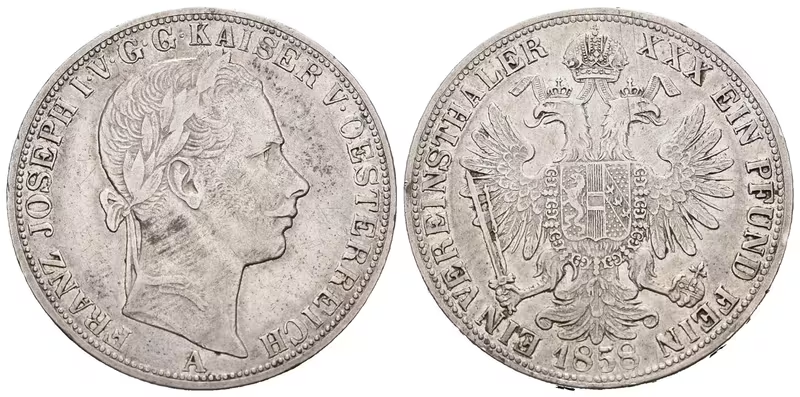
Skladem 1 ks - Code: MA039-1858A.4
Tolar spolkový 1858 A
František Josef I. (1848 - 1916) Tolar spolkový (Vereinsthaler) 1858 A - Vídeň, Ves. 39, patina, zbytky lesku, rysky a drobné hranky
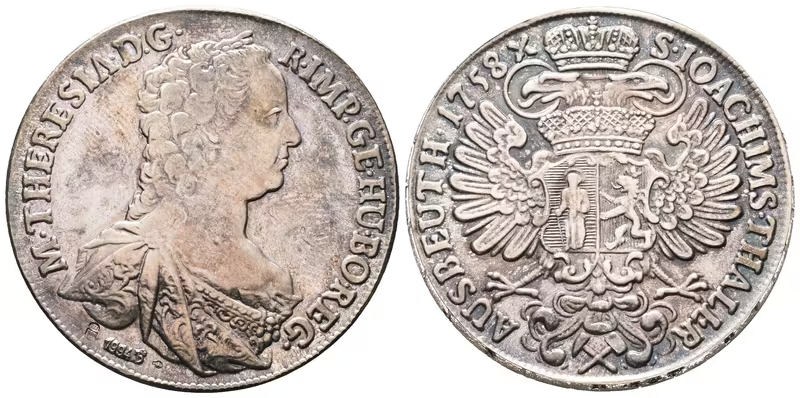
Skladem 1 ks - Code: RG-1994MAR
Výtěžkový tolar Marie Terezie 1758
AR Medaile 1994 - replika výtěžkového tolaru Marie Terezie 1758, Ag 0,999, 40 mm (29,16 g), etue Výtěžkové ražby jsou mince ražené ze surovin vytěžených v určitých místech. Do Čech přišel zvyk razit tyto mince ze saské strany Krušných hor. Na každé…
Skladem 1 ks