Small groschen (malý groš)
The small groschen (malý groš) is a small silver coin worth half a white groschen, introduced in the Bohemian lands under Emperor Rudolf II in 1577. It is famous, among other things, for being one of the few coins to bear a Czech inscription MALEY GROSS, and ranks among the popular collector strikes.
The small groschen arose at a time when Bohemian coinage was seeking to respond to the needs of the everyday market and to supplement circulation with a practical small silver coin. It was introduced by a decree of Emperor Rudolf II of 4 February 1577, on the recommendation of the Bohemian estates. Already the very manner of its introduction suggests that this was not a chance idea of the mint, but a deliberate intervention into the structure of small payments: the coin had a clearly set value, namely half a white groschen, and was meant to facilitate ordinary accounting and payment.
From a numismatic point of view the small groschen is also extremely interesting in how it is anchored in the monetary practice of the time. The period regulations worked with precise weight requirements, and for the small groschen a weight of approximately 1.055 g is given. Such a coin was small enough for minor payments yet still "silver" to a degree that was important for the market on account of trust. In the second half of the 16th century the relationship between nominal value, weight and fineness was one of the key themes of coinage policy, because small change wore out quickly and at the same time was the most sensitive to any debasement.
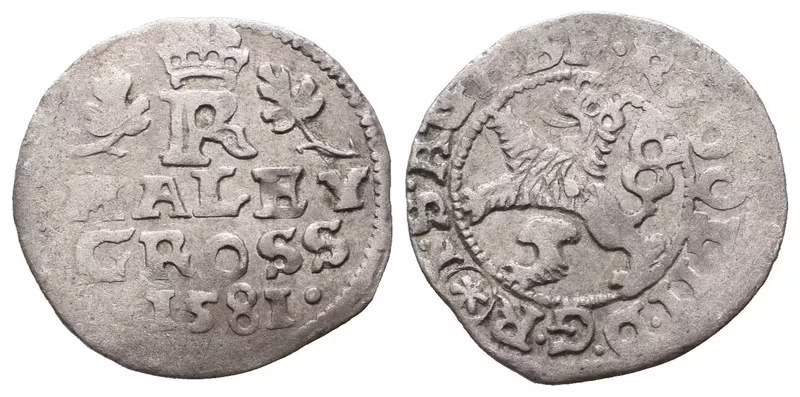
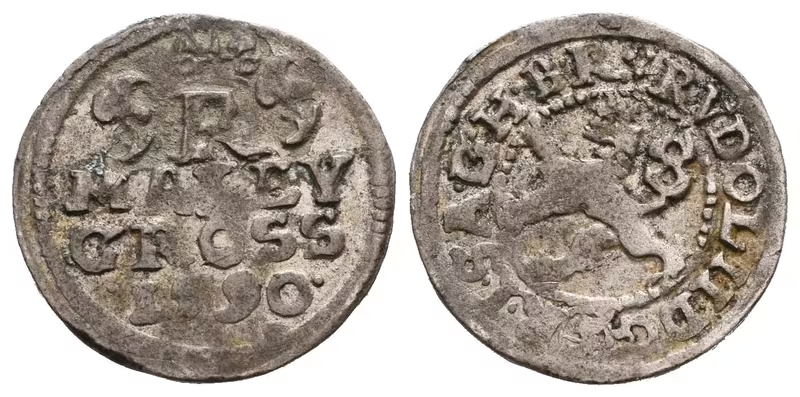
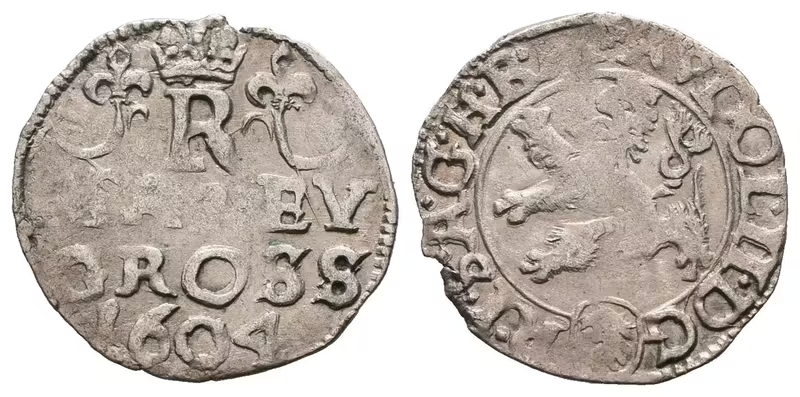
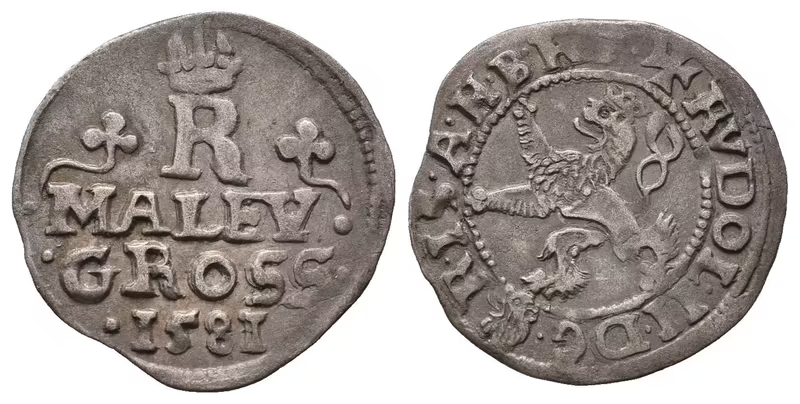
The small groschen has gained the most attention by being exceptional in Bohemian medieval and early modern coinage in the language of its legend. Unlike the usual Latin titulature and standard abbreviations, here a Czech inscription MALEY GROSS appears (in some places also in period variants such as MALEI GOSS). It is precisely this detail that makes it an easily recognisable and collector-attractive type: the coin "speaks Czech", and in an environment where Latin was traditionally used on coins, this is an extraordinary rarity.
The striking of small groschen took place under Rudolf II at several mints, which in itself increases the variety of types. The small groschen is encountered especially at the mints of Prague, Kutná Hora, Jáchymov and České Budějovice. The continuation of mintage also reaches into the period of the reign of Matthias (1611–1619), when the small groschen continued to be struck at the traditional coinage centres. Thanks to this there exists today a range of variants which differ not only by year but also by minor differences in lettering, composition and the execution of dies.
History
The end of the small groschen is connected with a monetary turning point: its mintage was abolished by the estates' coinage reform of 1619. With this a relatively short but numismatically very prominent chapter closed. It is interesting that precisely this "boundedness" — introduction by a clear act and abolition by another act — gives the small groschen a firm place in the history of Bohemian monetary circulation. Moreover, it is a type that has won favour not only among specialists but also among collectors: small silver coins tend to be more accessible than large denominations, and yet they can bear a rich typological variety and a high artistic standard.
The variety of types and aesthetics are precisely the reasons why the small groschen is often collected "as a series" according to mints and years. With this denomination it is worth perceiving that even small differences in the legend or in the drawing can mean a different variant, and therefore a different collecting rarity. The small groschen is, in short, a small coin which concentrates within itself a surprisingly large piece of the monetary and cultural history of the close of the 16th and the beginning of the 17th century.
The most typical identifying feature of the small groschen is the Czech inscription MALEY GROSS, which may also occur in small period variations. For collectors it is important that the legend in particular is most susceptible to wear in circulation on small coins, and therefore well-legible pieces are markedly more attractive. In identification, differences in the lettering (the shape of individual letters, spacing, abbreviations) and details of the motif also play a role, because the dies were prepared by hand and individual issues can differ in style.
The small groschen was conceived as a practical silver coin for everyday use, which corresponds to its relatively low weight of around 1.055 g. From the market's point of view it was a compromise: a small enough denomination for ordinary payments, yet still with the "metallic authority" that the paper money of the time did not replace. For today's collectors this means that you will often encounter well-worn pieces — and that condition is one of the main factors of price for this type.
Inscription, parameters and collecting notes
A great advantage of small groschen is their typological variety. Because they were struck at several mints and over several periods, there is a range of variants that can be collected thematically: by mint (Prague, Kutná Hora, Jáchymov, České Budějovice), by year, or by variants of the legend. Of interest also are occasional off-strikes and multiples, which show that even from a small denomination more representative strikes were sometimes made. With more valuable variants it is worth checking the edge and the surface: aggressive cleaning may "lighten" the coin but often destroys the original surface structure and lowers the collecting value.
If you are choosing a small groschen for your collection, focus on the legibility of the Czech legend, the sharpness of detail and a natural appearance. It is precisely the combination of small format, unusual language and rich typology that makes it a coin that collectors enjoy in the long term — and at the same time reliably illustrates how even "small money" can carry a great story.
In our auction and shop
- Code: M40B-DS1581
Rudolf II., Malý groš 1581, České Budějovice
Rudolf II. (1576 - 1612) Malý groš 1581, České Budějovice-Schönfeld, HN.10
Skladem 1 ks - Code: M40B-DS1590
Rudolf II., Malý groš 1590, České Budějovice
Rudolf II. (1576 - 1612) Malý groš 1590, České Budějovice-Kryštof Mattighoffer, HN.25 var. Ze sbírky Vladimíra Hanibala
Skladem 1 ks - Code: M40B-BS1604
Rudolf II., Malý groš 1604, Kutná Hora
Rudolf II. (1576 - 1612) Malý groš 1604, Kutná Hora-Enderle, HN.13a (opis 7a)
Skladem 1 ks - Code: M40BBS1581