Archduchy
An archduchy is a territorial and estate-based unit administered by an archduke, typically associated with the Austrian lands under Habsburg rule. In Europe the term is most often associated with the Archduchy of Austria, which was the core of Habsburg power and later one of the fundamental pillars of the Habsburg monarchy.
The archduchy as a concept derives from the title of archduke and reflects an effort to elevate the importance of a given territory above an ordinary duchy. In the Austrian case it was not merely a "nice designation" but a political programme: to express that the Austrian lands held an exceptional position within the empire and that their ruler stood above other dukes. Such shifts in titulature were important in the Middle Ages and the early modern period because the title was not merely ceremonial — it was an instrument of prestige, negotiating power and dynastic legitimacy.
The Archduchy of Austria gradually became the core of the House of Habsburg. From the "eastern march" and the subsequent duchy there developed a territory that had a strategic position on the Danube together with growing economic importance. When the Habsburgs established themselves in the upper politics of the empire, they needed a stable and prestigious home base. It was precisely the archduchy that fulfilled this role: it was the centre of the dynasty from which the other acquired lands were governed and from which the network of offices, finances and military capacities was built up.
History
In central Europe the significance of the archduchy became most evident at the time when the Habsburgs gradually assembled more crowns and lands — the Austrian lands, the Czech lands of the Bohemian Crown and the Kingdom of Hungary. The Archduchy of Austria thus became the "stable core" of a multi-ethnic composite state, which in various forms endured until the 20th century. Although administrative models changed over time, the Austrian lands retained a special symbolic weight: the archducal title and the concept of the archduchy were part of dynastic identity and an important element of Habsburg representation.
In the modern period the term archduchy is also used in connection with the way in which the Habsburg state professionalised. Administration, taxation, the army and the judiciary gradually became more centralised, and the archduchy functioned as a space where these changes were born and from which they spread to other parts of the monarchy. At the same time it was a territory that often set the "tone" of dynastic policy — not only because it was the homeland of the house, but also because the key institutions and the court were seated there.
Significance and links with titulature
It is important to understand the archduchy as a combination of territory and title. The title of archduke was reserved for the Habsburgs, and the archduchy thus represented their "home" unit in the hierarchy of European aristocracy. In practice this affected not only ceremony and diplomatic precedence but also how rulers presented themselves in documents and public symbols. The archducal titulature appeared in official texts and in rulers' styles and helped to emphasise that the Habsburgs were not merely one of many ducal houses but a dynasty of exceptional standing.
In historical memory, the archduchy is most often associated with Austria, but the term can be used more generally as a model of an "elevated duchy" linked with a higher title. In European reality, however, it is precisely the Austrian case that represents the best-known and most influential example: the archduchy as the base of a dynasty that shaped the history of central Europe for several centuries.
In our auction and shop
- Code: XB1500
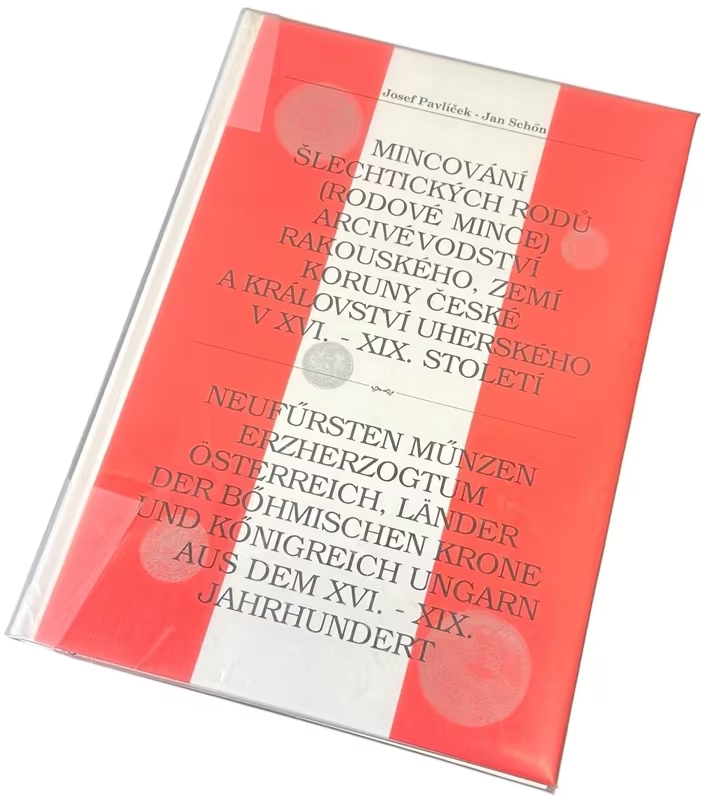
Mincování šlechtických rodů (rodové mince) Arcivévodství rakouského, zemí Koruny české a Království uherského v XVI.- XIX. století
Pavlíček, Josef a Schön Jan Mincování šlechtických rodů (rodové mince) Arcivévodství rakouského, zemí Koruny české a Království uherského v XVI.- XIX. století 113 stran, vázané, velikost A4, Zlín 2008