Brasília
Brasília is the capital of Brazil, built in the 1950s in the interior of the country. It arose as a symbol of the modern state and as an instrument for the development of more remote regions.
Brasília did not arise through natural growth like most of the world's metropolises, but as a political and urban-planning project. The idea of moving the capital from the coast into the interior had appeared in Brazil already in the 19th century and was linked with a long-standing problem of uneven development: the economic and power centre was concentrated on the Atlantic coast, while the vast interior remained sparsely settled and weak in infrastructure. The transfer of the metropolis was meant to be an impulse for the interconnection of the country, better administration of the territory and a strengthening of state presence in regions far from the ocean.
The decisive step came in the time of President Juscelino Kubitschek, who turned the project into one of the symbols of his political programme. In the mid-1950s construction began on the territory of the Federal District in the middle of the Brazilian plateau. The emergence of the city was exceptionally rapid and organisationally demanding: it was necessary to build roads, bring in power and water, create administrative buildings, housing and basic services. Tens of thousands of people worked on the construction, often in harsh conditions, and this labour migration in particular became one of the key social chapters of the city's history. Alongside the planned core, satellite settlements gradually emerged in which workers and new inhabitants settled, which over time transformed into the characteristic metropolitan structure: a representative centre and a broad hinterland around it.
The urban concept was built on the modernist idea of the "functional city". The plan envisaged clear division into administrative zones, residential sectors, commercial strips and traffic arteries. The basic ground plan is often described as the shape of an aeroplane or bird — it is a figurative comparison that captures the main axis of the city and the wings of residential quarters. Emphasis was placed on automobile transport and generous space, which at the time of construction was perceived as a sign of progress and modernity. At the same time, however, this laid the foundation for later challenges, since such a type of city can be less natural for pedestrian life and everyday "urban-ness" than traditional streets and squares.
History
A distinctive face was given to Brasília by modernist architecture, with which the name of Oscar Niemeyer is most often associated. Government palaces, the parliamentary complex, the cathedral and other buildings were designed to appear representative and yet at the same time light and sculptural. The city quickly became a symbol of the new Brazil: self-confident, technically oriented and open to grand gestures. In subsequent decades Brasília transformed into the administrative and political centre of the state, but at the same time into a metropolis which had to deal with the typical problems of rapidly growing big cities — transport, housing accessibility, social differences between centre and hinterland, and the question of how to reconcile the original plan with the reality of a million-strong agglomeration.
Brasília remains to this day one of the best-known examples of a planned modernist city. Its core is built on monumental spaces, vistas and symbols of state power. The government, parliament and supreme institutions stand in representative zones designed to appear ceremonial and clear in layout. The residential parts are often formed by blocks and sectors with their own services and greenery, which was meant to bring quality housing in an "organised" environment.
At the same time, Brasília is a city of contrasts. What is admired about it — its generosity, the cleanliness of its lines and architectural boldness — is at the same time a source of practical debates about everyday functioning. For many people it is more natural to live in the satellite cities and ordinary quarters around it, while the central planned zones function chiefly as administrative and representative space. The metropolitan area thus develops as a whole, in which the core fulfils a symbolic and political role and the surroundings carry a large part of the housing, services and industry.
Urban planning, architecture and the present-day role of the city
Brasília is today not only the seat of federal institutions but also a city with universities, culture and significance for the interior regions. Its uniqueness lies in the fact that it is a "living laboratory" of modernist ideals: in one place one can read the ambitions of the state, the architectural aesthetics of the 20th century and the practical consequences of large-scale planning. It is precisely for this reason that Brasília belongs among cities that evoke strong reactions — from admiration to criticism — and that at the same time remain one of the most distinctive symbols of modern Brazil.
In our auction and shop
- Code: SBRAZI-H1936L
Brazílie, 100 Reis 1936 - 1938
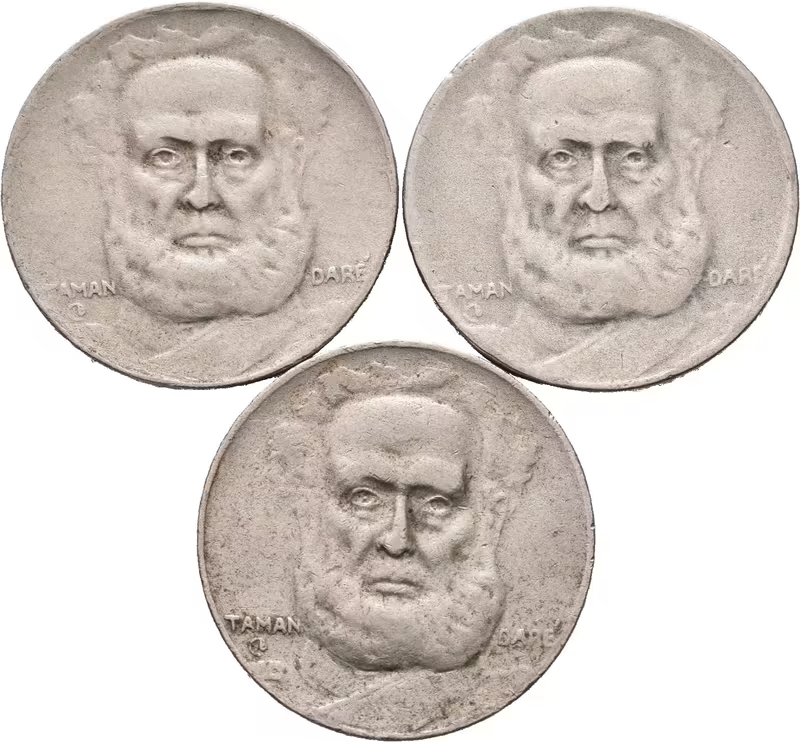
I. Republika, 1889 - 1967 Soubor mincí 100 Réis 1936 až 1938 - Joaquim Marques Lisboa , KM.536_celkem 3 kusy
Skladem 1 ks - Code: SBRAZI-H1934
Brazílie, 100 Reis 1934
I. Republika, 1889 - 1967 100 Réis 1934, KM.518, pěkná zachovalost
Skladem 1 ks - Code: SBRAZI-H1932
Brazílie, 100 Reis 1932
I. Republika, 1889 - 1967 100 Réis 1932 - 400. výročí kolonizace , KM.527, velmi pěkná zachovalost
Skladem 2 ks - Code: SBRAZI-G1940
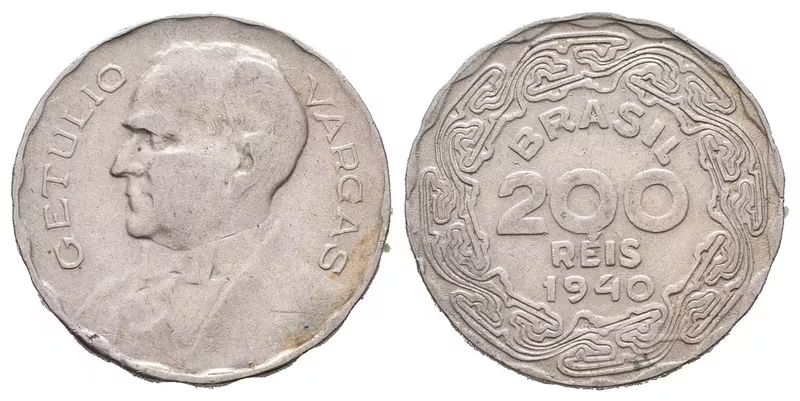
Brazílie, 200 Reis 1940
I. Republika, 1889 - 1967 200 Réis 1940 - Getúlio Dornelles Vargas , KM.545, oběh
Skladem 1 ks