Joan of Arc
Joan of Arc (French Jeanne d'Arc, also la Pucelle d'Orléans — the Maid of Orléans) was born around 1412 in the small village of Domrémy in north-eastern France. She was the daughter of the well-to-do peasant Jacques d'Arc and his wife Isabelle Romée.
France was in a desperate situation. Under the Treaty of Troyes (1420), the French Dauphin Charles (the future Charles VII) was stripped of his right of succession, and the throne was to pass to the English king Henry V and his descendants. After Henry's death (1422), northern France was ruled by the underage Henry VI with the support of his Burgundian allies. The Dauphin Charles controlled only a small territory around Chinon, and his position was hopeless.
At the age of thirteen, Joan began to hear voices, which she attributed to the Archangel Michael, St Catherine and St Margaret. These voices urged her to save France from English domination and to help crown Charles as the lawful king at Reims. In 1428 she set out to see the captain of the garrison at Vaucouleurs, Robert de Baudricourt, and persuaded him to provide an escort to the court of the Dauphin.
In February 1429 Joan arrived at Chinon, where at a private audience she gained the confidence of the Dauphin — she allegedly told him a secret that only a messenger of God could have known. Charles sent her with a military escort to besieged Orléans. Joan donned white armour, cut her hair short and led the army under her banner. Nine days after her arrival, on 8 May 1429, the English ended the siege and withdrew. This victory broke the morale of the English troops and emboldened the French resistance.
Victories, Coronation and Capture
After the liberation of Orléans, Joan led the army to further victories at the battles of Jargeau, Meung-sur-Loire and the decisive engagement at Patay (18 June 1429), where the French defeated the English archers. The way to Reims lay open. On 17 July 1429, Charles VII was crowned King of France in Reims Cathedral in the presence of Joan, who stood at his side bearing the royal banner.
After the coronation, Joan's influence at court declined. The unsuccessful siege of Paris in September 1429 weakened her position. In May 1430, while defending Compiègne, she was captured by Burgundian soldiers and sold to the English for 10,000 livres. The English handed her over to the ecclesiastical court at Rouen under Bishop Pierre Cauchon, who was a supporter of the English party.
The trial lasted from January to May 1431. Joan faced charges of heresy, witchcraft and the wearing of male dress. Although she defended herself before the court with remarkable eloquence, she was found guilty and on 30 May 1431 burned at the stake in Rouen. She was only nineteen years old. Her ashes were thrown into the Seine, to prevent the veneration of her relics.
Rehabilitation and Canonisation
After the recapture of Rouen by France in 1449, Charles VII ordered an investigation into the circumstances of Joan's execution. In 1455 Pope Callixtus III (Alfonso de Borja) ordered a retrial conducted by the Inquisitor General Jean Bréhal. Joan's mother Isabelle delivered an emotional speech at the opening session in the Cathedral of Notre-Dame. On 7 July 1456 the verdict of 1431 was declared invalid and Joan vindicated as a martyr unjustly condemned by a court that had itself broken canon law.
The city of Orléans had commemorated Joan's memory every year since 1432 and from 1435 staged a religious play celebrating her victory. Under Napoleon Bonaparte she was declared a national symbol of France in 1803. Pope Pius X beatified her on 18 April 1909 in the Cathedral of Notre-Dame in Paris. The canonisation took place on 16 May 1920 in the Basilica of St Peter in Rome under the pontificate of Pope Benedict XV, who issued the bull of canonisation Divina disponente. Over 60,000 people took part in the ceremony, including 140 descendants of Joan's family.
In our auction and shop
- Code: RX-Z-027
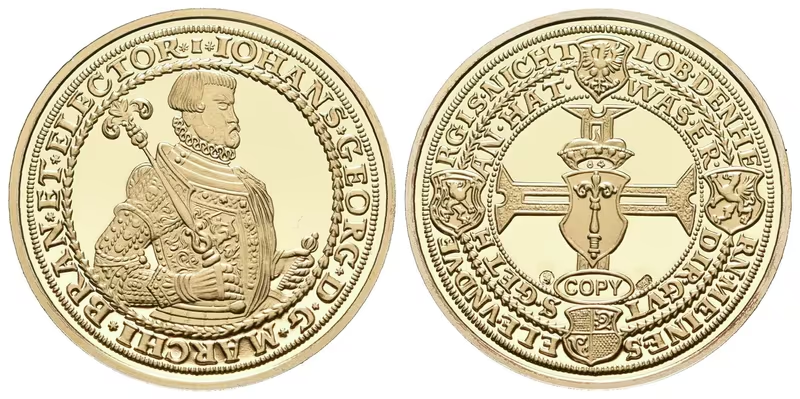
Německo (Braniborsko), 10 Dukátů (Portugaleser) 1584 - Kurfiřt Johann Georg I., pozlacená stříbrná replika
Braniborské kurfiřtství - Johann Georg I. (1571-1598) 10 Dukátů (Portugaleser) 1584 - Portrét kurfiřta Johanna Georga I. / ornamentální kříž s braniborskými erby, replika Ag (.925), pozlaceno, 25 mm (10 g), v kapsli. Stav mince odpovídá fotografii. Jedná…
Skladem 1 ks - Code: MCZ137
200 Kč 2022 - Gregor Johann Mendel
Česká republika (1993 - ) 200 Koruna 2022 - 200. výročí narození Gregora Johanna Mendela, autor Zbyněk Fojtů, Aurea C237, kapsle, bez certifikátu, běžná kvalita Ag 0,925, 31 mm (13 g), raženo 6 700 ks (běžná kvalita), 12 800 ks (proof)
Skladem (>5 ks) - Code: MCZ137-PROOF
200 Kč 2022 - Gregor Johann Mendel, PROOF
Česká republika (1993 - ) 200 Koruna 2022 - 200. výročí narození Gregora Johanna Mendela, autor Zbyněk Fojtů, Aurea C237, etue, certifikát, PROOF Ag 0,925, 31 mm (13 g), raženo 6 700 ks (běžná kvalita), 12 800 ks (proof)
Skladem (>5 ks) - Code: ZD-2018JIR
Sada dukátů 2018 - Jiří z Poděbrad a Johana z Rožmitálu
Česká republika (1993 - ) Sada dvou dukátů 2018 (Lubomír Lietava) - Jiří z Poděbrad a Johana z Rožmitálu 2x Au 0,986, 208 mm (3,49 g), náklad 300 ks, certifikát, dřevěná etue, papírový přebal, PROOF Naše vlast byla po staletí významnou zemí, která leckdy…