Alfonso de Borja
Alfonso de Borja was a Spanish ecclesiastical dignitary who became pope in 1455 as Callixtus III. His pontificate was short but left a marked imprint on history through his effort at a crusade against the Ottomans after the fall of Constantinople, and also by preparing the ground for the rise of the Borgia family in Renaissance Italy.
Alfonso de Borja (in Italian often given as Alfonso Borgia) came from the region of Valencia in the Kingdom of Aragon. He grew up in an environment where a learned legal tradition intermingled with the politics of Mediterranean sovereigns, and it was precisely legal education that opened to him the way into high ecclesiastical administration. He gradually built up a reputation as a capable diplomat and administrator, which allowed him to enter the service of the Aragonese court and to gain significant posts in the ecclesiastical hierarchy.
His career was closely linked to the power relations of the 15th century, when the papacy increasingly functioned also as a political actor between European states. Borja proved himself as a negotiator and relied on the support of the Aragonese king Alfonso V of Aragon, who had strong interests in Italy, particularly in Naples. In such an environment it was important for the papacy to have at court capable lawyers and diplomats who could mediate agreements and at the same time defend the interests of the Holy See.
In 1455 Alfonso de Borja was elected pope and took the name Callixtus III. His pontificate falls in the period immediately following the fall of Constantinople (1453), which shook Christian Europe and provoked fears of further Ottoman advance. Callixtus III therefore concentrated a large part of his energy on the organisation of a crusade and on supporting defence against Turkish expansion. In practice this meant negotiating with European rulers, the effort to raise finance and to mobilise broader political will — an exceptionally complicated task, because the European powers had their own conflicts and often preferred domestic interests.
History
Alongside this "grand" goal, however, his pontificate is also recorded by another feature typical of the Renaissance papacy: the strengthening of family ties and support for relatives in high office. It was precisely under Callixtus III that members of the Borja family acquired a more prominent position in Rome, which later culminated in the election of his nephew Rodrigo Borgia as pope (as Alexander VI). Callixtus's rule thus represents an important preliminary stage of the "Borgia" chapter of history, known for its mixture of political dexterity, court culture and sharp clashes for power.
Callixtus III died in 1458. His pontificate lasted only a few years, yet it had a long-term impact: it showed how urgently the Ottoman threat was being addressed in the middle of the 15th century, while at the same time recalling that the Renaissance papacy is not only a spiritual institution but also a political power that works with diplomacy, finances and dynastic influence. From this point of view Alfonso de Borja is a key figure in the transition between the late Middle Ages and the Renaissance in European politics.
Alfonso de Borja as Pope Callixtus III acted at a time when the papal court worked intensively with finances, taxes and special collections, particularly when it came to military undertakings. The calls to a campaign against the Ottomans demanded money, which was reflected in the organisation of ecclesiastical revenues and in broader economic life, because the papacy was a significant economic player. It is precisely at this time that one can see clearly that political decisions in high diplomacy always have a "monetary" side too: without resources one cannot wage war, maintain a fleet or finance allies.
The papacy, finances and the numismatic context
From a numismatic viewpoint the pontificate of Callixtus III is interesting chiefly within the framework of papal strikes, which in Renaissance Italy served not only as circulating coin but also as a tool of representation. Papal coins often bore the name and title of the sovereign-head of the Church, and in some cases symbols of the Holy See. For collectors such coins have value as precisely datable evidence of a rule and at the same time as a visual "signature" of a particular pontificate. With 15th-century strikes the legibility of the legends and the preservation of detail are important, because it is precisely the inscriptions that decide secure identification of the issuer.
If the collector is interested in a broader context, Alfonso de Borja may be a topic for collections focused on the Crusades and on the Mediterranean conflict with the Ottomans. Coins from the Italian environment, from the Papal States and from regions threatened by Turkish expansion can together create a tangible image of an age in which political decisions were born under the pressure of security concerns, of rivalries between Christian powers and of the growing importance of money as a tool of power.
In our auction and shop
- Code: ZD-3014MUCHA
Soubor medailí Alfons Mucha
Česká republika (1993 - ) Soubor medailí b.l. - Ikonická díla secesního mistra Alfonse Muchy Au 0,999, 18 mm (1,2 g), PROOF Cu-Ni 33 mm (15 g), PROOF 5x Pozlacené Cu 50 mm (49,4 g), PROOF ke každé medaili je certifikát, vše uloženo v kartonovém albu,…
Skladem 1 ks - Code: RAOPP-2010MUC
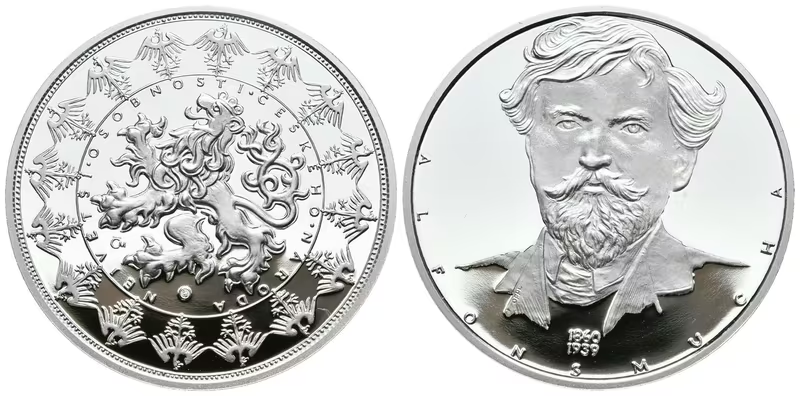
Oppl Vladimír - Alfons Mucha + certifikát
Oppl Vladimír (1953 - ) AR Medaile b.l. (2010) - Alfons Mucha Ag 0,999, 40 mm (29g), kapsle, certifikát autentičnosti, PROOF jedná se o komisní - druhotný prodej, možné drobné oxidační tečky v ploše Pamětní stříbrné medaile z čistého stříbra (999/1000) z…