St Vitus Cathedral
St Vitus Cathedral is the principal church of the Prague archbishopric at Prague Castle and a spiritual symbol of the Czech state. The Gothic building, founded in 1344, is linked with coronations, the tombs of sovereigns and the safekeeping of the coronation jewels.
On the site of today's cathedral a sacred building already stood in the early Middle Ages – first a rotunda and later a Romanesque basilica, since Prague-Hradčany was from the beginnings of the Přemyslid state a centre of both power and the church. A fundamental turning point came in the 14th century: in 1344 the bishopric of Prague was raised to an archbishopric, and at the same time the decision was taken to build a new representative church corresponding to the ambitions of the Kingdom of Bohemia. The construction was supported by Charles IV as Bohemian king and future emperor, as well as by the first archbishop of Prague, Ernest of Pardubice. The cathedral was to be not only a metropolitan church but also a place of coronation, a shrine for relics and a dynastic necropolis.
The first builder was Matthias of Arras, who brought to Prague the considered "French" conception of a cathedral with a high choir, a flying buttress system and a chevet of chapels. After his death the building lodge was taken over by Peter Parler, who developed the project significantly and gave it a distinctive character: he heightened the spatial dynamics, added daring vaults and developed the decorative programme. Linked with Parler are the key parts of the mediaeval cathedral – the choir with chapels, the Chapel of St Wenceslas, the triforium with busts and also the famous Golden Gate on the southern side with its mosaic of the Last Judgement. Part of the ambitious conception was also the Great South Tower, whose form, however, changed and was supplemented over the centuries.
The building advanced through generations, and its pace was influenced by finances, political conditions and wars. In the late Middle Ages the cathedral remained unfinished and its western part was for a long time closed off by provisional structures. During the Hussite Wars and later conflicts the focus of attention shifted elsewhere, and the great Gothic building waited for a new completion. Czech society returned forcefully to the ambition of "completing the cathedral" only in the 19th century, when interest in national monuments and in Gothic as a symbol of historical continuity was strengthened. At that time the long stage of neo-Gothic completion of the western part began, which sought to follow on from the mediaeval core and at the same time to supplement it sensitively with modern techniques.
History
The result was a cathedral in the form we know today: the Gothic core of the 14th–15th centuries joined with the neo-Gothic western part and façade. The solemn completion and consecration of the cathedral is linked with the year 1929, when the building was symbolically closed off after almost six centuries of work. St Vitus Cathedral is thus not a one-off "work of a single age", but a layered chronicle of Czech history: from the early mediaeval cult, through the Luxembourg High Gothic, to the modern era which sought to bring the monument to wholeness.
The cathedral is a three-aisled Gothic building with a flying buttress system, a high choir and a chevet of chapels, which create the typical "cathedral" scenography of light and space. The core of the building stands out with its vaults, ambulatory and rich stone-carved decoration; a significant element is the triforium with portrait busts of personalities linked with the building and the court. One of the most sacred places is the Chapel of St Wenceslas, built over the place where the relics of St Wenceslas are kept, decorated with precious stones and paintings – it is precisely here that the union of religious veneration and state tradition is strongly felt.
On the southern side the eye is caught by the Golden Gate with its mosaic, which is one of the most impressive monuments of the mediaeval visual programme in the Czech lands. The silhouette of Prague Castle is shaped by the Great South Tower, in which is housed also the famous Sigismund bell; the tower is at the same time a viewpoint and a landmark of the city. The interior is supplemented by stained-glass windows (some of which arose only in the 20th century), tombs and chapels, which commemorate sovereigns, saints and church dignitaries. The cathedral is also traditionally linked with coronations and with the keeping of the coronation jewels, which makes it not only a church but also a place of state memory.
Architecture, function and significance
From a practical point of view the cathedral is a living liturgical space, not merely a monument. Significant church rites and state commemorative events take place here, while for visitors it functions as a unique "textbook" of Gothic architecture and Czech history in stone, glass and metal. Its importance rests on its exceptional continuity: few buildings in Europe show so convincingly how mediaeval piety, royal representation and modern conservation can meet in a single space.
In our auction and shop
- Code: ZD-2019VIT
Sada mincí 2019 - Katedrála sv. Víta
Česká republika (1993 - ) Sada čtyř mincí 2019 (Josef Oplištil) - Katedrála sv. Víta 4x Au 0,9999, 22 mm (7,78 g), náklad 300 ks, certifikát, etue, papírový přebal, PROOF Bez ohledu na vyznání je katedrála svatého Víta duchovním symbolem, který je drahý…
Skladem 1 ks - Code: ZD-2018ZLA
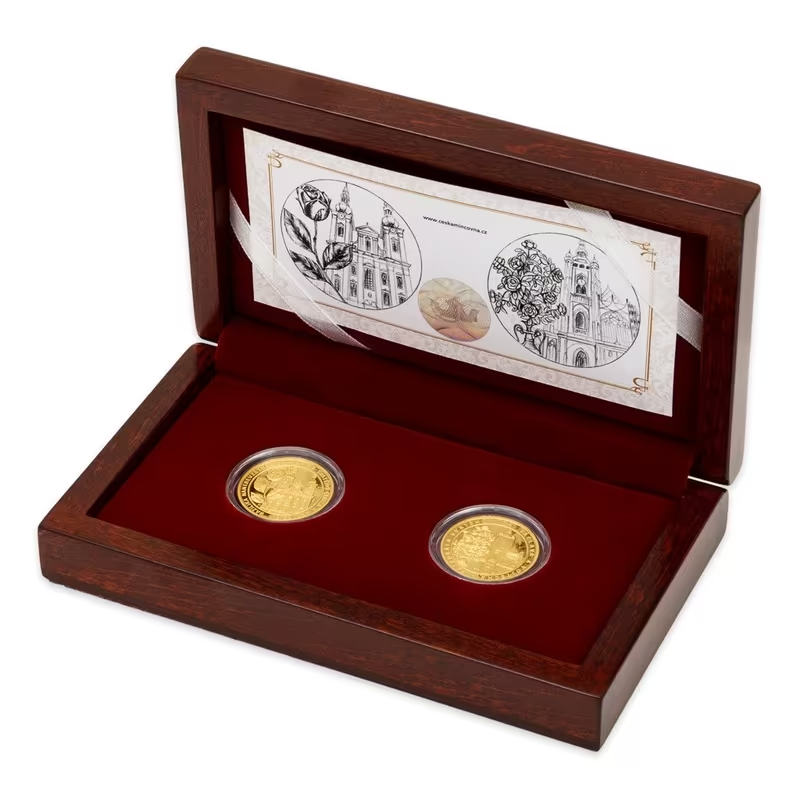
Sada mincí 2018 - Zlatá růže od papeže
Česká republika (1993 - ) Sada dvou mincí 2018 (Mária Filová) - Zlatá růže pro papeže - Velehradská bazilika, Katedrála sv. Víta 2x Au 0,9999, 22 mm (7,78 g), náklad 300 ks, certifikát, etue, papírový přebal, PROOF Když chce papež vyjádřit svou úctu a…
- Code: ZD-2017ARN
Zlatá mince 2017 - Arnošt z Pardubic
Česká republika (1993 - ) Zlatá čtvrtuncová investiční mince 2017 (Michal Vitanovský) - Arnošt z Pardubic Au 0,9999, 22 mm (7,78 g), náklad 200 ks, certifikát, etue, papírový přebal, PROOF Karel IV. je takřka bezvýhradně považován za největšího Čecha…
- Code: ZD-2019HRA
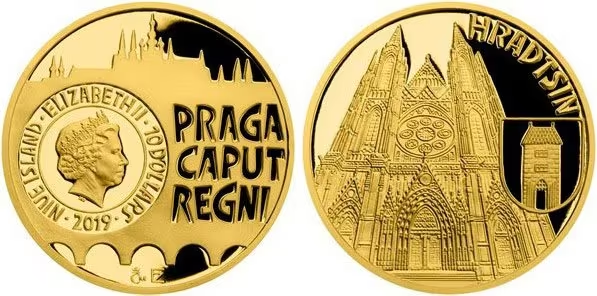
Zlatá mince 2019 - Hradčany
Česká republika (1993 - ) Zlatá čtvrtuncová investiční mince 2019 (Zbyněk Fojtů) - Vznik královského hlavního města Praha - Hradčany Au 0,9999, 22 mm (7,78 g), náklad 500 ks, certifikát, etue, papírový přebal, PROOF Čtyřdílnou minisérii zlatých mincí…