Margaret Thatcher
Margaret Thatcher (1925–2013) was a British Conservative politician and Prime Minister of the United Kingdom from 1979 to 1990. She became famous for her vigorous economic policy, her emphasis on limiting the role of the state and her uncompromising leadership style, by which she earned the nickname the "Iron Lady".
Margaret Thatcher, born Roberts, was born on 13 October 1925 in Grantham in the county of Lincolnshire. She grew up in the environment of a small-town shop and a Methodist family, which shaped her emphasis on personal responsibility, hard work and thrift. She studied chemistry at Somerville College, Oxford, where she also engaged in university politics. After her studies she worked as a research chemist and later qualified as a barrister specialising in tax law. This professional foundation was later reflected in her view of the functioning of the state, public finances and the role of the private sector.
She fully entered national politics after being elected Member of Parliament for the Finchley constituency in 1959. In the 1970s she rose rapidly in the Conservative Party, and in 1970 she became Secretary of State for Education and Science. Five years later she took over the leadership of the party, and as Leader of the Opposition she spoke out against the then prevailing economic policy and against the growing role of the state in the economy. When the Conservatives won the 1979 election, she took up the office of Prime Minister as the first woman to head a British government; she remained at the head of the cabinet until 28 November 1990 and won three consecutive general elections (1979, 1983, 1987).
Her government is associated with a profound transformation of the British economy and society. In the 1980s she pursued the liberalisation of the market, the privatisation of state enterprises, the curbing of trade-union power and the restructuring of industry. These steps were intended to tame inflation and increase competitiveness, but at the same time they brought significant social consequences in regions dependent on traditional heavy industry. One of the sharpest clashes was the long and socially polarising miners' strike of the mid-1980s, which became a symbol of the dispute over the shape of modern Britain.
History
In foreign policy she strengthened transatlantic ties and was closely associated with cooperation with American President Ronald Reagan. The international prestige of her government rose markedly after the United Kingdom's victory in the Falklands War of 1982. During the late Cold War she was also able to negotiate with the Soviet leadership; her pragmatic approach to dialogue with Mikhail Gorbachev is often mentioned as one of the factors that helped reduce tensions between East and West. Her relationship with European integration was more complicated: she supported the common market but firmly opposed the strengthening of supranational political power, which foreshadowed later debates within British politics.
In the late 1980s, dissatisfaction accumulated within her own party with some domestic measures and with a leadership style that often rested on the strong authority of the Prime Minister. A contentious point was also the reform of local taxes known as the "community charge" (often referred to as the "poll tax"), which provoked protests. After an internal challenge to the Conservative leadership and the loss of support of part of the cabinet in 1990, she resigned. In 1992 she received a life peerage and took her seat in the House of Lords as Baroness Thatcher. She died on 8 April 2013 in London; her legacy remains to this day one of the most debated in modern British history.
Thatcher pursued a policy that placed emphasis on market mechanisms, on limiting state expenditure and on having economic decisions borne more by companies and individuals than by the state. In practice this manifested itself in privatisations, deregulation of part of the financial sector and an effort to change the relationship between government, business and trade unions. She also supported the idea of a "property-owning society" — for example, by selling council houses to their tenants, which was meant to strengthen private ownership, but at the same time changed the structure of the housing stock and provoked long-term debates about the affordability of housing.
Politics, style of government and commemoration in culture
Her political style is described as very decisive, sometimes confrontational. For her supporters she represented the renewal of national self-confidence and a clear direction at a time of economic difficulties; for her critics she symbolised growing inequality and harsh effects on some communities. In the international context she became an icon of 1980s conservative politics, not only in the United Kingdom but also in the wider Western debate on the role of state and market.
Margaret Thatcher is often commemorated in culture, journalism and collector circles. There are, for example, commemorative medals and collector mintages issued by various issuers and overseas territories that have responded to key moments of her life and career. These items are mostly not intended for circulation as ordinary coins but function as commemorative or collector strikes that illustrate how strongly her personality penetrated the public symbolism of the late 20th century.
In our auction and shop
- Code: NASA-1181
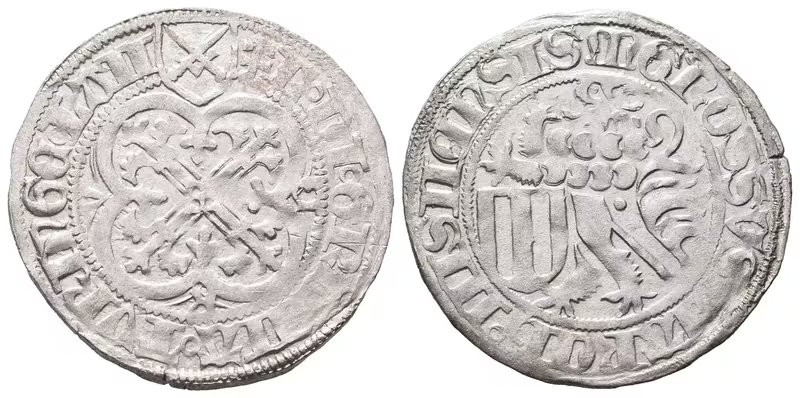
Sasko - Míšeň, Mečový groš, Colditz
Sasko - Míšeň, Friedrich II. a Margaretha (1456 - 1464) Schwertgroschen b.l. (1457 - 1464), Colditz, Krug.1181/77-78, stav 1/1, pěkná zachovalost, pěkně vyražený, drobné rysky
Skladem 1 ks - Code: SDANS89-C1958
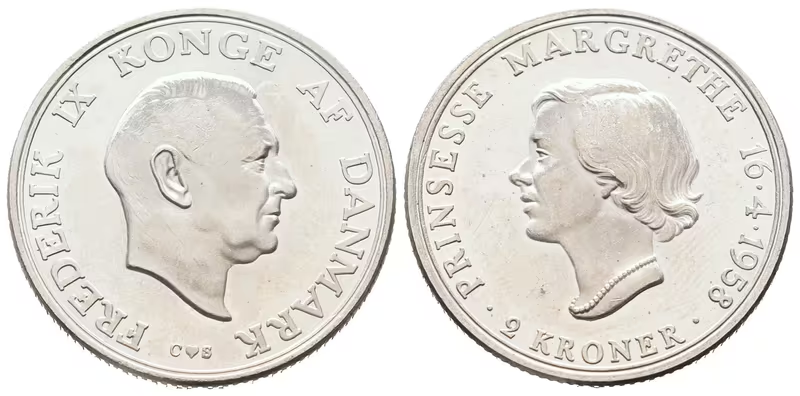
2 Kroner 1958 - Narozeniny princezny
Dánsko, Frederik IX. 1947 - 1972 2 Kroner 1958 - 18. narozeniny princezny Margarety, KM.845, krásná zachovalost, ražební lesk Ag 0,800, 31 mm (15,0 g)
Skladem 1 ks - Code: SDANS89-C1958.1
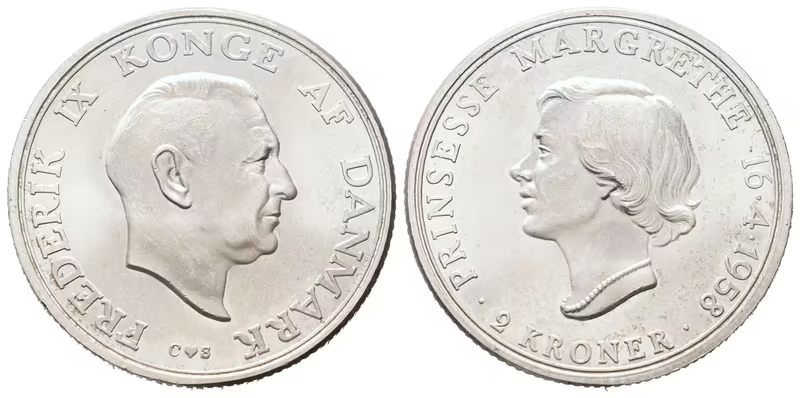
2 Kroner 1958 - Narozeniny princezny
Dánsko, Frederik IX. 1947 - 1972 2 Kroner 1958 - 18. narozeniny princezny Margarety, KM.845, krásná zachovalost, ražební lesk Ag 0,800, 31 mm (15,0 g)
Skladem 1 ks - Code: NARAD-1317
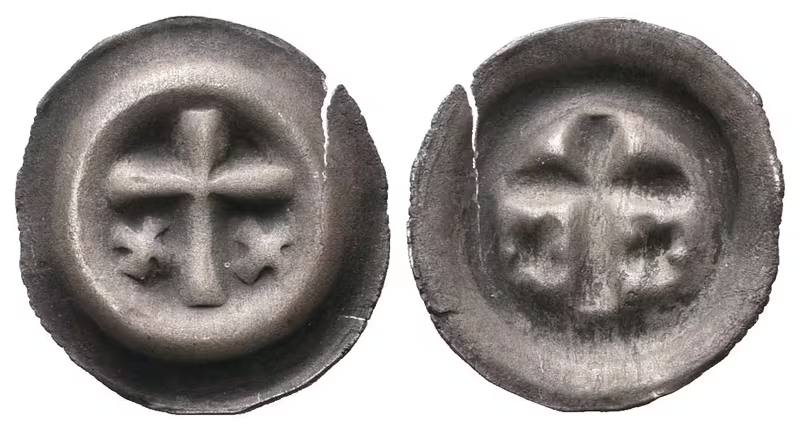
Němečtí rytíři, Brakteát
Řád německých rytířů, Werner von Orseln?,1317 - 1328 Malý brakteát - Latinský kříž, pod. Paszkiewicz T9.32, pěkná zachovalost a patina, lehce napr.
Skladem 1 ks