Bear market
A bear market denotes a prolonged period during which prices on financial markets fall significantly and investor pessimism prevails. Most often it refers to a decline of a broad equity index by at least 20% from its previous peak, accompanied by weaker demand, greater caution and often also an economic slowdown.
The term bear market arose in the environment of Anglo-American stock exchanges and gradually became a colloquial way to describe phases when the market "turns downward". The image of the bear is not accidental: in stock-exchange tradition "bulls" (optimists pushing prices upward) and "bears" (pessimists betting on a decline) stand opposed. More important than the metaphor itself, however, is the fact that markets have historically moved in cycles and significant declines have recurred — sometimes as short, sharp drops, at other times as protracted periods of gradual weakening.
In modern financial history, bear markets have appeared in various forms and from various causes. Sometimes they are triggered by market overheating and the subsequent bursting of a price bubble, at other times they are set off by a banking crisis, a geopolitical shock, a sharp rise in interest rates, or a sudden deterioration in economic prospects. It is common that the slump does not arise "from a single cause" but rather as a chain reaction: investors begin reducing risk, liquidating positions, nervousness grows and the decline thereby accelerates itself.
History shows that a bear market can have various dynamics. Sometimes it unfolds as a rapid fall followed by an equally rapid upward correction. At other times it may last months or years, with prices dropping in several waves. In such periods expectations are often reassessed — investors concentrate more on the quality of companies, their indebtedness, their ability to generate cash and on the stability of the entire financial system. Part of the "bear phase" also tends to be a worsening of mood in the media and in public debate, which can in turn affect consumption and investment in the real economy.
History
A significant feature of bear markets is their psychological dimension. Falling prices can intensify fear and lead to hasty decisions, whereas growth conversely encourages self-assurance and a willingness to take risks. Bear markets are therefore often described not only by numbers but also by atmosphere: a decline in the willingness to buy, a higher share of cash in portfolios and a shift of interest towards "safer" assets. This does not always mean that everything falls equally — even in a bear market some sectors or commodities may rise if they happen to benefit from circumstances (for example from inflation, an armed conflict or regulatory change).
In practice, a bear market is most often defined by the "minus 20%" threshold for a major index relative to its previous peak. This is, however, more of a guiding definition: for the investor it is more important to consider a combination of several signs — a more persistent series of declines, worsening sentiment, an increase in volatility (larger daily swings) and often also weaker economic data. In a bear market sensitivity to news usually increases, the gap between high-quality and risky firms widens and the market more severely punishes high indebtedness or uncertain business models.
A frequent accompanying phenomenon is the shift of capital into assets perceived as more stable, typically into government bonds of advanced countries, cash or defensive sectors. At the same time, interest in "hedging" against uncertainty may strengthen, for example through derivatives, or in assets that carry a different type of risk than equities. It is important, however, to distinguish between a short-term correction and a genuine bear market: a correction tends to be quicker and shallower, whereas a bear market is associated with a deeper break in expectations and a longer period of uncertainty.
How to recognise a bear market and what usually accompanies it
In investment practice the term is used mainly as a description of a market phase, not as a precise "forecast". For laypersons a useful rule of thumb may be that bear markets are a normal part of the cycle and historically alternate with periods of growth. When assessing the situation one therefore watches not only the decline itself but also its causes, the response of central banks, the state of the economy and whether signs of stabilisation appear (for example, slowing inflation, easing credit conditions or a return to corporate profitability).
In our auction and shop
- Code: SGRO-A1989
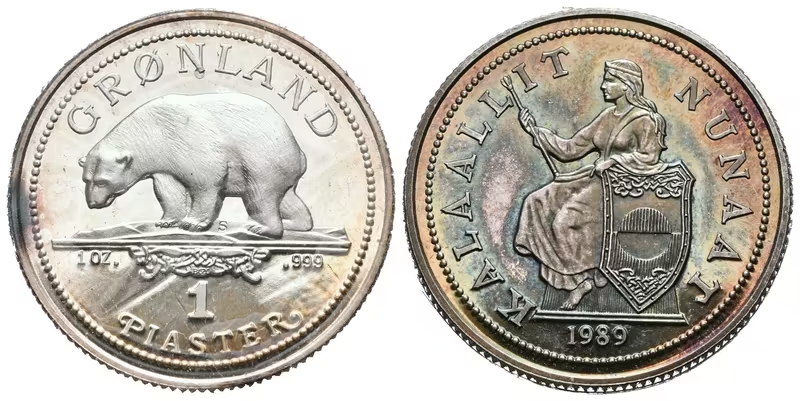
Grónsko, 1 Piaster 1989 - Lední medvěd; alegorie Grónska se štítem
Soukromý vydavatel (fantasy issue, 1987-2012) 1 Piaster 1989 - Lední medvěd; alegorie Grónska se štítem Ag (.999), 32 mm (31,6 g), BU, v kapsli. Stav mince odpovídá fotografii.
Skladem 1 ks - Code: SKAN90-N2011G
Kanada, 5 Dollars 2011 - Medvěd Grizzly
Elizabeth II. (1952 - 2022) 5 Dollars 2011 - Medvěd Grizzly Ag 0,9999, 38 mm (31,1 g), 1 Oz, běžná kvalita Medvěd grizzly (Ursus arctos horribilis) známý také jako medvěd hnědý severoamerický nebo jednoduše grizzly, je populace nebo poddruh medvěda…
- Code: SKAN90-N2011GZ
Kanada, 5 Dollars 2011 - Medvěd Grizzly
Elizabeth II. (1952 - 2022) 5 Dollars 2011 - Medvěd Grizzly částečně zlacené Ag 0,9999, 38 mm (31,1 g), 1 Oz, běžná kvalita Medvěd grizzly (Ursus arctos horribilis) známý také jako medvěd hnědý severoamerický nebo jednoduše grizzly, je populace nebo…
- Code: SKAN90-K2012
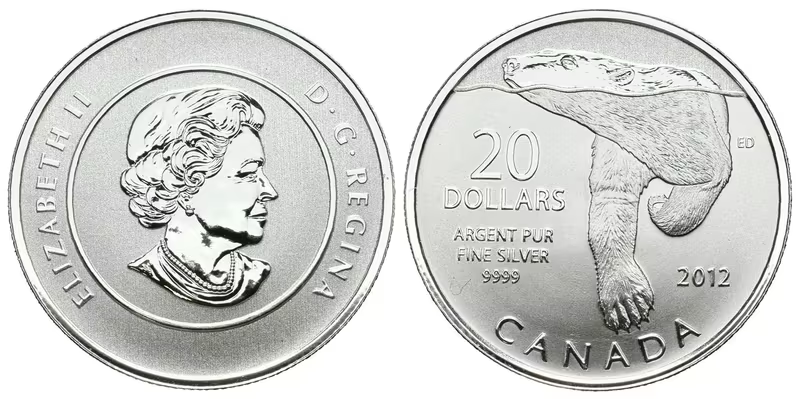
Kanada, 20 Dollars 2012 - Medvěd lední
Elizabeth II. (1952 - 2022) 20 Dollars 2012 - Medvěd lední, KM.1226 Ag 0,9999, 27 mm (7,96 g), Specimen finish, kapsle