Noah
Noah is an Old Testament biblical figure associated with the story of the Flood. According to the Book of Genesis he was chosen to build an ark, save his family and animals from destruction and become the recipient of God's covenant, the sign of which is the rainbow.
The story of Noah belongs to the best-known passages of the Book of Genesis (especially chapters 6-9). The biblical text presents him as a man who "walked with God" and who, in an environment of general corruption, stood out by his righteousness. The motif of the Flood is presented in the narrative itself as a judgement upon human violence and moral decline, but at the same time as an opportunity for a new beginning. Noah here appears in the role of mediator of salvation: he receives precise instructions for building the ark, into which he is to enter with his wife, three sons and their wives; along with them the species of animals are also to be preserved. The Bible at the same time emphasises obedience and perseverance - Noah does not act on his own initiative, but on the basis of God's command.
After the Flood has subsided the story does not continue merely with a "happy ending", but passes over into the theme of restored order. In Genesis God's covenant is then formulated with Noah and with "every living creature", and the rainbow becomes its visible sign as a reminder of the promise that a similar flood will not again be a means of destroying all life. This passage belongs to the fundamental biblical images of mercy and at the same time of human responsibility for the world in which we live. Part of the "Noachic" narrative is also a genealogical framework: Noah is regarded as the forefather of a new humanity and his three sons - Shem, Ham and Japheth - are listed as the starting point for the further settlement of the earth.
History
In the Jewish tradition Noah has his place not only as the hero of the Flood, but also as a figure to whom broader reflections on righteousness and human responsibility are attached. Christian interpretation often works with the symbolism of the ark as an image of salvation and new life, while the Flood itself can be read as a warning of the consequences of human action. The narrative of Noah has significantly influenced European culture: from mediaeval illuminations and sermons through Baroque visual art to modern literature. It is also important that the name Noah has become part of everyday language - "Noah's Ark" today denotes not only the biblical vessel but also a general image of "saving what is essential" in times of crisis.
A modern approach often treats the story in a multi-layered way: for believers the text remains a religious message, in the academic environment its literary structure, symbolism and relation to broader ancient traditions of a flood are studied. Regardless of interpretation, however, Noah represents one of the key figures of the biblical narrative, in whom the themes of judgement, hope and a new beginning are interwoven.
Motifs and significance in tradition
The story of Noah is built on several powerful motifs. The ark is an image of protection and the preservation of life amid chaos; in the text it is not just a technical structure, but a "space of survival" that arises through obedience and trust. The Flood represents a radical break with the old order - biblical symbolism here works with water as a force that can both destroy and cleanse. And finally, the rainbow in the role of the sign of the covenant reminds us that the renewed world is not merely a return to the original state, but carries within itself a promise and an obligation.
In cultural history Noah appears as an archetype of "the righteous man amid corruption" and also as an image of someone who prepares for a threat that others do not take seriously. For this reason his name is used outside the religious context as well - for example as a metaphor for a rescue project, refuge or considered prevention. At the same time it remains true that the biblical text does not idealise Noah into a flawless hero; rather, it shows a man who stands firm at the decisive moment and so gains a place in the history of religious and cultural memory.
In our auction and shop
- Code: SARM-H2023
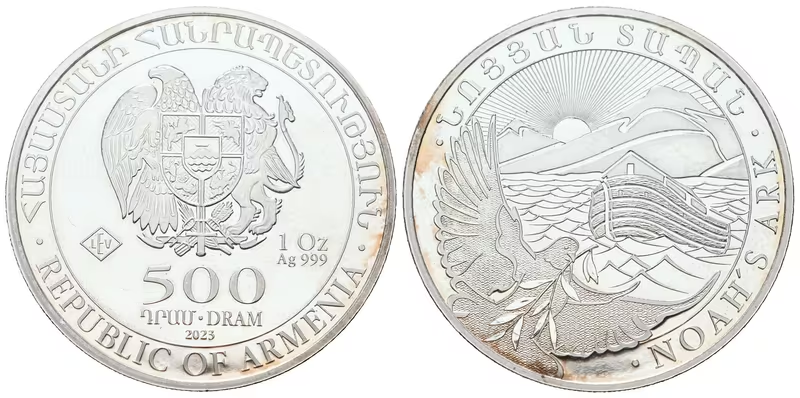
Arménie, 500 Dram 2023 - 1 Oz (Noemova archa)
Arménská republika (1993 -) 500 Dram 2023 - 1 Oz (Noemova archa), KM# 196 Ag (.999), 38,6 mm (31,1 g). Stříbrná investiční mince. Ze série "Noah's Ark" (Noemova archa). Mincovna: Leipziger Edelmetallverarbeitung GmbH - Německo. Lit.: KM# 196.
Skladem 1 ks - Code: ZD-2009SVA2
Medaile 2009 - Svatováclavská medaile
Česká republika (1993 - ) Medaile 2009 (Milan Knobloch) - Svatováclavská medaile k poctě papeže Benedikta XVI. Au 0,999, 34 mm (31,1 g), 1 Oz, vyraženo pouze 90 ks Benedikt XVI. (občanským jménem Joseph Ratzinger , ( 16. dubna 1927 Marktl – 31. prosince…
Skladem 1 ks - Code: ZD-2009SVA1.E
Medaile 2009 - Svatováclavská medaile
Česká republika (1993 - ) Medaile 2009 (Milan Knobloch) - Svatováclavská medaile k poctě papeže Benedikta XVI. Au 0,999, 34 mm (62,11 g), 2 Oz, vyraženo pouze 150 ks, etue Benedikt XVI. (občanským jménem Joseph Ratzinger , ( 16. dubna 1927 Marktl – 31.…
Skladem 1 ks - Code: SARM-H2025
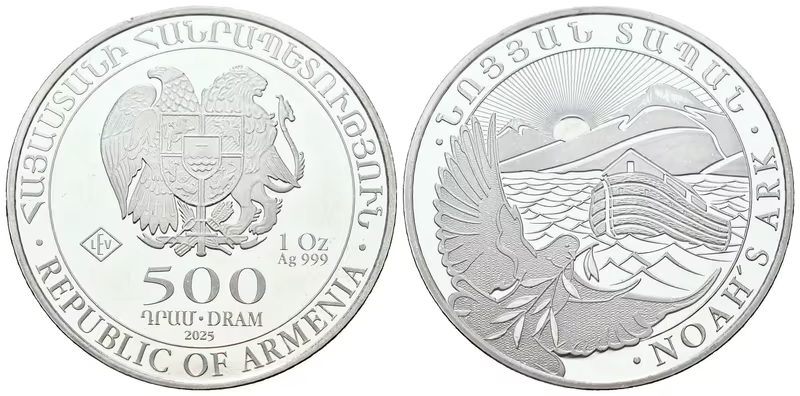
Arménie, 500 Dram 2025 - 1 Oz (Noemova archa)
Arménská republika (1993 -) 500 Dram 2025 - 1 Oz (Noemova archa), KM# 196 Ag (.999), 38,6 mm (31,1 g), v kapsli. Stříbrná investiční mince. Ze série "Noah's Ark" (Noemova archa). Mincovna: Leipziger Edelmetallverarbeitung GmbH - Německo. Lit.: KM# 196.