Pětka (five-piece)
Pětka was the popular designation for the Austrian five-gulden banknote with a value of 5 gulden. After the introduction of the koruna currency in 1892, the name passed over to the Czechoslovak koruna, because the previous 1 gulden was equal to 2 koruna.
The term "pětka" arose in the 19th century as a popular name for the Austrian five-gulden banknote, which was commonly used in the Habsburg Monarchy. These banknotes represented a middle denomination suitable for everyday payments and quickly gained popularity among the population. The gold standard was the basis of the Austrian monetary system, and the five-gulden banknote was a practical alternative to heavy coins for larger purchases. With the monetary reform of 1892 came the transition to the koruna system, in which 1 gulden was replaced by 2 koruna, which meant that the former "pětka" corresponded to 10 koruna. Popular speech, however, retained the original designation and "pětka" began to be used for the ten-koruna banknote or coin. This linguistic continuity attests to how strongly the popular names of monetary units were anchored in the daily life of the population of the Austro-Hungarian Monarchy.
History
The use of the term "pětka" for the ten-koruna persisted in various forms throughout the 20th century and is still occasionally heard in colloquial Czech today. In the period of the First Republic this expression was still alive and commonly used, especially among the older generation, who remembered the original Austrian conditions. Czechoslovak ten-koruna pieces were thus often popularly called "pětky" regardless of the fact that their official value was 10 koruna. After the monetary reforms following the Second World War and the changes in the political system, the use of this term gradually narrowed, but it never disappeared entirely. The etymological study of popular names of monetary units shows how financial terminology evolves and adapts to changing economic conditions. "Pětka" thus represents an interesting example of linguistic persistence, in which a historical name has been retained even after fundamental changes in the monetary system. Similar phenomena may be observed in other popular names of coins and banknotes, which often survive official changes of denomination and monetary reforms.
In our auction and shop
- Code: SRWAN90-X2010
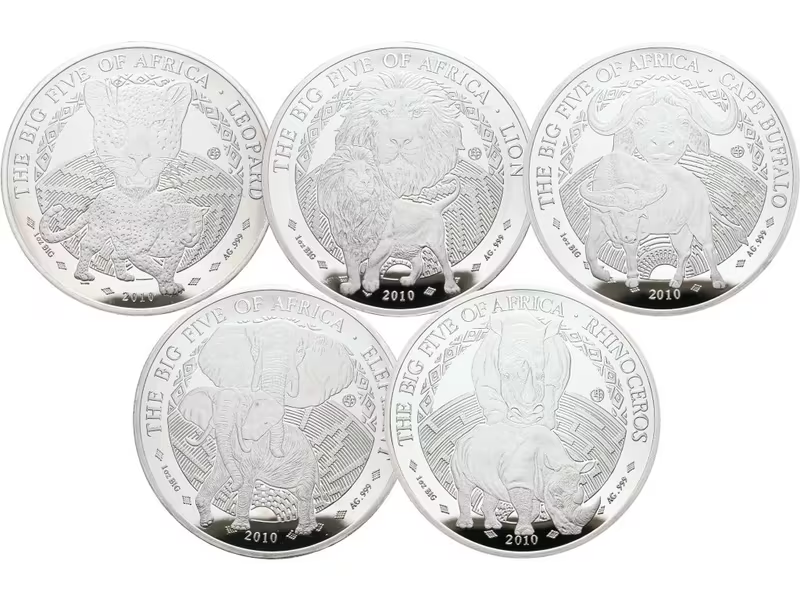
Rwanda, Big Five - sada stříbrných mincí Afrika
Rwanda 500 Franks (Amafaranga) 2010 - Big Five (Africká pětka), největší unce světa Ag 0,999, 65 mm (31,1 g), 1 Oz, Proof, dřevěná etue, celkem 5 ks The Big Five of Africa - Velká africká pětka Pět hlavních zástupců zvířecí říše Afriky na největších…