Protestant Union
The Protestant Union was a defensive political and military alliance of Protestant princes and free imperial cities of the Holy Roman Empire, concluded in 1608. It arose in response to mounting recatholicising pressure and confessional disputes and existed until 1621.
The origin of the Protestant Union must be understood against the background of long-term tension within the Holy Roman Empire after the Reformation. The basic framework for the coexistence of Catholics and Lutherans was set out by the Peace of Augsburg (1555), which, however, left a number of questions unresolved and moreover excluded certain other branches of the Reformation from its protection. At the turn of the 16th and 17th centuries, the pressure of the Counter-Reformation and disputes over Church property, jurisdiction and public expressions of faith were added. In practice this meant that local conflicts — sometimes seemingly "only" about a procession, a church or municipal rights — quickly grew into imperial politics and into mutually opposed blocs.
One of the immediate stimuli was the case of the free imperial city of Donauwörth, where religious clashes escalated to such an extent that the city was eventually occupied and subjected to intervention by Maximilian I of Bavaria. The Protestant estates perceived this as a warning: if the status of an imperial city could be intervened in in such a way, the same procedure might be repeated elsewhere. At the same time, the question of the restitution of ecclesiastical property was being reopened at imperial diets, which for many Protestant princes and cities had direct economic and power consequences. In this atmosphere some Protestant rulers decided to create a common defensive league.
The Union was proclaimed in 1608; the main initiator and "director" of the league became Frederick IV of the Palatinate. Alongside him, Christian of Anhalt-Bernburg also played a prominent role; he was among the chief organisers of the military side and sought to expand and consolidate the alliance. The Protestant Union included both princes and free imperial cities and — which was politically significant — brought together both Lutheran and Calvinist states. This very diversity, however, was from the outset a source of tension: the differing interests of territorial rulers and cities were difficult to align, and moreover some powerful Protestant players (typically Saxony) did not take part, choosing a more cautious, waiting policy.
History
The Catholic side's response was not long in coming. In 1609 the Catholic League came into being, whereby the confessional fracturing of the empire was transformed into a more open system of competing security blocs. The Union became involved in some disputes of imperial politics, among others in connection with the succession conflicts in the western part of the empire, but its actual cohesion proved fragile. The decisive test came with the situation after the outbreak of the Estates' Revolt in the Czech lands and the subsequent expansion of the conflict, which is regarded as the beginning of the Thirty Years' War.
In 1619 the Elector Palatine Frederick V of the Palatinate accepted the Bohemian royal crown, whereby the conflict with the imperial court dramatically sharpened. For part of the Protestant allies, however, this was not a purely "defensive" matter but a risky escalation that could draw them into an extensive war. The Union therefore gradually moved towards a policy of restraint and in 1620 concluded neutrality with the Catholic League (known as the Treaty of Ulm). After the defeat of the Estates' armies at the Battle of White Mountain (1620) and the subsequent imperial measures, the scope for the Union's functioning rapidly narrowed. Ferdinand II pressed for its disarmament and dissolution; in 1621 the Protestant Union was formally terminated. Although other coalitions later emerged in the Protestant camp (for example the Heilbronn League in the 1630s), these were already new arrangements in a different phase of the war.
The Protestant Union operated as a treaty-based league intended to provide member states and cities with mutual support in the event of threat. In practice this meant coordination of diplomacy, agreement on common action and, where necessary, the summoning of military forces. At the head stood a "director" (initially Frederick IV of the Palatinate, later the Palatine line represented by Frederick V of the Palatinate), but what was crucial was how individual members, who often had differing priorities, were able to agree on joint decisions. Cities typically looked to the protection of trade and rights; princes to the security of frontiers and to dynastic interests.
Organisation and significance in practice
A weakness of the Union was not only the internal religious diversity (Lutherans versus Calvinists), but also the differing willingness to bear costs and to risk open conflict. This was particularly evident at the moment when the conflict shifted from the level of "defence of imperial rights" into a direct confrontation with the emperor and the Catholic League. The neutrality of 1620 provided some members with short-term protection, but at the same time weakened the ability of the Protestant camp to act in unison. For the wider history of Central Europe the Union is significant chiefly as a forerunner of bloc politics, which accelerated the path to the Thirty Years' War.
From the standpoint of economic and social impacts it is important that the period in which the Union existed passed into the years of wartime destabilisation. The Thirty Years' War then led, in many lands of the empire, to extraordinary financial measures, an increase in the tax burden and, in some areas, to monetary upheavals that are reflected in the history of minting (emergency strikings, debasement of currency or efforts at reform). The Protestant Union itself was, however, above all a political-military instrument: its "legacy" is read above all in diplomatic documents, coalition treaties and in the transformation of the balance of power in the empire on the threshold of a great European conflict.
In our auction and shop
- Code: ZD-3005VALD
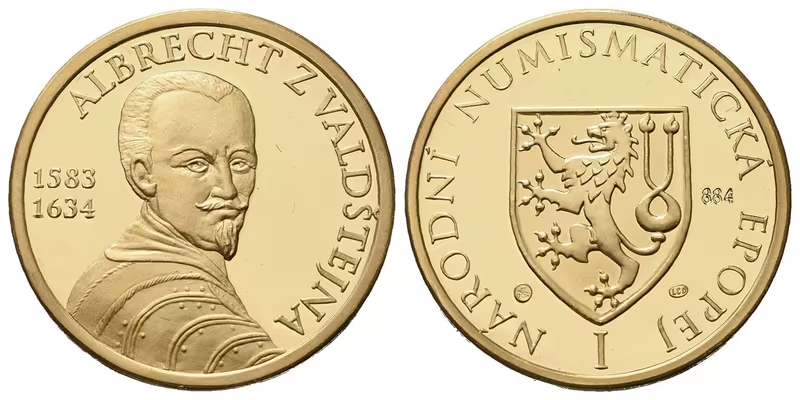
Medaile b.l. - Albrecht z Valdštejna - Národní numismatická epopej
Česká republika (1993 - ) Medaile b.l. (Luboš Charvát) - Albrecht z Valdštejna Au 0,999, 25 mm (7,15 g), certifikát, etue, PROOF Cyklus medailí Národní numismatická epopej Albrecht Václav Eusebius z Valdštejna (nebo také Vojtěch Václav Eusebius z…