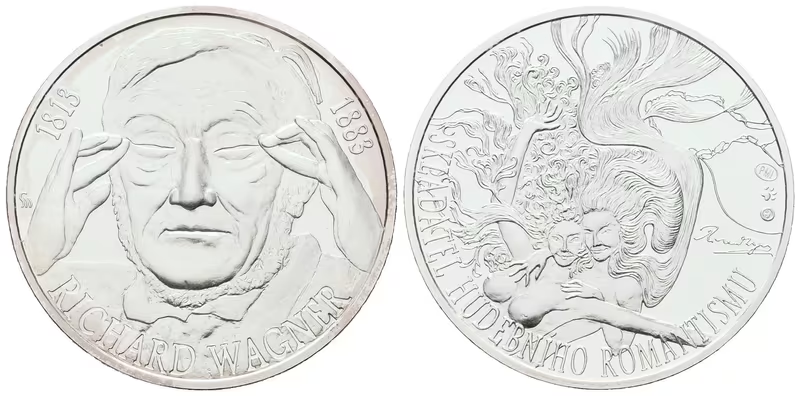
Richard Wagner
Richard Wagner (1813-1883) was a German Romantic composer, reformer of opera, and the author of the libretti to his own works. He became famous for his concept of music drama, his rich orchestral language, and his system of leitmotifs.
Richard Wagner was born on 22 May 1813 in Leipzig and gradually became one of the most influential figures of 19th-century European music. Already in his early years he was interested not only in composition but also in theatre and literature - it was typical of his further development that he did not want to settle for the role of "supplier of music" but strove for a unified stage form in which music, word, gesture, and visual aspect together form a single whole. This vision later became associated with the concept of Gesamtkunstwerk (total work of art), which became one of the key expressions of Wagnerian aesthetics.
After his first engagements in theatres outside the major centres and after compositional experiments, he established himself with operas in which he still drew on Romantic tradition, while also seeking his own path. Among his early successes were The Flying Dutchman, Tannhauser, and Lohengrin, in which his interest in legends, myth, and medieval symbolism is markedly evident. During this period he also gained experience with conducting and operatic management, which he later used in promoting his own staging ideas.
A fundamental turning point came in the years around the revolutionary events of 1848 and the Dresden uprising (1849), after which he found himself in a politically dangerous situation, followed by long years outside Germany. Paradoxically, exile (in Switzerland, among other places) was very productive for him: here he formulated his theoretical views on music drama and worked on works that marked a turning point in the history of opera. It was during this period that the plan for the monumental tetralogy The Ring of the Nibelung gradually came into being, drawing on Germanic and Norse myths, in which the composer combined music and libretto into a unified structure.
History
In the 1860s, his situation improved significantly thanks to the support of Ludwig II of Bavaria, an admirer of Wagner's work. The monarch helped him stabilise his financial and social position; nevertheless, in Munich Wagner was at the same time a source of disputes and resistance from a part of the public and politicians. Wagner's life was long marked by conflicts - artistic, personal, and ideological - and also by the shadows of his journalism, which provokes controversy to this day.
The pinnacle of his artistic and organisational ambition became Bayreuth. In 1871 Wagner chose this town as the site for his own festival theatre, and between 1872 and 1875 the Bayreuth Festival Theatre was built there according to his conceptual requirements (executed by the architect Otto Bruckwald). In 1876 the first Bayreuth Festival took place, accompanying the premiere of The Ring of the Nibelung, thus founding a tradition that to this day is among the most important operatic events in the world. Wagner died on 13 February 1883 in Venice, but his aesthetic and approach to music drama continued to influence composers, directors, and cultural debates throughout Europe.
Wagner's work is characterised by a shift from the "number" opera to a continuous dramatic flow. One often speaks of the so-called endless melody, in which the music flows without sharp dividers between arias and ensembles, and of elaborate orchestration in which the orchestra is not merely an accompaniment but an active bearer of meaning. A fundamental role is played by leitmotifs (characteristic motifs) - short musical ideas associated with characters, objects, or ideas, which transform during the work and help the listener to navigate both the plot and the psychology of the characters.
Work and features of the Wagnerian style
Among the best-known Wagnerian works, alongside the tetralogy The Ring of the Nibelung, are also Tristan and Isolde, often cited as a milestone in 19th-century harmonic thinking, then Die Meistersinger von Nurnberg, and the late Parsifal, which Wagner associated with the idea of a ceremonial "stage consecration play". Specific too is the fact that Wagner wrote his libretti himself and built them on mythical or legendary material, in order to create timeless models of human conflict (power, desire, guilt, redemption, loyalty). In staging practice his works are often associated with high demands on singers, orchestra, and directorial conception, which is one of the reasons why an exceptionally strong interpretative tradition has formed around Wagner, as well as a lively, sometimes sharply divided, field of opinion.
In our auction and shop
- Code: RG-2013RIWA
AR Medaile b.l. (2013) - Richard Wagner - 200. výročí narození
Česká republika (1993 - ) AR Medaile b.l. (2013, Miroslav Schovanec) - 200. výročí narození Richarda Wagnera (1813 - 1883) Ag 0,999, 37 mm (31,1 g), 1 Oz, číslo 146 (raženo 616 ks), kapsle, etue, certifikát, PROOF Stříbrná pamětní medaile z cyklu…
Skladem 1 ks