Congress of Vienna
The Congress of Vienna was a major diplomatic conference of European powers in 1814–1815 that, after the Napoleonic Wars, redrew the map of Europe. Its aim was to restore stability, return legitimate dynasties and set rules so that a similarly extensive conflict would not recur.
The Congress of Vienna convened after the fall of Napoleon and after exhausting wars that, over two decades, had altered borders, states and the conduct of politics. Europe needed not only a peace treaty with defeated France but, above all, a new system that could maintain a long-term balance between the great powers. Vienna became the venue for the negotiations, and the principal players were Austria, Russia, Prussia and Great Britain; France, though defeated, was able through skilful diplomacy to re-enter the negotiations and avoid being permanently pushed to the margins.
The Austrian negotiations were led by Klemens Wenzel Lothar Metternich, who advocated the idea of conservative stability: in his view, Europe should be held together by traditional dynasties, intelligible rules and the rejection of revolutionary experiments. The congress therefore relied on the principle of legitimacy, that is, the return of "rightful" ruling houses, and at the same time on the principle of the balance of power. It was not about ideal justice but about practical politics: ensuring that no state would become so strong as to dictate to the others.
The negotiations were complex and often resembled behind-the-scenes bargaining. The greatest tension arose over the territorial gains of Prussia and Russia. Russia sought decisive influence in Poland, Prussia wanted to strengthen its position in the German space and acquire strategic territories. The other powers tried to prevent the victors from becoming a new hegemon. The result was compromises that did not satisfy everyone but created a framework in which the great powers checked one another.
History
In practice the congress brought a number of concrete changes. France returned to borders close to those before the revolutionary expansion and was to be "surrounded" so that it could not easily threaten its neighbours again. The United Kingdom of the Netherlands was created to form a buffer on the northern border of France. In the German space a German Confederation was established as a loose association of states, meant to replace the dissolved Holy Roman Empire and at the same time prevent excessive strengthening of a single centre. Austria retained marked influence in Italy and in central Europe, Prussia acquired important areas that later supported its rise, and Russia consolidated its position in eastern Europe.
Part of the post-war settlement was also an effort towards a "system" of cooperation. The victorious powers agreed that they would act together on key issues and intervene early against crises. This practice is sometimes described as the European Concert of great powers: it was not a unified organisation, but rather a habit of regularly balancing conflicts through diplomacy before they grew into a continental war. This framework genuinely contributed to the fact that Europe did not experience a conflict comparable to the Napoleonic Wars for most of the 19th century, even though there were plenty of local and regional wars.
The Congress of Vienna is often summed up by three concepts: legitimacy, balance of power and conservative stability. In practice this meant the restoration of dynasties, caution towards revolutionary movements and an attempt to "brake" rapid changes that might once again disrupt Europe. From today's perspective this approach can be evaluated in various ways: it brought a long period of relative calm among the great powers, but at the same time it suppressed the national and liberal aspirations that later returned anyway in revolutions and unification processes.
Principles, impacts and connections with money
The impacts of the congress are clearly visible also in economic and state finances. After years of war, states had to stabilise budgets, repay debts, restore trade and reset administration. This is indirectly reflected even in coins: a peaceful period usually improves the regularity of minting, allows parameters to be standardised and supports the broader circulation of quality denominations. In central Europe, moreover, the role of large state units was strengthened; their administration and taxes created the preconditions for a more extensive and more uniform monetary environment than had existed in the fragmented conditions of preceding centuries.
For collectors, the Congress of Vienna is also interesting as a "time threshold" on coins and medals. Many monarchs and states issued commemorative medals recalling the defeat of Napoleon, the restoration of peace or the new settlement. On circulating coins changes are often manifested in titulature and symbols: the return of dynasties and the emphasis on legitimacy is reflected in how rulers present their titles and state arms. If someone collects the 19th century, the Congress of Vienna is an excellent point of orientation, because it helps to place the coins of individual countries within a broader story: from the revolutionary era through the Napoleonic Wars to the Restoration and the subsequent transformations of Europe.
In our auction and shop
- Code: ZSRAK2-F1994
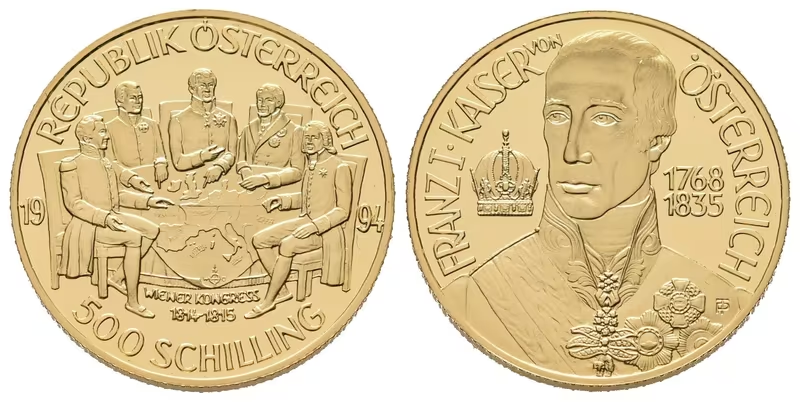
Rakousko, 500 Schilling 1994 - Císař František I.
Rakousko, II. republika (1945 - ) 500 Schilling 1994 - Císař František I. - Vídeňský kongres, Au 0,986, 22 mm (8 g), kapsle, certifikát, PROOF