
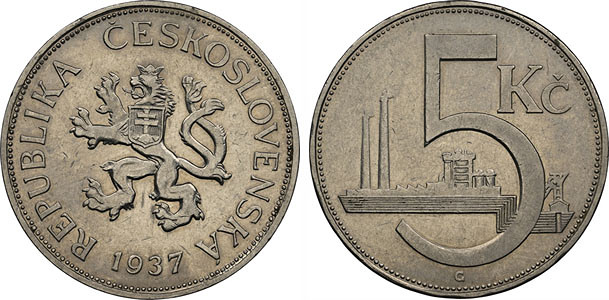
Why the switch to nickel came in 1937
- The silver problem — silver five-koruna coins and other similar pieces became unsustainable in the 1930s.
- Hardness and durability — pure nickel was expected to withstand circulation and daily use better.
- Legislative basis — the change was enabled by Act No. 36/1937 Coll.
It is precisely the combination of an experiment, a low number of pieces and the very limited survival rate that makes this coin an exceptionally strong collector's item.
Production timeline
| Date | Event |
|---|---|
| 30 November 1936 | The Ministry of Finance proposes a five-koruna coin made of pure nickel. |
| 4 March 1937 | The obverse design bearing the year 1937 is completed. |
| 6 April 1937 | Sandrik Dolné Hámre wins the contract to supply the nickel planchets. |
| 22 September 1937 | The Kremnica mint is cleared to begin striking when capacity allows. |
| 7 October 1937 | The pilot run of 8,000 pieces is launched. |
| 1 May 1938 | The coin is declared legal tender. |
Specifications
| Specification | Value |
|---|---|
| Material | Ni 100% |
| Diameter | 27 mm |
| Weight | 8 g |
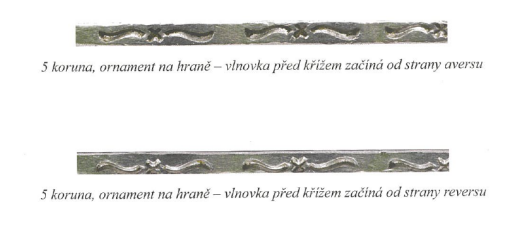
| Edge | Plain, with a deeply engraved “wave–cross–wave” ornament |
| Designer | Otto Gutfreund |
| Rarity | RR |
Watch the edge: the orientation of the wave motif is random. This is what creates the mirror-image variants that collectors have long tracked.
How many pieces actually survive
Archive records show that the nickel planchets did not reach Kremnica until late September 1937 and that production ran on only some of the presses. The entire pilot run was struck, but some pieces were used for testing and some probably disappeared outside the official channels.
Today's estimates broadly agree on around 2,000–3,000 surviving pieces in any grade. Only a few dozen pieces survive in genuinely top grade.
How to spot a genuine piece in 60 seconds
- Magnet — pure nickel is mildly ferromagnetic; how the metal behaves is the first filter.
- Weight and diameter — 8.00 ± 0.05 g and 27.00 ± 0.05 mm.
- Edge — the ornament must be sharply engraved in relief, not soft and flat.
- The lion device — Gutfreund's lion is finer than on the earlier silver five-koruna coins.
- Certification — for strong pieces above 100,000 CZK, an NGC or PCGS holder is almost standard.
Investment potential
- First Republic + pure nickel + low mintage make for a liquid collector's item
- a strong origin story gives the coin added cultural and auction appeal
- the fact that it is not a widely known rarity still leaves room for awareness and prices to grow further
Next step
Do you have a 1937 nickel five-koruna at home?
Send us a photo of the obverse and reverse. We are glad to help with identification, appraisal, and placing it in an auction.