5 koruna
The 5 koruna is a coin denomination which appears in our lands in various forms from the period of Austria-Hungary onwards, continuing through Czechoslovakia to the present-day Czech Republic. Over time both the material and the purpose changed markedly — from the silver coin of the koruna currency through interwar variants to today's circulating 5 koruna…
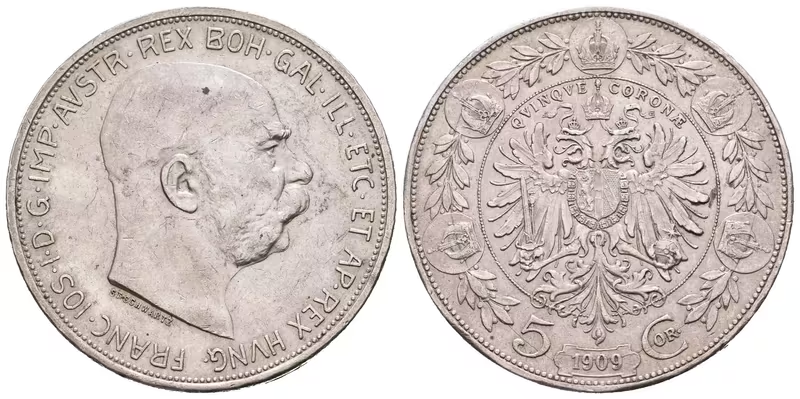
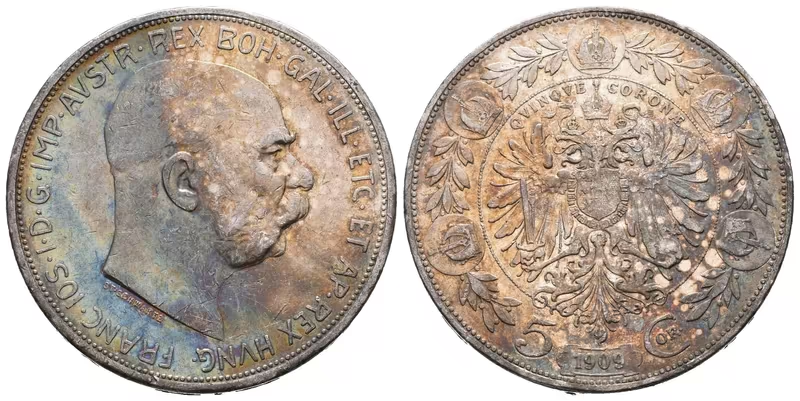
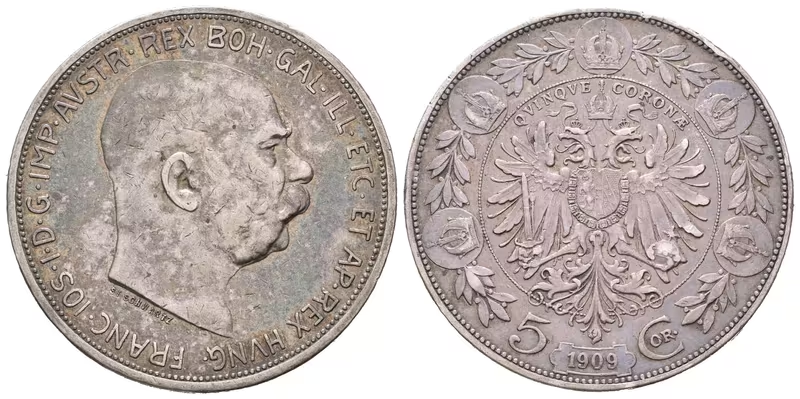
The 5 koruna was first struck for our lands within the koruna currency with the years 1900 and 1907–1909 as a silver coin of 900/1000 fineness and a weight of 24 g. It was a value standing on the boundary between ordinary circulation coin and "better" silver: the 5 koruna was high enough to be used for larger payments, but at the same time practical enough to be actually used in circulation. The reverse of these Austro-Hungarian 5 koruna pieces bore a motif that worked directly with the denomination: around the imperial eagle five imperial crowns were displayed in a wreath.
A part of the history of the Austro-Hungarian 5 koruna is also the jubilee issue of 1908 issued for the 60th anniversary of the accession of Franz Joseph I. Such commemorative issues usually have a dual role: they were usable as legal tender, but at the same time they carried a ceremonial dimension and were often kept rather than spent, so that they may have been preserved in better condition than ordinary circulation issues.
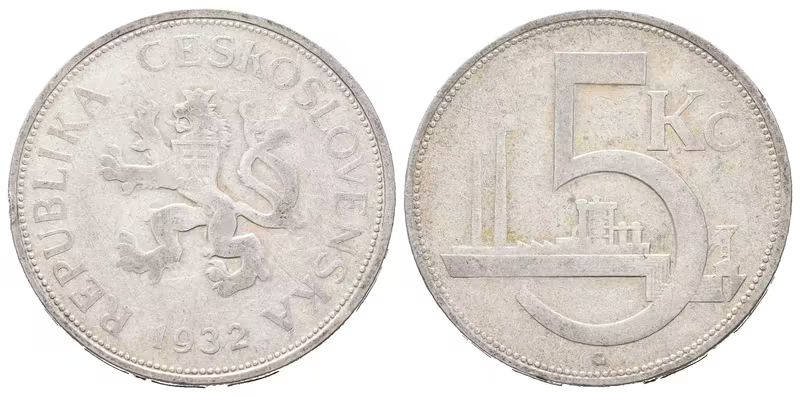
The Czechoslovak 5 koruna began to be struck from 1925 according to a design that was unusual for its time, by Otakar (Otto) Gutfreund. The first series from 1925–1927 was made of cupronickel, followed by the period 1928–1932, when the 5 koruna was struck as a silver coin (a weight of 7 g and a fineness of 500/1000 are given). In 1937–1938 the material changed again and the 5 koruna was struck from nickel. The alternation of metals reflects the times well: the state was looking for a compromise between durability, cost and the kind of "weight" the denomination should have in circulation and in the eyes of the public.
History
A separate collecting chapter is the year 1937, which was struck only in a very limited quantity and therefore ranks among the rarest Czechoslovak coins. With such year-issues it is typical that even small differences in preservation and provenance have a great influence on price, and that specialised catalogues and long-term demand revolve around them.
After the war the 5 koruna is recalled also in connection with the year 1952: according to the same design, a 5 koruna made of aluminium was struck, but because of the monetary reform of 1953 it did not enter circulation, and it is reported that the entire issue was melted down. Even so, a small portion of these coins reached collectors illegally, which makes them sought-after "story" material — it is not only a question of rarity, but also of the circumstances of why the coin was never meant to be in normal use.
Mintage of the 5 koruna was renewed only in 1966 in cupronickel and continued until the dissolution of Czechoslovakia (1992). After the establishment of the Czech Republic the Czech 5 koruna was introduced, struck from 1993 in galvanically nickel-plated steel according to the design by J. Harcuba. The transition to a steel core with surface plating is typical of modern circulation coinage: the coin is meant to be durable, cheap to produce and easily recognisable in everyday use.
Material, varieties and collecting points of interest
The 5 koruna is an excellent denomination for collecting "across regimes", because on a single number one can see the whole development of currency and technology. Austro-Hungarian silver 5 koruna pieces (24 g, 900/1000) are often collected as representative silver of the koruna currency, while Czechoslovak 5 koruna pieces offer interesting material changes (cupronickel, silver 500/1000, nickel) and a distinctive authorial handwriting of Otakar Gutfreund. The modern Czech 5 koruna, on the other hand, belongs to coins that everyone has in hand, but even with it one can follow years, minting varieties and preservation in collector-grade quality.
With 5 koruna coins the material strongly influences preservation. Silver pieces often acquire a patina that may be valued by collectors, while nickel and cupronickel coins tend to be more durable, but easily catch small scratches from circulation. With rare years such as 1937, the "purity" of the surface is also essential: careless cleaning or traces of polishing can significantly reduce value. The 1952 aluminium coin also deserves special attention — here, alongside condition, demonstrable provenance is often decisive, because it is an issue that did not officially enter circulation.
In our auction and shop
- Code: MA130-1909.26Back in stock
5 Koruna 1909
František Josef I. (1848 - 1916) 5 Koruna 1909, typ Schwartz, Ves. 130 Ag 0,900, 36 mm (24 g)
Skladem 1 ks - Code: MA130-1909.27Back in stock
5 Koruna 1909
František Josef I. (1848 - 1916) 5 Koruna 1909, typ Schwartz, Ves. 130 Ag 0,900, 36 mm (24 g)
Skladem 1 ks - Code: MA130-1909.28Back in stock
5 Koruna 1909
František Josef I. (1848 - 1916) 5 Koruna 1909, typ Schwartz, Ves. 130 Ag 0,900, 36 mm (24 g)
Skladem 1 ks - Code: MC009-32