Abraham
Abraham is the biblical patriarch with whom the Jewish, Christian and Islamic traditions associate the beginnings of faith in one God. In the biblical narrative he appears as a man of calling and covenant who leaves his original land and becomes a symbol of trust, obedience and the promise of progeny.
Abraham is among the most prominent figures of the Old Testament narrative. His story is anchored in the Book of Genesis and is built around several key motifs: setting out into the unknown, God's promise, and the covenant that has lasting consequences for the identity of whole generations. Traditionally he is associated with the name Abram, which in the biblical text is transformed into Abraham as a sign of a new task and a new standing. This very change of name is often interpreted as a symbol of the passage from a personal story to the history of a lineage and of faith.
In the Jewish tradition Abraham is regarded as the forefather of Israel and the bearer of the fundamental promise from which the relationship between God and the people is derived. Christianity builds upon him with its emphasis on faith as an inner disposition that precedes outward acts and becomes a model for the spiritual life. In Islam, Abraham (Ibrahim) is honoured as a prophet and an example of pure monotheism; his story is in many respects parallel, although certain emphases and interpretations differ. All three traditions, however, agree that he is a figure standing at the roots of religious identity and one repeatedly recalled in liturgy, exegesis and art.
History
The significance of Abraham gradually expanded in history beyond the purely religious framework. He became a symbol of pilgrimage, of decision and of the responsibility a person assumes in the face of uncertainty. The motif of "leaving the father's house" is interpreted as an archetypal image of change and maturation, while the theme of covenant and promise is reflected in reflections on history, law and commitments. In European culture Abraham appears in literature, painting and music, often as a figure who combines obedience with inner struggle and shows that faith is not just a sum of rules but also a personal journey.
In the broader cultural setting Abraham has also become a "common denominator" of dialogue and dispute between religions. It is precisely for this reason that he is described as the patriarch of the three great monotheistic traditions. This image has great power: it underlines the shared origin and the kinship of the narratives, but at the same time it recalls that individual interpretations may differ and that the meaning of the figure has developed in its own direction in each tradition. In modern times Abraham frequently appears in debates on religious tolerance, the roots of European culture and the role of faith in public life.
Significance, symbolism and commemoration
At the symbolic level Abraham is associated above all with the concepts of faith, covenant and promise. He is often recalled as a model of someone who makes decisions on the basis of trust and accepts responsibility for a future he cannot yet see. In art he tends to be depicted in several typical scenes — for instance on his journey, in a family context with Sarah, or at dramatic moments of testing that highlight the tension between human experience and obedience to a higher calling.
In numismatics, Abraham does not have a unified "coin tradition" such as that enjoyed by rulers or state emblems, yet he may appear on commemorative medals and thematic strikes that draw on biblical motifs, religious symbolism or cultural history. Such pieces are sought by collectors because they connect a visual motif with a story and often serve as a reminder of a particular event, anniversary or spiritual theme. In collecting, identification of the issuer, the execution, the mintage and the grade of preservation is then especially important, since these factors usually determine value and collector interest.
In our auction and shop
- Code: RX-USA-009
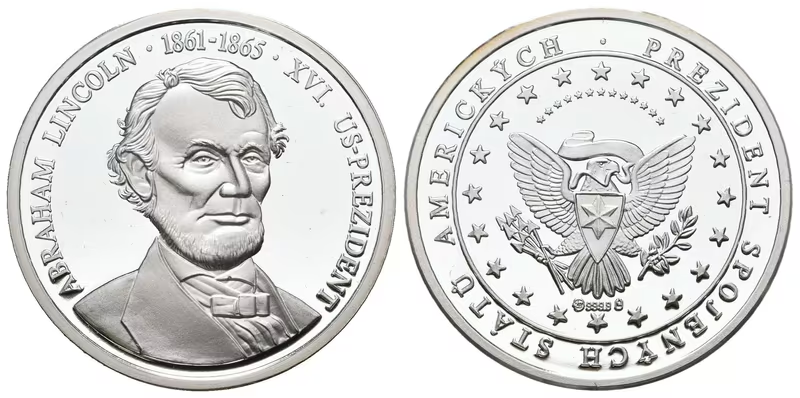
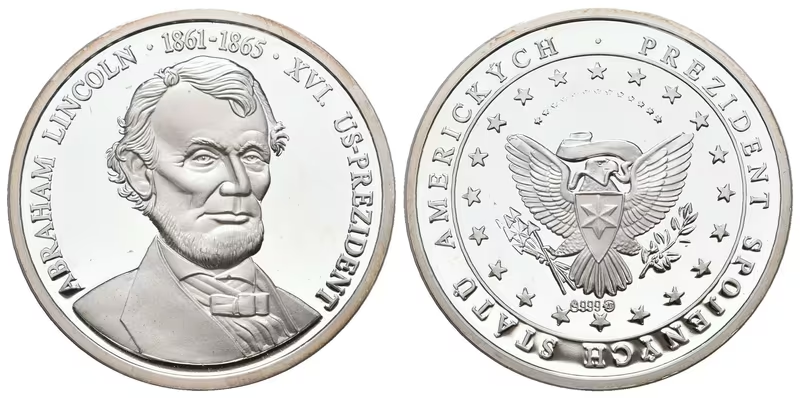
USA, medaile - Abraham Lincoln, XVI. prezident USA, prezidentský znak
Soukromá ražba - série Prezidenti USA Medaile - Abraham Lincoln, XVI. prezident USA, prezidentský znak Ag (.999), 30 mm (8,5 g), v kapsli. Stav mince odpovídá fotografii. Jedná se o druhotný prodej. (Možná oxidace, atd.. ! - VIZ FOTOGRAFIE !)
Skladem 1 ks - Code: RX-USA-008
USA, medaile - Abraham Lincoln, XVI. prezident USA (1861-1865); avers: portrét Lincolna, legenda ABRAHAM LINCOLN · 1861-1865 · XVI. US-PREZIDENT; revers: americký orel se štítem, hvězdy, legenda PREZIDENT SPOJENÝCH STÁTŮ AMERICKÝCH
Soukromá ražba - série Prezidenti USA Medaile - Abraham Lincoln, XVI. prezident USA (1861-1865); avers: portrét Lincolna, legenda ABRAHAM LINCOLN · 1861-1865 · XVI. US-PREZIDENT; revers: americký orel se štítem, hvězdy, legenda PREZIDENT SPOJENÝCH STÁTŮ…
- Code: SUSA-SP2009A
USA, 1 Dollar 2009 - Abraham Lincoln, PROOF
1 Dollar 2009 P - K 200. výročí narození Abrahama Lincolna, KM. 454 Ag 0,900, 38,1 mm (26,73 g), PROOF