Alexander II Nikolayevich
Alexander II Nikolayevich was Russian tsar from 1855 to 1881, known as the "Liberator" thanks to the abolition of serfdom. His rule brought a series of reforms of administration, the judiciary and the army, but at the same time faced a growing radicalism that culminated in his assassination.
Alexander II Nikolayevich ascended the throne at a time when the Russian Empire needed to catch up with economic and military backwardness. The defeat in the Crimean War (1853–1856) had exposed the weaknesses of the state — from technology and logistics to inefficient administration and the countryside's dependence on outdated social relations. The new tsar inherited a system built under Nicholas I, which was firmly centralised and rested on discipline, censorship and police oversight. Alexander II was, however, aware that without change the empire would be ever more vulnerable, and so he opened a period of reforms that belong among the most marked in Russian 19th-century history.
The best-known and at the same time the most fundamental step was the abolition of serfdom in 1861. By the reform the tsarist power attempted to dissolve the personal dependence of millions of peasants on the nobility and to create conditions for a more modern economy. In practice, however, it was not possible to resolve everything with a single decision: the peasants gained personal freedom, but the question of land, redemption and economic independence was complex and often brought disappointment. Even so, it was a historic dividing line — the state thereby acknowledged that the old model was untenable, and opened the way to a transformation of the countryside and of working relations.
The emancipation was followed by further reforms designed to make the state more effective and "more legible" for its inhabitants. In the 1860s the judicial reform developed with an emphasis on publicity of proceedings and more modern rules of procedure. At the same time local self-government in the form of the zemstvos arose, which was to deal with practical questions of education, healthcare, roads and local finances. Military reforms then responded to the experience of the Crimean War: the organisation of the army was changed and a system gradually came in that was to be fairer and at the same time more effective for modern warfare. The reforming atmosphere also touched education and university life, although the degree of relaxation varied over the years and the state feared losing control over the public space.
History
Alexander II at the same time ruled in a multinational empire in which in the 19th century national programmes were ever more strongly emerging. A significant test was the Polish question and the uprising of 1863–1864, which led to harsh suppression and to further tension between the centre and parts of the empire. Foreign policy brought Russia some successes too, particularly in south-eastern Europe and in the Caucasus, and in the 1860s the sale of Alaska to the United States also took place. All this fills out the picture of a rule that sought to strengthen the state through modernisation but at the same time had to deal with geopolitical pressures and internal contradictions.
Over time, however, the reforming course came into conflict with the expectations of various groups. Part of society regarded the changes as too slow and insufficient; others, conversely, feared that the reforms would disturb traditional hierarchies and authority. In an atmosphere of dissatisfaction radicalism grew, and organisations appeared willing to resort to violence. Several attempts on the tsar's life were made, and eventually Alexander II was killed in an attack in St Petersburg in 1881. His death became a turning point: reforming expectations were sharply chilled, and the accession of his son Alexander III is associated with a more conservative turn and with the strengthening of state control.
Alexander II Nikolayevich is perceived in history as a sovereign who opened the way to modernisation but at the same time showed how difficult it is to change a huge empire without deeper political consensus. The abolition of serfdom and the reform of administration created new social and economic conditions, but at the same time brought disappointment and tension, because expectations of freedom and prosperity collided with the reality of land redemption, indebtedness and inequality. It is precisely this division — between reform and the fear of chaos — that is typical of his age.
The legacy of the reign and the numismatic context
From a numismatic point of view Alexander II falls in the era when the Russian currency is firmly tied to the rouble system, and when in circulation small copper (later also bronze) kopek denominations meet higher silver and gold values. For the collector, attractive on his coins is the combination of sovereign titulature and state symbolism — chiefly the double-headed eagle — and also the fact that coins of this period often exist in many years of issue and variants. With Russian strikes of the 19th century it is worth following the details of the rendering of the emblem, the lettering of the legends and the overall quality of strike, because it is precisely these that help to distinguish types and more interesting collector variants.
The value of coins of Alexander II is in practice substantially affected by grade of preservation. With copper pieces one often encounters wear and surface changes that have arisen from long circulation; with silver and gold coins the naturalness of the surface and the absence of harsh cleaning are important. For thematic collections his era is rewarding also because it can be linked to great history: a collector can assemble a series that "narrates" the reform era from accession to the throne to the tragic end of 1881, and shows how political history is reflected in everyday circulating coinage.
In our auction and shop
- Code: BE062-0080
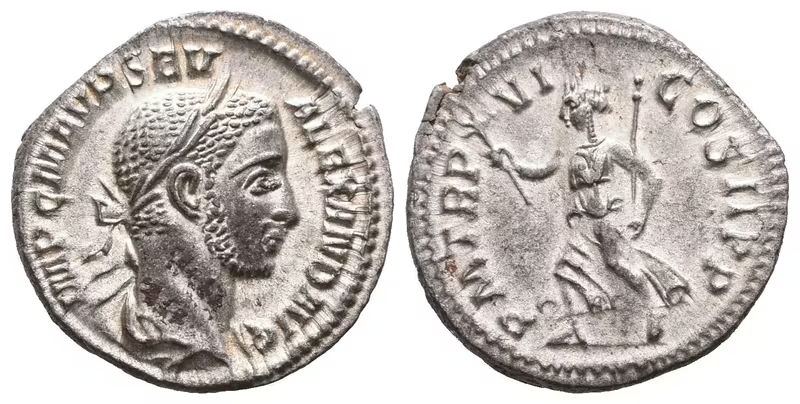
Severus Alexander, denár, Řím, RIC 80
Severus Alexander (222 - 235) mincovna Řím, raženo 228 n.l., křáčející Pax s ratolestí, TRP VI COS II, RIC 80
Skladem 1 ks - Code: SVIRG-X2013
Virgin Islands, Sada stříbrných mincí 2013 - 400. výročí Romanovců.
Virgin Islands, Elizabeth II., 1952 - 2022 Sada stříbrných mincí 1 Dollar 2013 - K 400. výročí dynastie Romanovců. Petr Veliký, Mikuláš II., Alexandr I., Kateřina Veliká 4x Ag 0,925, 38,61 mm (28,56 g), původní etue, kapsle, certifikát, celkem 4 kusy v…
- Code: SRUSFIN88-B1865
Finsko pod Ruskem, 1 Markka 1865 S
Ražby pro Finsko, Alexander II., 1855 - 1881 1 Markka 1865 S, Helsinky, Bitkin2.625, Uzd.4665
- Code: SRUSFIN89-B1874
Finsko pod Ruskem, 1 Markka 1874 S
Ražby pro Finsko, Alexander II., 1855 - 1881 1 Markka 1874 S, Helsinky, Bitkin2.631, Uzd.4709