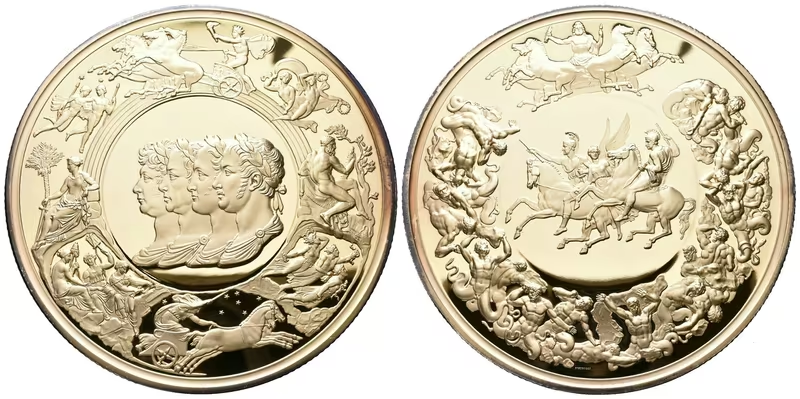
Battle of Leipzig
The Battle of Leipzig (the so-called Battle of the Nations) took place from 16 to 19 October 1813 and was the largest clash of the Napoleonic Wars. Coalition armies defeated the army of Napoleon Bonaparte, thereby breaking his power in Germany and forcing France to retreat.
After the unsuccessful campaign in Russia, the position of Napoleon Bonaparte in Europe deteriorated significantly. A wider coalition formed against France, the aim of which was to limit French influence and restore the balance of power on the continent. The German space became the main battlefield, because here Napoleon had long rested his power on allied or satellite states and on a network of strategic fortresses and lines of communication.
In October 1813 Napoleon concentrated his forces near Leipzig, where he attempted to face the advancing coalition armies. On the coalition side stood chiefly Russians, Prussians, Austrians and Swedes; an important role was played by the sovereigns Alexander I and Frederick William III, while the Austrian forces were associated with the name of Karl I Philipp, Prince of Schwarzenberg. The coalition had the advantage of numerical superiority and of the possibility of continuously replenishing forces, which played a key role in the multi-day clash.
The battle developed into a series of engagements on a broad front around the city. The first day brought heavy clashes without a clear decision, but as time passed the coalition pressure intensified. The turning point came when Napoleon's army began to find itself in a disadvantageous situation and had to retreat from the positions it held. The withdrawal from Leipzig was complicated and painful; the battle therefore entered history as exceptionally bloody and logistically demanding.
History
In wider terms, the coalition victory at Leipzig meant the end of Napoleon's dominance in the German lands. The French army was forced to retreat across the Rhine, and in the following year the fighting moved directly onto French territory. Leipzig thus belongs to the events that prepared the fall of Napoleon's rule and opened the way to the post-war settlement of Europe.
The nickname "Battle of the Nations" captures the scale of the clash and the extraordinary number of participating soldiers from various countries. It was not only a conflict of two armies but a clash of great coalition blocs, in which the interests of powers and their visions of the future of Europe were projected. The battle therefore became an important symbol not only in military history but also in the memory of individual nations.
Numismatically, Leipzig has a rich "afterlife" in the form of commemorative medals and anniversary strikes, which arose in various countries already in the 19th century and continue today. For collectors of the Napoleonic era such medals are interesting as both a document of contemporary propaganda and an artistic artefact. In practice it pays to observe whether it is a contemporary medal (often with historical patina and specific engraving) or a modern commemorative strike, where the mintage, designer and production quality decide.
Why "Battle of the Nations" and how it is commemorated
If a collector focuses on the wider context, they may add to the Leipzig theme also coins from the period of the Napoleonic Wars and from the time of the restoration of European monarchies. Such a "thematic collection" then tells not only the story of one battle but also the story of the transformation of Europe at the turn of the 18th and 19th centuries.
In our auction and shop
- Code: RX-VEL2015
Velká británie - Bitva u Waterloo
Velká Británie AE Medaile 1815 - 2015 (B. Pistrucci) - Medaile na památku bitvy u Waterloo Bronz zlacený ryzím zlatem 88,9 mm (cca 400 g), číslováno na hraně, brožura s certifikátem a popisem bitvy, vojevůdci, historie vzniku medaile, etue, papírový…
Skladem 1 ks - Code: ZSRAK-E1976
Rakousko, 1000 Schilling 1976 - Babenberg
Rakousko, II. republika (1945 - ) 1000 Schilling 1976 - Babenbergové, Au 0,900, 27 mm (13,5 g), pův. etue Rakouské národní banky Babenberkové ( německy Babenberger ) byl německo-rakouský šlechtický rod původem z Frank ( Bamberg ), v letech 976 až 1246…
- Code: ZSFRA-89F1852
Francie, 20 Frank 1852 A
Francie, Napoleon III. ( 1852 - 1870) 20 Frank 1852 A - jako president II. republiky, mincovna Paříž Au 0,900, 21 mm (6,4516 g), KM. 774 Charles Louis Napoleon Bonaparte jinak též Napoleon III. (20. dubna 1808 – 9. ledna 1873) byl syn krále Ludvíka…
- Code: ZSFRA-89F1855.1
Francie, 20 Frank 1855 A
Francie, Napoleon III. ( 1852 - 1870) 20 Frank 1855 A, mincovna Paříž Au 0,900, 21 mm (6,4516 g), KM. 781.1 Charles Louis Napoleon Bonaparte jinak též Napoleon III. (20. dubna 1808 – 9. ledna 1873) byl syn krále Ludvíka Bonaparta a královny Hortensie de…