County of Brabant
The County of Brabant was a medieval territory in the area of present-day Belgium and the Netherlands, which gradually developed into one of the most important units of the Netherlandish lands. Its history is closely linked with trade, towns and the later Burgundian and Habsburg era.
In the Middle Ages Brabant belonged among the regions in which towns, crafts and long-distance trade developed exceptionally rapidly. From an originally smaller territorial unit, a region with marked economic strength gradually emerged, based on markets, textile production and a position between northern Europe and the Rhineland. In the course of the High Middle Ages, Brabant's position grew strong enough for it to become one of the politically most visible players in the Low Countries.
An important role was played by towns such as Brussels, Antwerp and Leuven, which gradually became centres of administration and trade. It was precisely the urban environment that contributed to the earlier emergence here than elsewhere of institutions and agreements on the rights and duties of the ruler. Brabant is often recalled in history for the tradition of estate and municipal liberties, which were meant to limit the arbitrariness of rulers and to strengthen legal certainty — which is logical in an economically active region, since trade needs stable rules.
History
In the later period Brabant became part of larger political units, which gradually united the Netherlandish lands. The influence of the Burgundians and subsequently of the Habsburgs linked the region with European great-power politics. Brabant thus found itself at the centre of conflicts and diplomatic negotiations that affected the Netherlandish lands in the early modern period. The economic strength of the region was meanwhile sustained over the long term — and that is precisely why the history of Brabant is often told as a story of the interconnection of towns, trade and state power.
In numismatics, Brabant is interesting because a strong demand for reliable currency arose in the urban and commercial environment. The region therefore offers a broad spectrum of historical strikes: from medieval silver coins to later denominations corresponding to monetary reforms in the Netherlandish lands. Attractive for collectors tend to be coins with clear heraldic motifs (arms, shields, crosses) and with legible inscriptions that allow more precise identification.
Brabant coins and the minting tradition
With Brabant strikes, it is good to follow whether the coin is a ruler's, a municipal or a later strike within a wider state unit. In practice the same region passed through several "administrative regimes" and the coins responded with changes of titulature and emblems. With older pieces, provenance and an expert description play a major role, because in an environment of intensive trade coins often spread far beyond the region's borders and the typology can be similar to neighbouring areas.
In our auction and shop
- Code: SNIZBRA-D1550
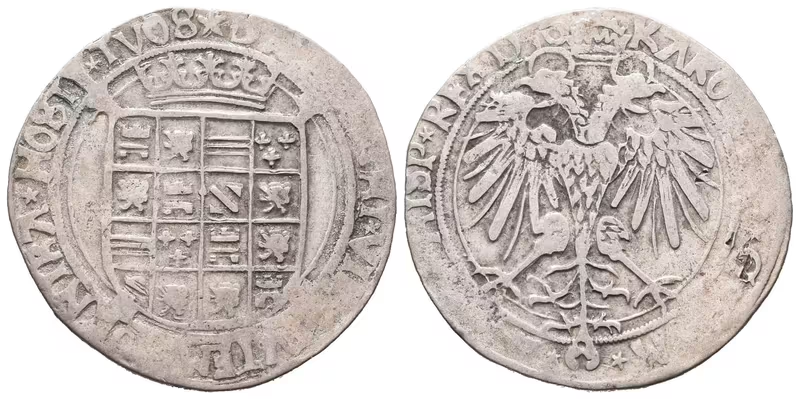
Nizozemí-Brabantsko, 4 Patard 1546
Nizozemí - Brabantsko, Karel V. Habsburský, 1506 - 1555 4 Patards/Stuivers 1546/1550, minc. Antvery, GH.189, Van.226 var., patina, dobově ořezaný
Skladem 1 ks - Code: SNIZSPA-F1612
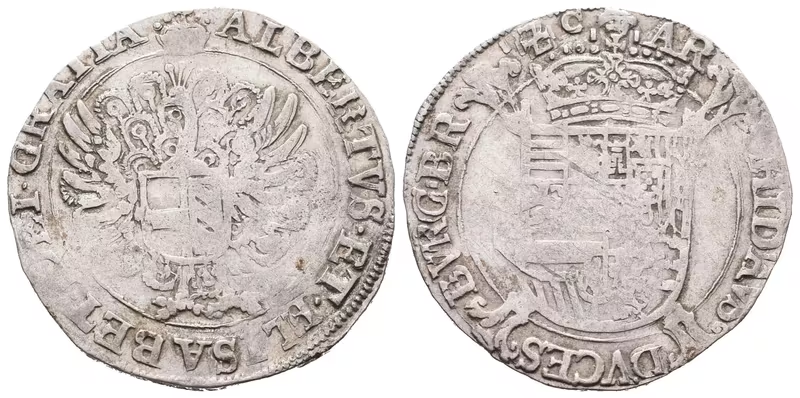
Španělské Nizozemí, Escalin b.l. (1612 - 1621)
Španělské Nizozemí - Brabantsko, Albrecht V. a Isabella Španělská, 1598 - 1621 Escalin/Schelling b.l. (ražen 1612-1621), minc. Brusel, KM.47, Van.623 var., pěkná zachovalost a patina, dobově ořezaný
Skladem 1 ks