Dutch Republic
The Dutch Republic was a Western European federative state existing from 1581 to 1795, which arose from the revolt of seven northern Dutch provinces against Spanish rule and became the leading commercial and naval power of the world. The Dutch Republic is famous in numismatics for its gold ducats with the knight, silver rijksdaalders and characteristic pr…
The emergence of the Dutch Republic took place in two steps: on 23 January 1579 the seven northern provinces - Holland, Zeeland, Utrecht, Gelderland, Overijssel, Friesland and Groningen - signed the Union of Utrecht as a defensive alliance against Philip II of Spain, and on 26 July 1581 the Plakkaat van Verlatinghe (Act of Abjuration) formally proclaimed independence from the Spanish crown. The Eighty Years' War of Independence (1566-1648) began with the iconoclastic riots and the rising of the Dutch nobility led by William of Orange against the Spanish Catholic Counter-Reformation and increased taxation. The northern provinces with a Protestant majority chose resistance, while the Catholic south remained loyal to Spain.
The beginnings of the republic were hard - the Spanish army under the Duke of Alba bloodily suppressed the rebellion, but the Sea Beggars (Watergeuzen) gradually liberated coastal towns. The capture of Brielle in 1572 began the successful phase of the revolt, while the long sieges of Leiden and Alkmaar showed the Spanish inability to break Dutch resistance in conditions of delta and marshland.
The 17th century became the "Golden Age" of Dutch culture and prosperity. The Dutch pushed the Portuguese out of most Asian colonies and built their own commercial empire led by the East India Company (VOC) and the West India Company (WIC). Amsterdam became the financial centre of Europe, Dutch painting reached its world peak with Rembrandt and Vermeer, while Dutch science and philosophy influenced the whole Enlightenment thought.
The political system of the republic was a unique combination of federalism and oligarchic government. The seven provinces retained considerable autonomy, while common affairs were directed by the States General in The Hague. The Stadtholder of the House of Orange served as the supreme military commander and representative of the state, but his power was limited by the patrician regents who dominated the city councils of the main commercial towns.
History
The Dutch commercial network reached global dimensions with colonies and trading stations in Asia (Batavia, Malacca, Ceylon), the Americas (New Amsterdam, Surinam, the Antilles), Africa (Cape Town) and Oceania. The VOC became the first multinational corporation in the world, with its own army, fleet and minting rights. The Dutch Golden Age was founded on speculation, insurance and the most developed financial system of its time.
The 18th century brought a gradual decline of Dutch power. The Anglo-Dutch wars over national trade, French expansion and above all growing competition from England weakened the Dutch position. The VOC went bankrupt and most of the Asian colonies fell to the English. The French revolutionary invasion of 1795 ended the existence of the republic and a satellite Batavian Republic emerged in its place.
After the Napoleonic Wars the Kingdom of the Netherlands was established, comprising present-day Holland and Belgium, but in 1830 Belgium achieved independence. The Dutch retained part of their colonial empire, including Indonesia, until the 20th century. The last colonies were Surinam (independence in 1975) and the Netherlands Antilles, some of which remain autonomous territories of the Kingdom of the Netherlands to this day.
Dutch coinage reflected the federative structure of the republic - each province retained its own minting rights and struck coins according to its own standards. The most important were the mints in Amsterdam, Dordrecht, Middelburg and other commercial centres, which struck both for domestic needs and for international trade. A unifying element was the Dutch lion and the heraldic symbols of the individual provinces.
Dutch republican coinage
The most famous Dutch coins were the gold knight's ducats (ridderdukaten) with a knight standing with sword and shield, which became an internationally recognised currency. These coins maintained the same weight and quality for centuries, which made them favoured means of international trade. Dutch ducats have been found in hoards from northern Europe to Asia as evidence of the extent of Dutch commerce.
Silver coins included rijksdaalders, daalders and their fractions for larger transactions, while stuivers and duits served for everyday trade. A characteristic feature was the depiction of provincial coats of arms, lions in various poses and allegorical figures representing the individual provinces. The quality of Dutch coins was generally high thanks to a prospering economy and advanced craftsmanship.
The colonial coinage of the VOC represented a revolutionary innovation. In the East Indies colonies coins adapted to local needs were struck - rupees in India, reals in Indonesia and ducats in Ceylon. These coins combined Dutch motifs with local symbols and were often struck from local metals. The West India Company struck coins for the American colonies with characteristic motifs of palm trees, ships and trading symbols.
In our auction and shop
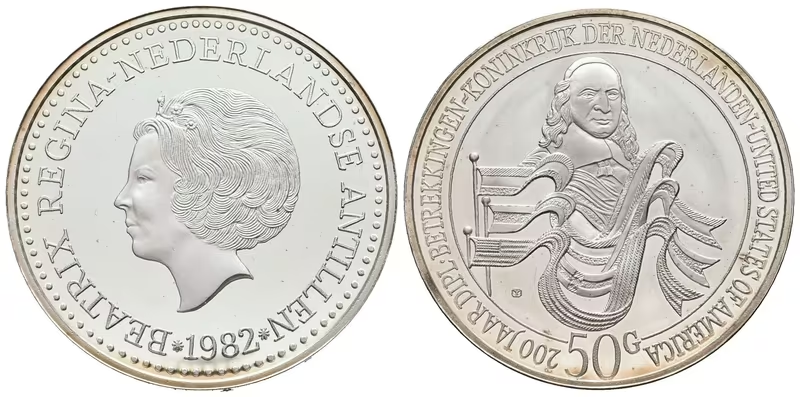
- Code: SNIZAN-B1982
Nizozemské Antily, 50 Gulden 1982 - 200 let diplomatických vztahů Nizozemska a USA, Petr Stuyvesant
Koninkrijk der Nederlanden / Nizozemské Antily (1954-2010) 50 Gulden 1982 - 200 let diplomatických vztahů Nizozemska a USA, Petr Stuyvesant, KM# 30 Ag (.925), 38 mm (25 g), v kapsli. Stav mince odpovídá fotografii.
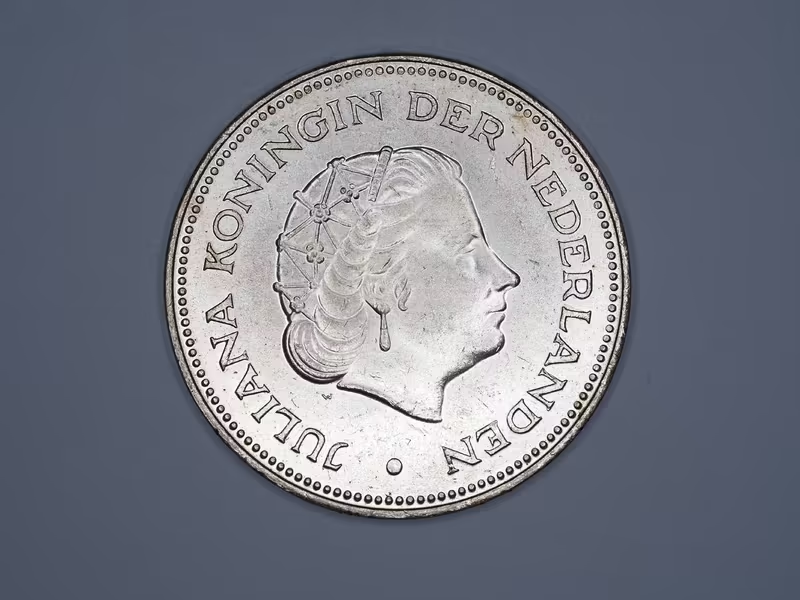
Skladem 1 ks - Code: SNIZ95-E1970.5
Nizozemí, 10 Gulden 1970 - Osvobození
Nizozemsko, Juliana (1948-1980) 10 Gulden 1970 - Osvobození, KM# 195 Ag (.720), 38 mm (25 g). Mincovna: Královská holandská mincovna - Utrecht. Hrana s nápisem "★ GOD ★ ZIJ ★ MET ★ ONS". Stříbrná pamětní oběžná mince - k 25. výročí osvobození Nizozemska…
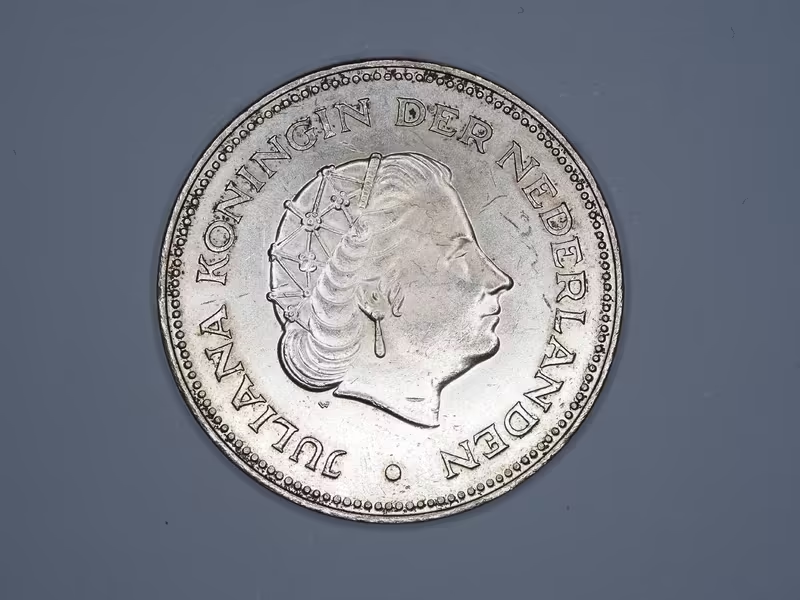
Skladem 1 ks - Code: SNIZ95-E1970.6
Nizozemí, 10 Gulden 1970 - Osvobození
Nizozemsko, Juliana (1948-1980) 10 Gulden 1970 - Osvobození, KM# 195 Ag (.720), 38 mm (25 g). Mincovna: Královská holandská mincovna - Utrecht. Hrana s nápisem "★ GOD ★ ZIJ ★ MET ★ ONS". Stříbrná pamětní oběžná mince - k 25. výročí osvobození Nizozemska…
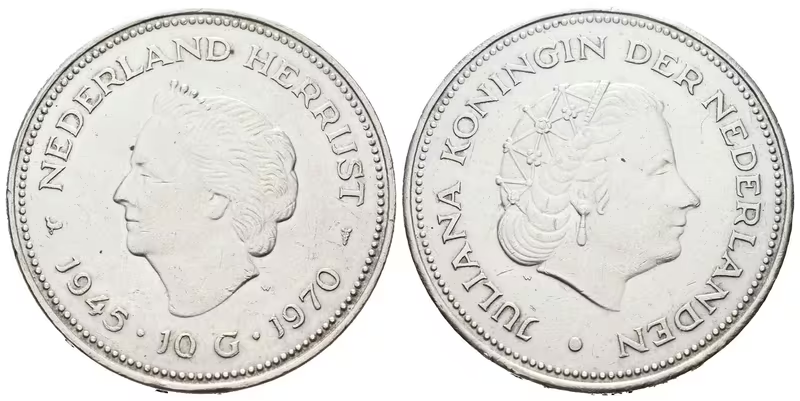
Skladem 1 ks - Code: SNIZ95-E1970.4
Nizozemí, 10 Gulden 1970 - Osvobození
Nizozemsko, Juliana (1948-1980) 10 Gulden 1970 - Osvobození, KM# 195 Ag (.720), 38 mm (25 g). Mincovna: Královská holandská mincovna - Utrecht. Hrana s nápisem "★ GOD ★ ZIJ ★ MET ★ ONS". Stříbrná pamětní oběžná mince - k 25. výročí osvobození Nizozemska…
Skladem 1 ks