Ice Age
The Ice Age denotes a geological period in which the Earth's climate cooled significantly and extensive ice sheets permanently covered a large part of the continental area. In the strict palaeoclimatic sense, an "Ice Age" is any longer period during which permanent ice exists in the polar regions and alpine-type glaciers reach to lower altitudes.
The Quaternary glaciation is characterised by regular alternation of cold glacials and warmer interglacials with a periodicity of approximately one hundred thousand years, explained by the Milankovitch cycles - periodic changes in the eccentricity of the Earth's orbit, the tilt of the Earth's axis and the precession of the equinoxes. Current palaeoclimatic reconstructions, based on the isotopic record from deep-sea drilling (marine isotope stages, MIS), from polar ice cores (the Vostok, EPICA Dome C and GISP2 drillings) and from imprints of fossil marine-organism shells, have documented approximately 23 glacial-interglacial cycles during the last 2.5 million years. The most pronounced cooling in each cycle represented a decline of global temperature by up to 21 °C compared with the present and an increase in the ice mass which drew off enormous amounts of water from the oceans: the global sea level during glacial maxima fell by up to 120 metres, creating land bridges between Asia and North America (Beringia), the British Isles and continental Europe (Doggerland) and between the Sunda Islands in south-eastern Asia (Sundaland).
Definition and the Quaternary cycle
The last glacial was the so-called Würm in the Alpine division and the Weichsel in the North European; it covered the period from approximately 115,000 to 11,700 BC. The maximum of glaciation - the Last Glacial Maximum (LGM) - fell in the period around 26,500 to 19,000 BC. At this time Scandinavia, north-eastern Asia, the northern half of North America (the Laurentide Ice Sheet) and the Alps were covered by powerful ice sheets, while the whole of central Europe was a periglacial steppe landscape resembling today's Mongolian taiga. The British Isles were accessible on dry foot across Doggerland; Beringia made possible the first migrations of humans to America around 18,000 BC. To the north of the Mediterranean lived populations of hunters and gatherers of the Gravettian and Magdalenian cultures, who left behind a rich tradition of cave paintings (Lascaux, Altamira, Chauvet, Pekárna) and figurines of female figures (Venus of Dolní Věstonice, Venus of Willendorf).
The last glacial and the Last Glacial Maximum
The transition from the last Ice Age to today's warm period did not proceed smoothly. Around 14,700 BC there began a rapid warming known as the Bølling-Allerød interstadial, which raised temperatures to almost present-day values. About 12,900 years ago, however, the climate again cooled sharply, and a 1,300-year cold period of the Younger Dryas began, lasting until 11,700 BC. The probable cause was the disintegration of the Laurentide Ice Sheet and the outflow of freshwater Lake Agassiz into the North Atlantic, which for a time disabled the thermohaline circulation. The Younger Dryas ended suddenly, within a few decades, and opened a new geological epoch, the Holocene - a stably warm period that lasts to this day and within which Neolithic agriculture, the emergence of the first cities, the invention of writing, the striking of the first coins and the development of all hitherto documented civilisations took place.
The Younger Dryas and the beginning of the Holocene
The Pleistocene is characterised by a rich megafauna - large mammals adapted to the glacial and periglacial environment. Among them are the woolly mammoth (Mammuthus primigenius), the woolly rhinoceros, the cave bear, the sabre-toothed tiger (smilodon), the giant ground sloth (megatherium), the muskox, the reindeer, the cave lion, the Irish elk (Megaloceros) and others. Most of these species died out at the end of the Pleistocene between 12,000 and 9,000 BC; the debate over the causes still continues and combines climate change, hunting pressure from Homo sapiens and possible epidemics. The last populations of mammoths survived on Wrangel Island until approximately 1,600 BC - that is, at a time when in Mesopotamia and Egypt urban civilisation with the striking of precious metals and cuneiform writing had long been functioning. For Czech prehistory the Gravettian sites of the southern Moravian mammoth hunters - Dolní Věstonice, Pavlov, Předmostí - are key, where literally an archaeological cross-section of life in the last glacial has been preserved.
Pleistocene megafauna
The Ice Age has an indirect but fundamental significance for the history of trade and money. Without emerging from the cold of the last glacial, the Neolithic transition to agriculture (around 10,000 BC in the Fertile Crescent) would not have been possible; without it there would not have arisen the food surplus enabling the specialisation of crafts; without specialisation, exchange beyond barter does not arise; without exchange, neither long-distance trade nor the first forms of money - cowrie shells, cattle, grain and subsequently metal fragments and the first struck coins in ancient Lydia around 600 BC. The end of the Ice Age thus on a wider scale forms the climatic prerequisite for the emergence of the whole of numismatic history. In the opposite direction, the gold and silver deposits intensively used for striking coins in antiquity and the Middle Ages were uncovered in Europe precisely by glacial processes: glacial erosion exposed the ore veins of the Ore Mountains, the Alps, the Pyrenees and the Scandinavian Shield, which subsequently became sources of European precious metal.
Significance for the emergence of civilisation and trade
In our auction and shop
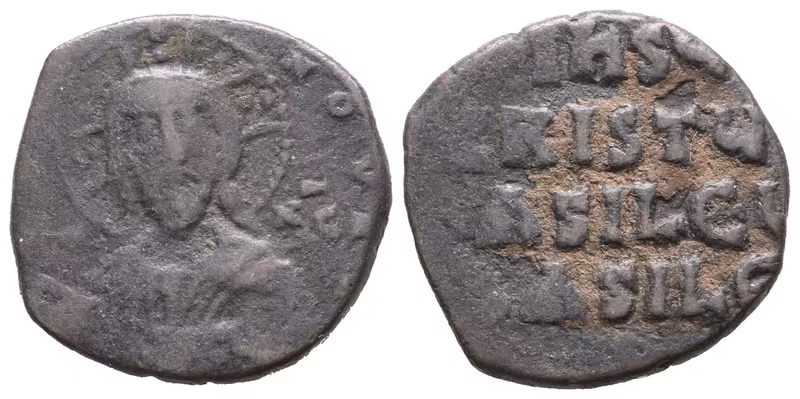
- Code: BF0432-1813
doba Basila II., follis, Sear 1813
doba Basila II. (976-1025) Ježíš Kristus čelně držící Evangelia, nápis (4 řádky), Sear 1813
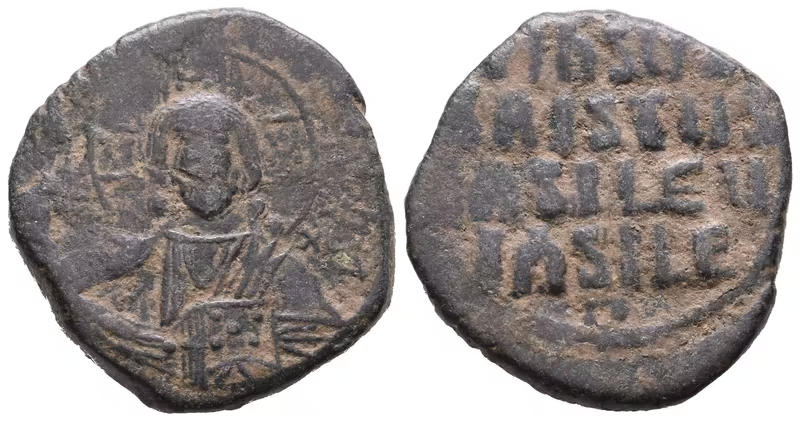
Skladem 1 ks - Code: BF043-1818.1
cca 1020 - 1030, follis, Sear 1818
cca 1020 - 1030 (doba Konstantina VIII.) Ježíš Kristus čelně držící Evangelia, nápis (4 řádky), Sear 1818
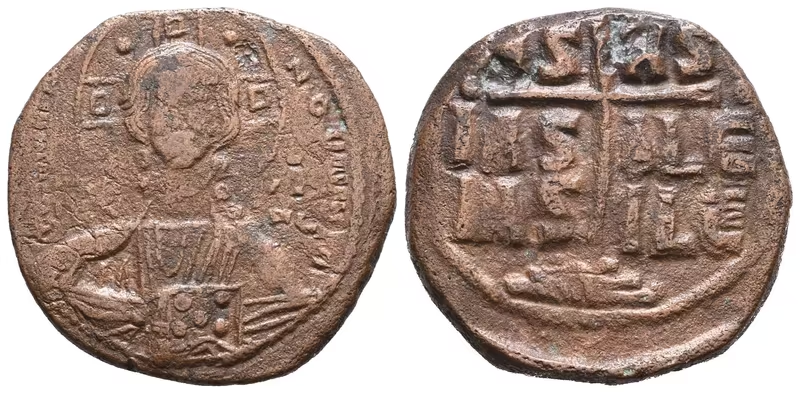
Skladem 1 ks - Code: BF044-1823
cca 1028 - 1034, follis, Sear 1823
cca 1028 - 1034 (doba Romana III.) Ježíš Kristus čelně držící Evangelia, nápis (3 řádky), Sear 1823
Skladem 1 ks - Code: RASOPR-0
Sopr Alois - Na pamět 5.května
Sopr Alois (1913 - 1993 ) AE Medaile b.l. - SVU Mánes/ Na paměť 5.května 1945 Bronz 55 mm (94 g)
Skladem 1 ks