Egyptian religion
Egyptian religion was the complex belief system of ancient Egypt, which for more than three thousand years influenced the form of Egyptian tender and later of Ptolemaic and Roman provincial coins. Depictions of gods, sacred animals and hieroglyphic symbols on Egyptian strikes served not only as an expression of religious identity but also as magical prote…
Egyptian religion took shape as early as the predynastic period around 4000 BC, when individual Nilotic communities worshipped local deities often in the form of animals or natural forces. The unification of Upper and Lower Egypt around 3100 BC led to the gradual joining of local cults into a unified religious system. Each important city, however, retained its principal god — Ptah ruled in Memphis, Amun in Thebes, Re in Heliopolis — which was later reflected in regional strikes as well.
In the Old Kingdom period (2686–2181 BC) the concept of the pharaoh as a living god, son of the sun god Re, was developed. This divine status of the sovereign remained the foundation of Egyptian state ideology until the end of the Ptolemaic era and directly influenced the iconography of Egyptian tender. Although Egypt did not yet strike coins of its own at this time, standardised metal rings and the weight unit deben were used, sometimes bearing religious symbols.
The Middle Kingdom (2055–1650 BC) brought a democratisation of religion, with the originally royal mortuary texts becoming accessible to ordinary Egyptians too. The development of the cult of Osiris as ruler of the underworld and judge of the dead created the notion of an afterlife open to all believers. Amulet coins and metal votive objects with the symbols of Osiris from this period attest to the linking of religion with early forms of money.
History
Under the New Kingdom (1550–1077 BC) Egyptian religion attained its greatest complexity. The cult of Amun-Re became the state religion, and the Theban priests controlled vast wealth, including gold and silver reserves. Akhenaten's attempt to introduce the monotheistic cult of the god Aten (1353–1336 BC) temporarily disrupted the traditional system, but after his death Egypt returned to its original polytheism. From this period come the first Egyptian proto-currencies in the form of gold and silver rings with royal cartouches.
The Ptolemaic period (305–30 BC) brought a synthesis of Egyptian and Greek religion. The Ptolemies had themselves depicted both as pharaohs and as Greek rulers, which was reflected on their coins by the combination of hieroglyphs with Greek inscriptions. The cult of Serapis, a syncretic deity uniting Osiris with Greek gods, became a symbol of this religious fusion. Ptolemaic bronze coins frequently bore depictions of traditional Egyptian gods such as Isis, Harpocrates or the sacred Apis bull.
In the Roman period (30 BC – AD 641) Egyptian religion preserved its identity, although it gradually gave way to Graeco-Roman cults and later to Christianity. Alexandrian strikes of provincial coins down to the 3rd century depicted Egyptian gods, the Nile as a deity and traditional symbols such as the sphinx and the pyramids. The last hieroglyphic inscription dates from AD 394 at Philae; the last Egyptian religious motifs on coins disappeared under Diocletian around 300.
Religious motifs on Egyptian tender and coins
Egyptian religious symbols on tender and coins formed an elaborate system of visual communication. The most frequent motif was the Eye of Horus (wedjat), a symbol of protection and royal power, which appeared on Ptolemaic and Roman Alexandrian strikes alike. The cartouche with royal names contained magical protection of the sovereign and legitimised the value of the tender. The ankh as the symbol of eternal life guaranteed the lasting value of the coin.
Depictions of Egyptian gods on coins followed strict iconographic conventions. Isis was shown with a throne on her head or as Isis-Sothis with the Dog Star; Harpocrates as a naked child with a finger to his lips; Anubis with a jackal's head. Sacred animals represented deities — the Apis bull embodied Ptah, the ibis represented Thoth, the falcon symbolised Horus. The crocodile as the embodiment of the god Sobek appeared on coins from the Fayum.
Alexandrian coins of the Roman period created a unique synthesis of Egyptian and Graeco-Roman elements. Emperors were depicted with traditional Egyptian crowns — the double crown of unified Egypt (the pschent), the white crown of Upper Egypt or the red crown of Lower Egypt. The personification of the Nile as a bearded man with a horn of plenty combined Egyptian and classical iconography.
In our auction and shop
- Code: BC-SYLLOGE-04
SNG Czech Republic, vol 4 - Egypt
Sylloge Nummorum Graecorum Czech Republic, Volume IV - The Luboš Král Collection, Egypt: Roman Provincial Coinage Národní muzeum v Praze Jiří Militký, Luboš Král Na konci roku 2021 vyšel další svazek edice Sylloge Nummorum Graecorum (Česká republika),…
Skladem 4 ks - Code: SEGY-E1994
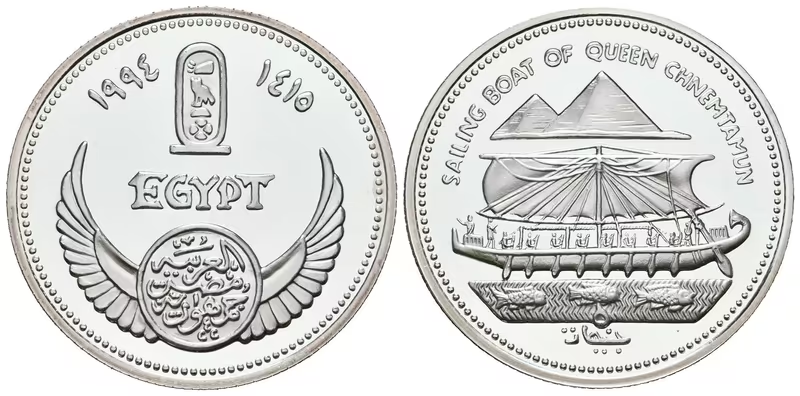
Egypt, 5 Pounds 1994 - Loď královny Chnemtamun, starověká egyptská plavidla, pyramidy
Arabská republika Egypt 5 Pounds 1994 - Loď královny Chnemtamun, starověká egyptská plavidla, pyramidy, KM# 971 Ag (.925), 37 mm (17,5 g), v kapsli. Stav mince odpovídá fotografii.