Frederick I of Prussia
Frederick I of Prussia (1657–1713), originally Frederick III of Brandenburg, was the first "King in Prussia" from 1701. The son of the Great Elector, he elevated Brandenburg-Prussia to a kingdom in exchange for supporting the emperor in the War of the Spanish Succession.
Frederick was born in Königsberg as the son of Elector Frederick William and Louise Henriette of Orange. From his mother he inherited a love of art and luxury, which contrasted with his father's Spartan austerity. Hunchbacked and physically frail, he compensated for his shortcomings through intellectual and artistic activity. His first marriage to Elisabeth Henriette of Hesse-Kassel was unhappy; his second, to Sophia Charlotte of Hanover, was happy — Sophia founded Charlottenburg Palace and patronised Leibniz.
After his father's death in 1688, Frederick inherited prosperous but scattered domains from the Rhine to the Niemen. He yearned for a royal title as confirmation of the rise of the Hohenzollerns. The Duchy of Prussia lay outside the Holy Roman Empire, which made a sovereign title possible. Leopold I needed an ally against France — in exchange for 8,000 soldiers he permitted the royal dignity. On 18 January 1701 Frederick crowned himself in Königsberg as Frederick I, "King in Prussia" (not "of Prussia", because Western Prussia belonged to Poland). The ceremony cost 6 million thalers — a third of the annual budget.
History
Frederick's reign was an era of Baroque and absolutism. He founded the Prussian Academy of Sciences (1700), the university in Halle (1694), and the Academy of Arts (1696). Berlin expanded with the addition of Friedrichstadt. The architect Schlüter created Baroque Berlin. But luxury depleted the finances — the court cost more than the army. Frederick was no soldier — wars were waged by his generals. His patronage of art and scholarship laid the cultural foundations of Prussia, but his son Frederick William I despised his father's "vain extravagance". Frederick died on 25 February 1713, leaving behind a kingdom, but also debts. His significance was symbolic — he created the Prussian royal dignity.
In our auction and shop
- Code: NBBAD-AX1902.1
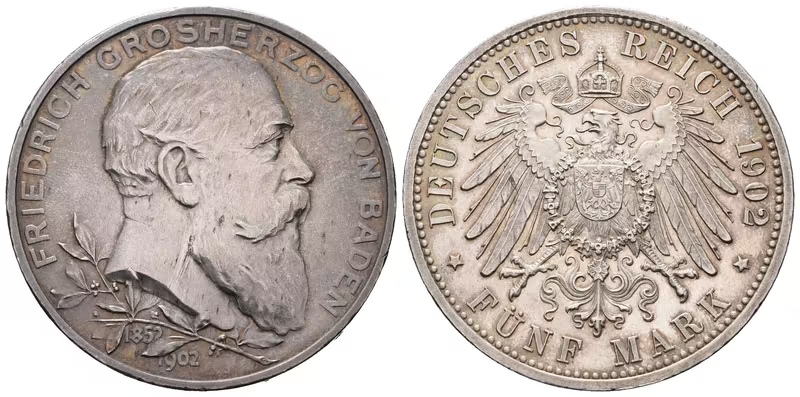
Baden, 5 Marka 1902 - 50. výročí panování
Baden, Friedrich I. (1856 - 1907) 5 Marka 1902 - K 50. výročí panování, J. 31, nádherná zachovalost s ražebním leskem a pěknou patinou
Skladem 1 ks - Code: NBBAD-AZ1907
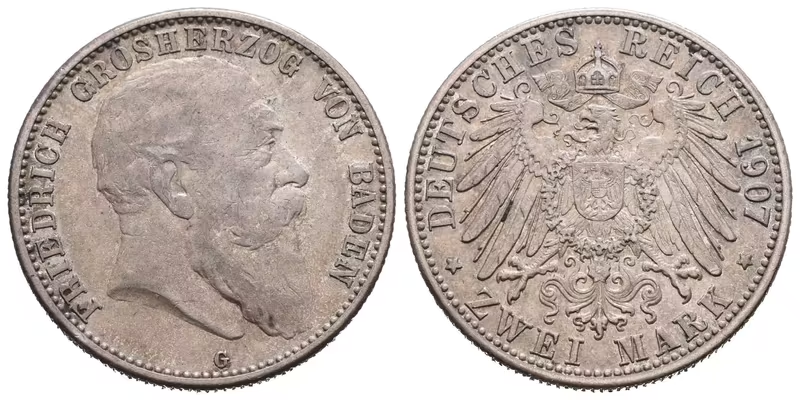
Baden, 2 Marka 1902 - 50. výročí panování
Baden, Friedrich I. (1856 - 1907) 2 Marka 1907 G, J. 34, krásná zachovalost, tmavá patina, lesk, drobné rysky
Skladem 1 ks - Code: NBBAD-BZ1907VC
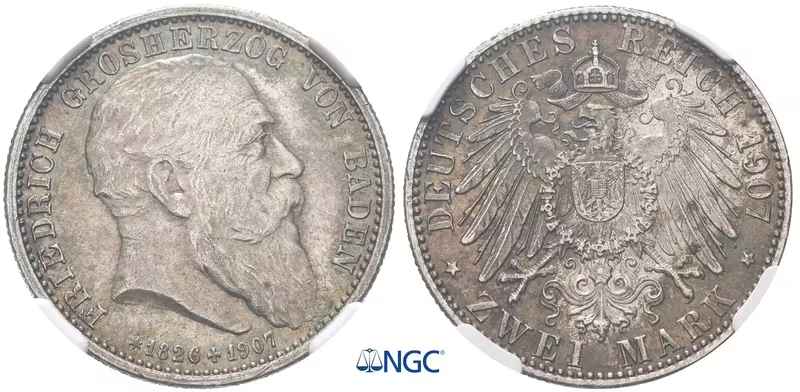
Baden, 2 Marka 1907 - Pamětní, MS 63
Baden, Friedrich I. (1856 - 1907) 2 Mark 1907 G - Na památku úmrtí, Karlsruhe, KM.278, J.36 , certifikace NGC, hodnocení MS 63, luxusní zachovalost
Skladem 1 ks - Code: NBBAD-BZ1907V
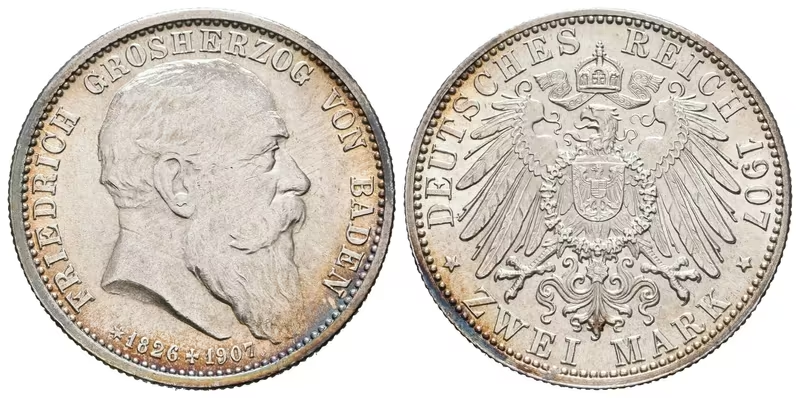
Baden, 2 Marka 1907 - Pamětní
Baden, Friedrich I. (1856 - 1907) 2 Mark 1907 G - Na památku úmrtí, Karlsruhe, KM.278, J.36 , krásná zachovalost, pěkná patina, ražební lesk, drobné rysky
Skladem 1 ks