Frederick II of Hohenstaufen
Frederick II of Hohenstaufen was Holy Roman Emperor reigning from 1220 to 1250, King of Sicily from 1198, and one of the most learned monarchs of the Middle Ages, whom his contemporaries called "Stupor Mundi" — the Wonder of the World. For Czech history he was a key figure when, in 1212, he issued the Golden Bull of Sicily, which elevated Bohemia to a her…
Frederick was born on 26 December 1194 in Jesi in central Italy as the son of Emperor Henry VI of Hohenstaufen and the Sicilian queen Constance of the Norman Hauteville dynasty. After his father's death in 1197, he inherited the Kingdom of Sicily as a three-year-old, while his uncle Philip of Swabia competed with Otto IV of Brunswick for the German crown. Frederick's childhood in Palermo shaped his cosmopolitan personality — he grew up in an environment where Latin, Greek, Arab, and Norman cultures intermingled.
Decisive for Frederick's rise was the support of Pope Innocent III, who became his guardian. When Otto IV of Brunswick broke his agreements with the Pope in 1211 and invaded southern Italy, Innocent backed the young Frederick as anti-king. A key role was played by the Bohemian king Přemysl Otakar I, who was the first of the imperial princes to support Frederick's candidacy. In return for this support, Frederick issued the Golden Bull of Sicily in Basel on 26 September 1212.
The Golden Bull of Sicily represented a landmark document in Czech history. In it Frederick confirmed the hereditary nature of the royal title within the Přemyslid dynasty, exempted Bohemia from most obligations toward the Empire apart from participation in coronation expeditions to Rome, and established that the Bohemian king had the right of investiture of bishops. Bohemia gained the status of an almost independent kingdom within the Empire. The document was named the Sicilian Bull after Frederick's first royal title.
After victory over Otto IV at the Battle of Bouvines in 1214, where Frederick's ally, the French king Philip II Augustus, fought, Frederick became sole king. In 1220 he was crowned emperor in Rome by Pope Honorius III. He promised to organise a crusade, which he fulfilled only in 1228, when he obtained Jerusalem by diplomatic means and had himself crowned King of Jerusalem, thereby antagonising the Pope.
Frederick's rule in Germany was marked by rivalry with his son Henry VII, whom he had installed as German king. When Henry rebelled in 1234, Frederick deposed and imprisoned him. He named his second son Conrad IV as the new king. In Germany he issued important law codes — the Mainz Land Peace of 1235, which prohibited private wars and strengthened the peace of the land.
History
Frederick's main residence remained southern Italy and Sicily, where he built a centralised state on the Byzantine model. In 1224 he founded the university in Naples, the first state university in Europe. At Melfi in 1231 he issued the Constitutiones Regni Siciliae, the most modern law code of the Middle Ages, inspired by Roman law. He built a network of castles including the famous Castel del Monte, a geometrically perfect structure combining European and Oriental elements.
The conflict with the papacy escalated under the pontificates of Gregory IX and especially Innocent IV. The Pope excommunicated Frederick in 1227 and again in 1239, branded him as the Antichrist, and convened the Council of Lyon in 1245, where the emperor was deposed. Frederick, however, had strong support among the German princes, including the Bohemian king Wenceslas I, who remained a loyal imperial partisan. The struggles between the imperial Ghibelline party and the papal Guelph party divided Italy for generations.
Frederick was an exceptionally learned monarch speaking six languages — Latin, German, Italian, French, Greek, and Arabic. He took an interest in the natural sciences, philosophy, poetry, and architecture. His court in Palermo was the centre of a school of translation, where Arabic scientific writings were translated into Latin. He wrote a treatise on falconry, "De arte venandi cum avibus", which is still valued today for its precise observations of bird behaviour.
Frederick II died on 13 December 1250 at Fiorentino Castle in Apulia, probably of dysentery. His death marked the end of the Hohenstaufen era and the beginning of the Great Interregnum in the Empire. His son Conrad IV died as early as 1254, and his grandson Conradin was executed in 1268, by which the Hohenstaufen dynasty died out in the male line.
Frederick II carried out a fundamental monetary reform that influenced all of Europe, including Bohemia. In 1231 he introduced the augustale in the Kingdom of Sicily, a gold coin struck on the Byzantine model with the emperor's portrait in Roman style. It was the first gold coin with a realistic portrait of a ruler struck in Western Europe since the fall of Rome. The augustale became the model for later European gold issues, including the Bohemian florins of Charles IV.
Economic policy and minting
In Germany, Frederick supported the development of municipal minting. He granted minting rights to many towns, which led to the flourishing of regional currencies. This decentralisation, although weakening imperial power, fostered economic development. Bohemian minting of this period benefited from the privileges of the Golden Bull of Sicily — the Bohemian kings had the exclusive right of minting without imperial oversight.
Frederick's economic policy in Sicily was revolutionary. He introduced state monopolies on the production of silk, salt, and certain other commodities. He built an efficient tax system with regular censuses of population and property. The revenues of the Sicilian crown were the highest in Europe, which made it possible to finance costly buildings and wars. This model of a centralised economy later inspired absolutist monarchies.
Of fundamental importance for commerce was Frederick's protection of merchants and markets. He introduced uniform weights and measures in the Kingdom of Sicily, punished coin counterfeiting with death, and guaranteed the safety of trade routes. He supported maritime trade with the Orient; his fleet controlled the central Mediterranean. The Czech lands benefited from this prosperity indirectly through commercial contacts with Italian cities.
In our auction and shop
- Code: ZSRAK-E1976
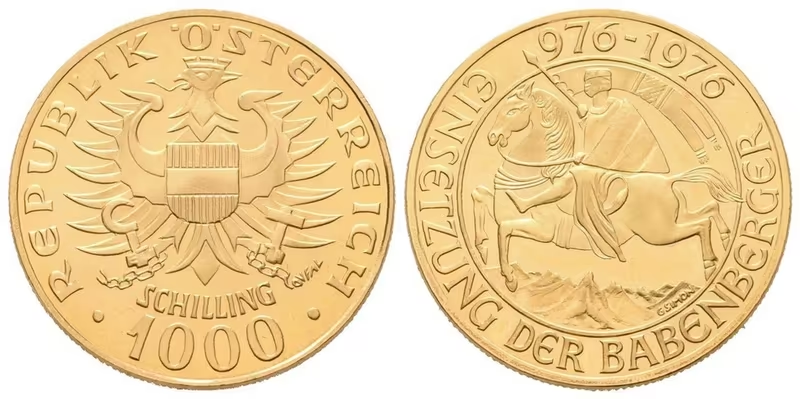
Rakousko, 1000 Schilling 1976 - Babenberg
Rakousko, II. republika (1945 - ) 1000 Schilling 1976 - Babenbergové, Au 0,900, 27 mm (13,5 g), pův. etue Rakouské národní banky Babenberkové ( německy Babenberger ) byl německo-rakouský šlechtický rod původem z Frank ( Bamberg ), v letech 976 až 1246…