Galerius Maximianus
Galerius Maximianus was a Roman emperor reigning from 305 to 311, who became one of the key figures of the late Roman Empire during the period of the Tetrarchy. This capable general and stern administrator became famous above all as the last great persecutor of Christians and as the author of the Edict of Toleration, which paradoxically ended the systemat…
Gaius Galerius Valerius Maximianus was born around 250 in Serdica, today's Sofia, or according to other sources in Dacia near Florentina. He came from humble circumstances, his father being a herdsman and his mother coming from a barbarian tribe beyond the Danube. The young Galerius entered the Roman army, where, thanks to his physical strength, military abilities, and unyielding nature, he rose rapidly through the ranks. His career was significantly influenced by his meeting with the future emperor Diocletian, who recognised his military talent during the campaign against the Persians.
In 293 Galerius was appointed Caesar for the eastern part of the Empire within Diocletian's Tetrarchy, the system of rule by four emperors. In order to consolidate his position, he had to divorce his first wife and marry Diocletian's daughter Valeria. As Caesar he obtained control over the Balkan provinces, including Pannonia, Moesia, and Thrace. His main task was the defence of the Danube frontier against the barbarian tribes and the conduct of wars against the Sasanian Empire in the east. Galerius proved excellent military abilities in several successful campaigns against the Sarmatians and the Carpi on the Danube.
Galerius achieved his greatest military success in the Persian war in the years 296 to 298. After an initial defeat at Carrhae, for which he was publicly humiliated by Diocletian, he reorganised the eastern army and in 298 achieved a decisive victory over the Persian king Narseh. He captured the Persian capital Ctesiphon, took the royal family prisoner, and forced Persia into a peace which secured for Rome control over Mesopotamia and Armenia for another forty years. This triumph significantly strengthened Galerius's prestige and influence in the Tetrarchy.
History
After Diocletian's abdication on 1 May 305 Galerius became Augustus for the east together with Constantius Chlorus in the west. As senior Augustus he obtained de facto control over the entire Empire and appointed new Caesars according to his own will, by which he disrupted Diocletian's system of succession. His reign was marked by the continuing persecution of Christians, which he had already initiated as Caesar. Galerius's edict of 303 ordered the destruction of churches, the burning of Christian writings, and the imprisonment of clergy, which led to the harshest persecution in the history of the early Church.
In the last years of his reign Galerius faced the growing instability of the Tetrarchy and revolts by usurpers. His attempt to control the western part of the Empire after the death of Constantius Chlorus failed when the army proclaimed Constantine Augustus. In 310 Galerius fell ill with a mysterious disease, probably bowel cancer, which caused unbearable pains. In April 311, shortly before his death, he surprisingly issued the Edict of Toleration, which ended the persecution of Christians and allowed them the free practice of their faith. He died in May 311 in Serdica, thus ending one of the most controversial reigns of the late Empire.
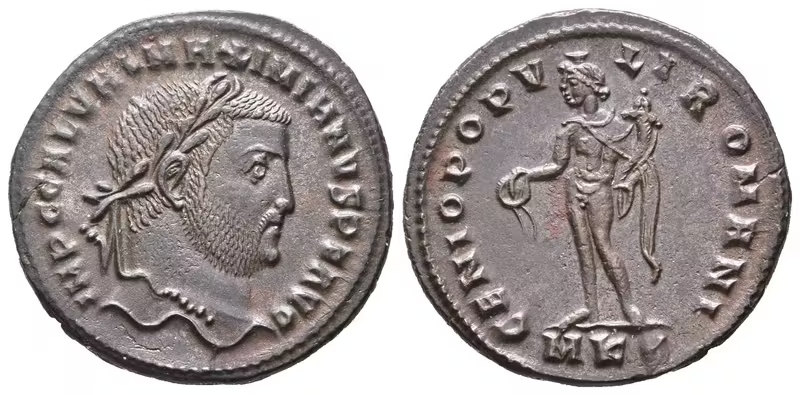
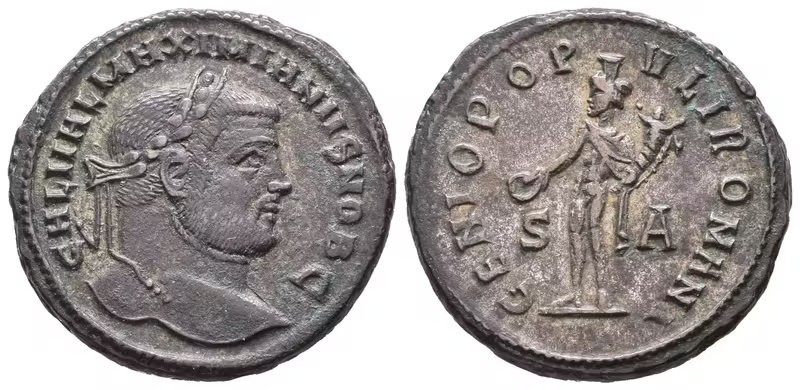
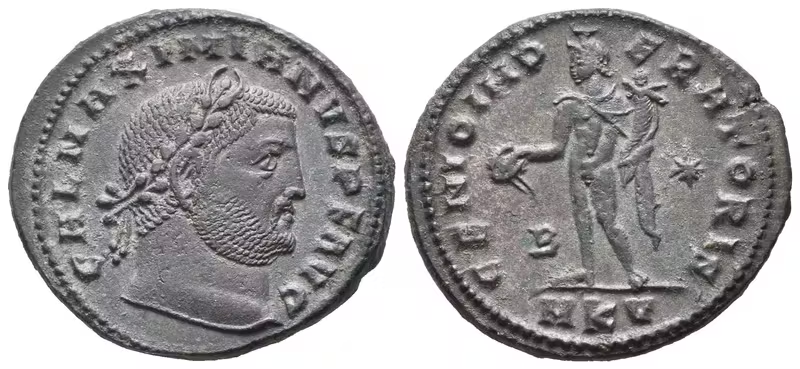
Galerius struck coins in all the main mints of the eastern part of the Empire, especially in Antioch, Alexandria, Cyzicus, and Serdica. His portraits on the coins depict a massive figure with a pronounced chin and stern expression, which reflected his military nature. On the reverses of his coins, military motifs most often appear, such as Victory, Mars, or Jupiter, emphasising his role as protector of the Empire. Significant are the coins with the legend GENIO POPVLI ROMANI, which expressed his conception of divine protection of the Roman people.
His reign and minting
Galerius's economic policy continued Diocletian's reforms of the monetary system. He introduced new denominations, including the solid gold aureus, and improved the quality of the silver argenteus. His mints produced enormous quantities of bronze folles, which formed the basis of ordinary circulation. Galerius sought to stabilise inflation by controlling prices and wages through the Edict on Maximum Prices. On the coins he propagated the Tetrarchic ideology through legends such as CONCORDIA MILITVM and VIRTVS EXERCITVS, emphasising the unity of the army and the emperors.
The administrative reforms of Galerius included the reorganisation of the provinces and the strengthening of the bureaucratic apparatus. He divided the large provinces into smaller units for better control and more efficient collection of taxes. He introduced a new tax system based on regular censuses of population and property. His building activity included the construction of the palace at Thessaloniki, the triumphal arch, and the mausoleum at Romuliana, his native town renamed Felix Romuliana. These monumental buildings, partly preserved to this day, testify to Galerius's efforts to legitimise his rule through architecture.
In our auction and shop
- Code: BE122-0035
Galerius, follis, Cyzicus, RIC 35
Galerius (305 - 311) mincovna Cyzicus, raženo cca 308 - Galerius jako augustus, génius držící modius a roh hojnosti, GENIO POPVLI ROMANI, RIC 35
Skladem 1 ks - Code: BE122-0081
Galerius, follis, Siscia, RIC 81
Galerius (305 - 311) mincovna Siscia, raženo 294 (Galerius jako caesar), génius držící modius a roh hojnosti, GENIO POPVLI ROMANI, RIC 81
Skladem 1 ks - Code: BE122-0035.1Recommended
Galerius, follis, Cyzicus, RIC 35.1
Galerius (305 - 311) mincovna Cyzicus, raženo cca 308 - Galerius jako augustus, génius držící modius a roh hojnosti, GENIO POPVLI ROMANI, RIC 35 var.
Skladem 1 ks