Grande Armée
The Grande Armée, in English the Great Army, was the main military force of the French Empire under the rule of Napoleon Bonaparte. This army, reaching in 1812 a strength of over 600,000 men, represented the largest military formation Europe had seen up to that time.
The Grande Armée was officially established in August 1805 at the camp at Boulogne, where Napoleon was concentrating forces for the planned invasion of Britain. When the invasion proved unfeasible after Nelson's victory at Trafalgar, Napoleon turned his army against his continental enemies. The Great Army became the instrument of lightning campaigns which during the following years remade the political map of Europe.
The core of the Grande Armée was made up of veteran units which had passed through the revolutionary wars and the Italian campaigns. Napoleon inherited an army which the revolutionary governments had transformed from a royal mercenary force into a national defence force based on universal military service (levée en masse). This system made it possible to mobilise far greater numbers of men than the traditional professional armies of the monarchical states.
Organisationally, the Grande Armée was divided into army corps (corps d'armée), self-sufficient units numbering 15,000 to 30,000 men under the command of marshals. Each corps had its own infantry, cavalry, artillery, and support services, which made independent operations possible. Napoleon could disperse the corps for marching and supply and rapidly concentrate them for battle — a tactic which repeatedly surprised and defeated enemies.
Among the most famous marshals of the Grande Armée were Michel Ney, called the bravest of the brave, Louis-Nicolas Davout, the only marshal who never lost a battle, Jean Lannes, Napoleon's personal friend killed at Aspern, and Joachim Murat, the brilliant cavalry commander and later king of Naples. In all, Napoleon appointed 26 marshals, each of whom commanded an army corps or an independent army.
History
The campaign of 1805 demonstrated the capabilities of the Grande Armée in full force. Within a few weeks, Napoleon encircled and forced the Austrian army to capitulate at Ulm, occupied Vienna, and on 2 December 1805 crushed the joint Russo-Austrian forces at the Battle of Austerlitz. This victory in the Battle of the Three Emperors is considered Napoleon's military pinnacle and a demonstration of his genius in manoeuvre warfare.
In the following years the Grande Armée continued its chain of victories. Prussia was defeated within a mere three weeks in the campaign of 1806, ending with the battles of Jena and Auerstedt. Russia capitulated after Friedland in 1807. Austria was again defeated at Wagram in 1809. Napoleon controlled practically the whole of continental Europe and his army seemed invincible.
The turning point came with the Russian campaign of 1812. Napoleon assembled the largest army in history up to that time — over 600,000 men from France and the satellite states, including Polish, Italian, German, Swiss, and even Austrian and Prussian contingents. The campaign ended in catastrophe — fewer than 100,000 men of the Grande Armée returned. The Russian winter, partisan warfare, epidemics, and above all the breakdown of the supply system destroyed the most famous army of its time.
The Grande Armée introduced a number of military innovations which influenced warfare for decades. The corps system made flexible operations across extensive territories possible. The mass deployment of artillery at decisive moments of the battle became Napoleon's characteristic tactic. The emphasis on speed of movement and the surprise of the enemy contrasted with the slow manoeuvres of the armies of the 18th century.
Military system
Training and morale formed the basis of the Grande Armée's successes. Napoleon personally inspired his soldiers and created a cult of the imperial soldier (grognard). Veterans of old campaigns enjoyed special respect and formed the backbone of the army. The system of promotion based on merit rather than noble birth opened career possibilities for talented officers from the lower classes — Napoleon himself recalled that every soldier carries a marshal's baton in his knapsack.
Logistics was at one and the same time the strong and the weak side of the system. The Grande Armée was largely supplied by requisitions in the occupied territories, which made rapid marches without dependence on slow supply trains possible. In the wealthy areas of Central Europe this system worked, but in sparsely populated Russia or arid Spain it led to the collapse of the army.
In our auction and shop
- Code: SKUB-O1998G
Kuba, 10 Pesos 1998 – Rio Grande
10 Pesos 1998 - Rio Grande, Rio Bravo, Hamburg - Habana Ag 0,999, 30 mm (15 g), Proof
- Code: SSPAN96-A1966
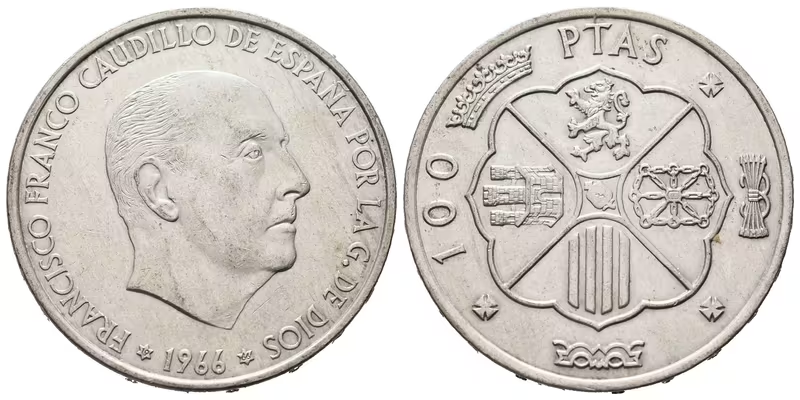
Španělsko, 100 Pesetas 1966 - Franco
Španělský stát, Francisco Franco (1936-1975) 100 Pesetas 1966 - Franco, KM# 797 Ag (.800), 34 mm (19 g). Mincovna: Madrid - Španělsko. Hrana: s nápisem "🟌 UNA 🟌 🟌 GRANDE 🟌 🟌 LIBRE 🟌". Autor: Manuel Marín Jimeno. Lit.: KM# 797.
- Code: ZSFRA-96K2010
Francie, 50 Euro 2010 - Lille Europe TGV
Francie, V. republika (1958 - ) 50 Euro 2010 - Gare Lille Europe - TGV (Trains á Grande Vitesse), vysokorychlostní železniční vlak Au 0,920, 22 mm (8,45 g), 1/4 Oz, limitovaná edice, náklad 1000 ks, certifikát, etue, PROOF