Battle of Austerlitz
The Battle of Austerlitz (Slavkov) took place on 2 December 1805 near Brno and ended with a decisive victory of Napoleon Bonaparte over the Austro-Russian army. The clash is known as the Battle of the Three Emperors because the names of Napoleon Bonaparte, Alexander I and Francis II are associated with it.
The Battle of Austerlitz took place at a time when Europe faced the rapid rise of the French Empire. Against Napoleon the Third Coalition formed, in which the Austrian Empire and the Russian Empire played the leading role. Its aim was to halt French expansion and restore the balance of power, which Napoleon's previous victories had substantially disrupted. Military operations in the autumn of 1805 moved into Central Europe, and Moravia also became a battlefield.
The coalition army, linked with the authority of Alexander I and the Austrian emperor Francis II, concentrated in an area to the east of Brno. Napoleon, known for his ability to work with information and to manoeuvre quickly, sought to lure his opponent into a decisive attack on conditions favourable to the French. Slavkov was thus not a "random" clash but the result of a strategic contest, in which both the psychological and the logistical sides of the conduct of war played a role.
On 2 December 1805 the battle took place which soon became Napoleon's most famous. The French managed to disrupt the coalition's plan, seize key positions and gradually force the opponent into retreat. The result had immediate political consequences: Austria was forced to conclude the Treaty of Pressburg, and the European arrangement shifted once more in favour of France. Austerlitz moreover belongs among the events that prefigured the demise of the Holy Roman Empire in the following year and the overall transformation of Central Europe.
History
In the Bohemian lands the battle left a deep mark also because it took place in a densely populated area and affected the local population. Apart from military glory, it brought also the image of war as a human tragedy, which is reflected in places of remembrance and in commemorative traditions still associated with the battlefield today.
The Austerlitz battlefield is linked with a dense network of memorials and with a tradition of anniversary events. In the Bohemian environment the best-known symbol is the Cairn of Peace near Prace, which commemorates the victims of the battle and the transformation of the view of military history, from celebration of victory to remembrance and commemoration of human losses. This very combination of "great history" and a concrete place in the landscape makes Austerlitz exceptionally attractive even for those interested in history.
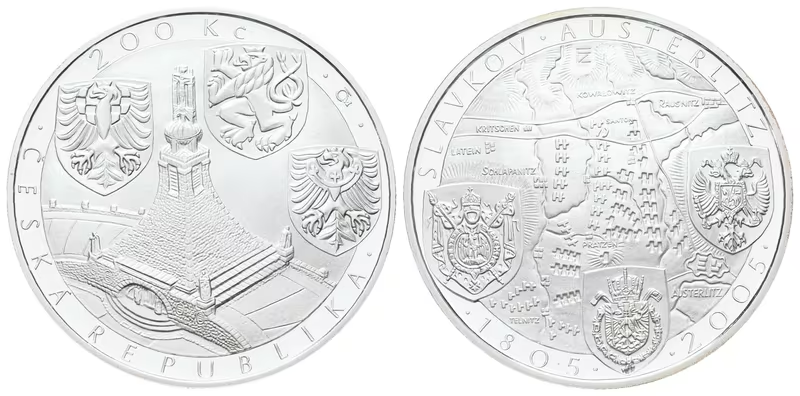
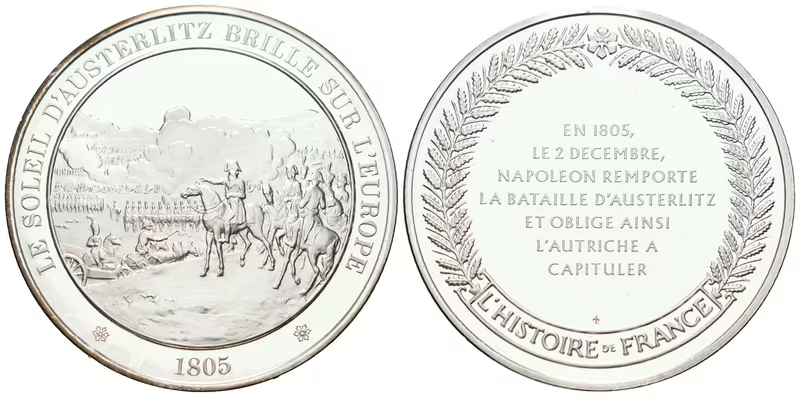
Numismatics responded to Austerlitz already in the 19th century and continues to do so today. Commemorative medals and themed strikes arise that work with motifs of the three sovereigns, with a map of the battlefield or with iconic memorials. Modern mints regularly issue Austerlitz issues, and for collectors they are often an accessible entry into the theme of the Napoleonic Wars without the need to seek out rare contemporary medals.
Memory of the place and numismatic commemorations
With commemorative strikes it pays to watch above all the metal parameters (fineness), weight, mintage, certificate and reputation of the issuer. If, on the contrary, you collect contemporary objects from the Napoleonic era, provenance and expert determination are key, since the market is sensitive to modern imitations. Austerlitz is a typical theme in which historical numismatics, modern commemorative medals and tourist souvenir strikes can coexist, and each of these categories is evaluated by different criteria.
In our auction and shop
- Code: MCZ050-PROOF
200 Kč 2005 - Bitva u Slavkova, PROOF
Česká republika (1993 - ) 200 Koruna 2005 - 200. výročí bitvy u Slavkova, autor Zbyněk Fojtů, Aurea C150, etue, certifikát, PROOF Ag 0,900, 31 mm (13 g), raženo 11 335 ks (běžná kvalita), 8 197 ks (proof)
Skladem 4 ks - Code: RX-FRAN064
Francie - AR Medaile b.l. - Austerlitz
Austerlitz - 1805 Ag 0,800, 44 mm (cca. 37 g) Na minci se nachází Francouzský punc ryzosti. V originální kapsli. Medaile je ze série 'Historie Francie v medailích' - Na některých mincích jsou viditelné stopy patiny aj. - Viz. obrázek. L'Histoire de…