French Empire
The French Empire was a European empire existing in two periods - as the First French Empire (1804-1814/1815) under Napoleon I and the Second French Empire (1852-1870) under Napoleon III, which transformed France from a republic into a mighty European empire with extensive influence. The French Empire is in numismatics famous for the gold Napoleons, the s…
The First French Empire arose on 18 May 1804, when Napoleon Bonaparte had himself crowned Emperor of the French in the cathedral of Notre-Dame in Paris. Napoleon had taken power by the coup of 18 Brumaire in 1799 as the First Consul of the republic, but gradually concentrated power in his own hands, and in 1804 declared himself emperor. The coronation took place in the presence of Pope Pius VII, but Napoleon placed the crown on his own head, thereby symbolically showing his independence from the Church.
Napoleon transformed revolutionary France into a modern centralised state. He issued the Civil Code (Code Napoleon), which influenced legal systems throughout the world, reorganised the education system, founded the Bank of France, and built an efficient administration. At the same time he waged a series of wars against the European coalitions, which sought to stop French expansion and restore the old order.
The Napoleonic Wars (1803-1815) transformed the map of Europe. Napoleon defeated the Austro-Russian coalition at Austerlitz in 1805, the Prussians at Jena and Auerstadt in 1806, and the Russians at Friedland in 1807. The peak of French power was the Peace of Tilsit in 1807, when Napoleon controlled, directly or indirectly, most of continental Europe. The French Empire encompassed territory from Hamburg to Rome and from Warsaw to Madrid.
The Continental Blockade against England, however, led to a conflict with Russia and the catastrophic campaign of 1812. The loss of the Grande Armee in the Russian snows began the decline of Napoleonic power. The coalition of European powers gradually liberated the occupied territories and in 1814 forced Napoleon to abdicate. After the Hundred Days and the definitive defeat at Waterloo in 1815, the empire was ended and Napoleon was sent into exile on St Helena.
History
After the fall of Napoleon came the restoration of the Bourbons (1815-1830), the July Monarchy (1830-1848), and the Second Republic (1848-1852). Louis-Napoleon Bonaparte, nephew of the emperor, became president of the republic but in 1851 carried out a coup d'etat and in 1852 declared himself emperor as Napoleon III, thereby founding the Second Empire.
The Second French Empire (1852-1870) represented a period of economic flourishing and territorial expansion. Napoleon III carried out the modernisation of Paris under the leadership of Baron Haussmann, supported the Industrial Revolution, and pursued colonial expansion into Africa and Asia. France intervened in European politics - it supported the unification of Italy against Austria and waged the Crimean War alongside England against Russia.
The end of the Second Empire came with the Franco-Prussian War of 1870. Napoleon III underestimated Prussian military strength and after the defeat at Sedan was taken prisoner together with the whole French army. Paris proclaimed the Third Republic and the empire definitively ended. Napoleon III died in English exile in 1873, ending the Bonapartist dynasty.
The Napoleonic legacy, however, endured long after the fall of the empire. The Civil Code, the metric system, the administrative reforms, and the educational system influenced the development of modern states throughout the world. The Napoleonic Wars also contributed to the awakening of European nations and laid the foundations of modern nationalism.
French imperial coinage
Napoleonic coinage represented the watershed between the Old Regime and modern coinage. Napoleon I abolished the revolutionary calendar and restored the traditional French coinage system based on the franc, but with new imperial motifs. The basic coin became the silver 5-franc thaler with Napoleon's portrait, which replaced the revolutionary coins with allegorical motifs of the republic.
The most famous Napoleonic coins were the gold Napoleons - 20-franc pieces with the imperial portrait and the French imperial eagle on the reverse. These coins were struck in enormous quantities and became a basic international means of payment, replacing the Spanish escudos. Napoleon's coins were distinguished by their high quality and precise portraits, which captured the evolution of the emperor's appearance from young general to elderly ruler.
During the empire representative and commemorative coins were also struck, celebrating military victories, dynastic births (the King of Rome), and significant events such as coronations or peace treaties. These coins used allegorical symbolism - victorious France, the peace olive branch, military trophies, and references to ancient Roman models. The propagandistic character of Napoleonic coins influenced later modern coinage.
Napoleon III took up his uncle's coinage tradition but adapted it to the 19th century. The Second Empire struck modern coins with portraits of the emperor and Empress Eugenie, while technical quality attained a new level thanks to steam engines and industrial methods. The French imperial coins influenced the coinage of many countries, which adopted French models and technologies.
In our auction and shop
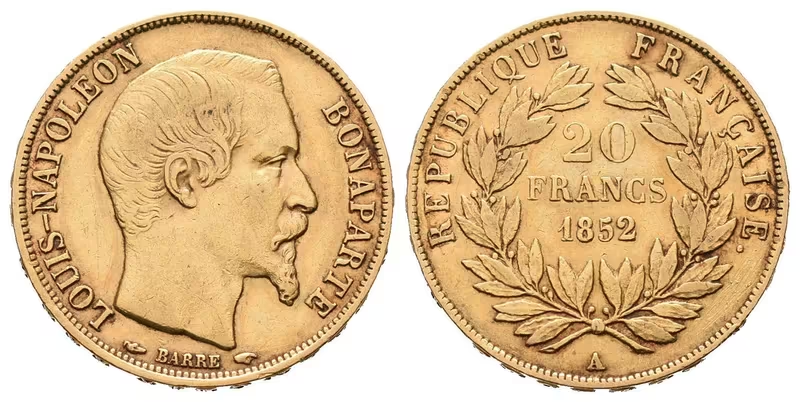
- Code: ZSFRA-89F1852
Francie, 20 Frank 1852 A
Francie, Napoleon III. ( 1852 - 1870) 20 Frank 1852 A - jako president II. republiky, mincovna Paříž Au 0,900, 21 mm (6,4516 g), KM. 774 Charles Louis Napoleon Bonaparte jinak též Napoleon III. (20. dubna 1808 – 9. ledna 1873) byl syn krále Ludvíka…
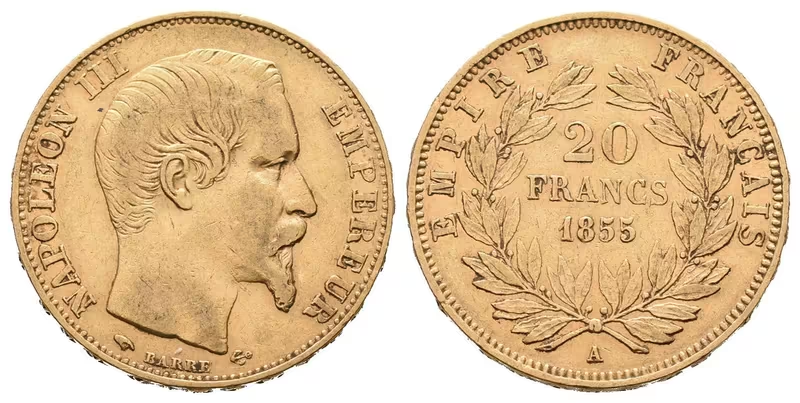
- Code: ZSFRA-89F1855.1
Francie, 20 Frank 1855 A
Francie, Napoleon III. ( 1852 - 1870) 20 Frank 1855 A, mincovna Paříž Au 0,900, 21 mm (6,4516 g), KM. 781.1 Charles Louis Napoleon Bonaparte jinak též Napoleon III. (20. dubna 1808 – 9. ledna 1873) byl syn krále Ludvíka Bonaparta a královny Hortensie de…
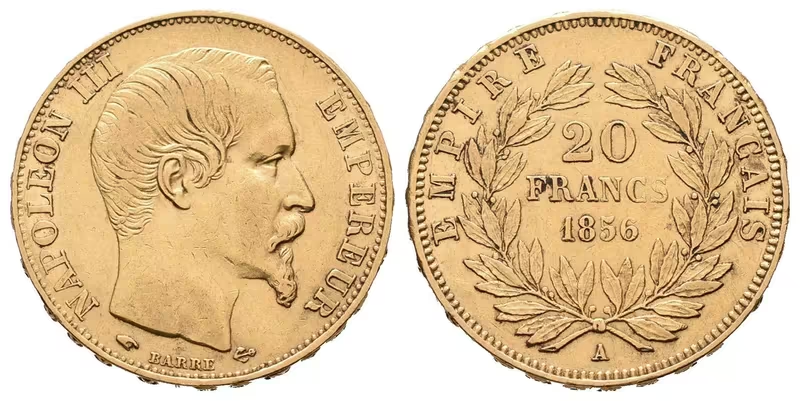
- Code: ZSFRA-89F1856
Francie, 20 Frank 1856 A
Francie, Napoleon III. ( 1852 - 1870) 20 Frank 1856 A, mincovna Paříž Au 0,900, 21 mm (6,4516 g), KM. 781.1 Charles Louis Napoleon Bonaparte jinak též Napoleon III. (20. dubna 1808 – 9. ledna 1873) byl syn krále Ludvíka Bonaparta a královny Hortensie de…
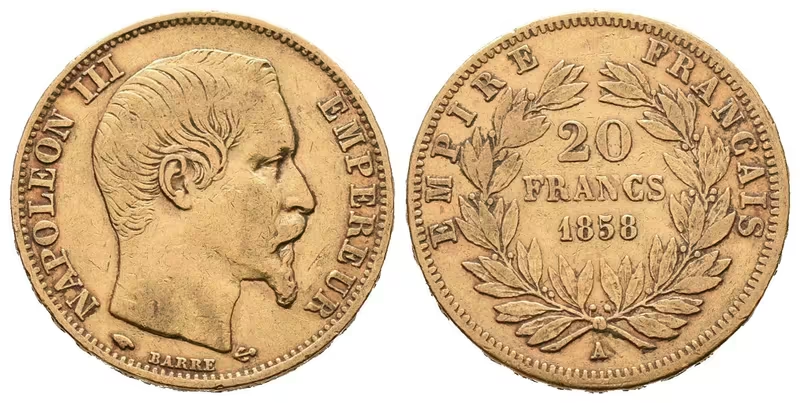
- Code: ZSFRA-89F1858
Francie, 20 Frank 1858 A
Francie, Napoleon III. ( 1852 - 1870) 20 Frank 1858 A, mincovna Paříž Au 0,900, 21 mm (6,4516 g), KM. 781.1 Charles Louis Napoleon Bonaparte jinak též Napoleon III. (20. dubna 1808 – 9. ledna 1873) byl syn krále Ludvíka Bonaparta a královny Hortensie de…