Madrid
Madrid is the capital of Spain and one of the most significant cities of the Iberian Peninsula. Since the 16th century it has fulfilled the role of the country's political centre and thanks to this has become a key place for state administration, trade and coinage, which belongs among the important chapters of Spanish history.
Madrid has its origins in the Middle Ages, when a fortified seat arose at a strategic place in the interior, intended to control the surrounding region and to protect communications. The real ascent, however, came only in the early modern period. The turning moment was the decision of Philip II, who in 1561 transferred the court to Madrid and made of it the permanent seat of the monarchy. With this the city was transformed from a regional centre into the heart of the empire, from where the administration of extensive possessions in Europe and overseas was directed.
The choice of Madrid had practical reasons. Its location in the centre of the country made the administration of the kingdom easier, the city was not too closely tied to the power of the old regional elites and at the same time offered enough space for the growth of the court, the offices and the supply structures. The presence of the court attracted the nobility, church institutions and merchants, whereby the social composition of the city changed. In a short time new palaces, monasteries, offices and communications were arising, because the royal administration required an extensive infrastructure.
History
In the 17th century Madrid became a symbol of Spanish power, but at the same time bore the weight of the economic troubles that affected the whole kingdom. Nevertheless the city grew, because the court and the officialdom created a permanent demand for services, crafts and food. Cultural life in the era of the Habsburg sovereigns acquired extraordinary strength, and Madrid became one of the centres of European Baroque. In the later period, after the accession of the Bourbons to the Spanish throne, the city saw further urban and administrative changes intended to make the running of the state more efficient and to modernise the metropolis.
The Napoleonic era and the 19th century brought Madrid a turbulent period of wars, political upheavals and disputes over the shape of the modern state. At the same time infrastructure, transport and industrial facilities developed, so that the city gradually acquired the features of a modern metropolis. In the 20th century Madrid was affected by the Civil War and the subsequent dictatorship, but after the return of democracy the city rapidly transformed into a dynamic European centre which combines a historical layer with modern administration, services and culture.
The metropolis and its connections with coinage
Madrid is important for numismatics above all because, as the seat of the monarchy, it concentrated the key institutions which took part in the management of the currency, finance and state expenditure. In the early modern period and later, coinage belonged among the basic instruments of state power: the coin was not merely a practical means of payment but also a public symbol of the sovereign and proof that the state guaranteed the weight and fineness of the metal. For this reason Spanish coins are often distinguished by a prominent titulature and state symbolism intended to reinforce confidence in circulation.
As the centre of administration, Madrid attracted money from the entire kingdom and from colonial trade. Payments for the army, the offices and contractors were concentrated in the great city, so that there was a very lively circulation of silver and gold coins here. From the collector's point of view, Madrid is also interesting because the Spanish monetary world was long tied to the flow of precious metals from America, which affected both the quantity of coins in circulation and the economic policy of the state. In a numismatic collection, therefore, Madrid represents rather a "node" of history: the place from which decisions about the currency were taken, and at the same time the city where the results of those decisions were daily reflected in trade and finance.
In our auction and shop
- Code: SSPAN90-D1807M
Španělsko, 2 Real 1807 M-AI
Španělsko, Carlos IV., 1788 - 1808 2 Reales 1807 M-A.I., Madrid-Goycoechea Urquiza, pěkná zachovalost a patina, drobné rysky
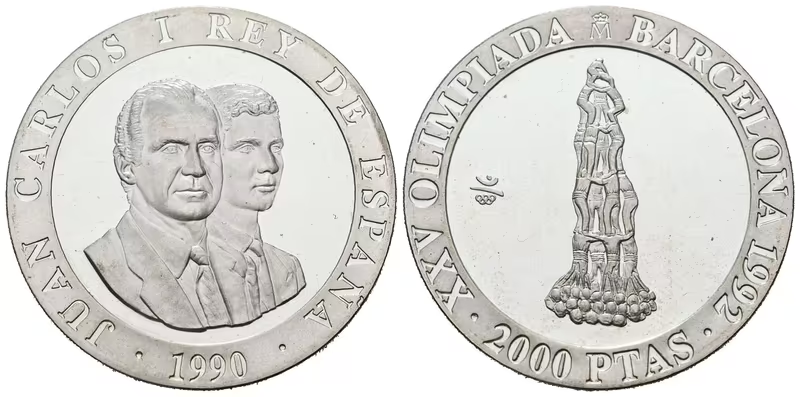
Skladem 1 ks - Code: SSPAN-C1990B
Španělsko, 2000 Pesetas 1990 - Castell
Španělské království, Juan Carlos I. (1975-2014) 2000 Pesetas 1990 - Castell, KM# 863 Ag (.925), 40 mm (27 g), proof, bez kapsle. Emise: 73 510 ks. Hrana: vroubkovaná. Mincovna: Královská mincovna v Madridu - Španělsko. Pamětní neoběžná mince, vydaná k…
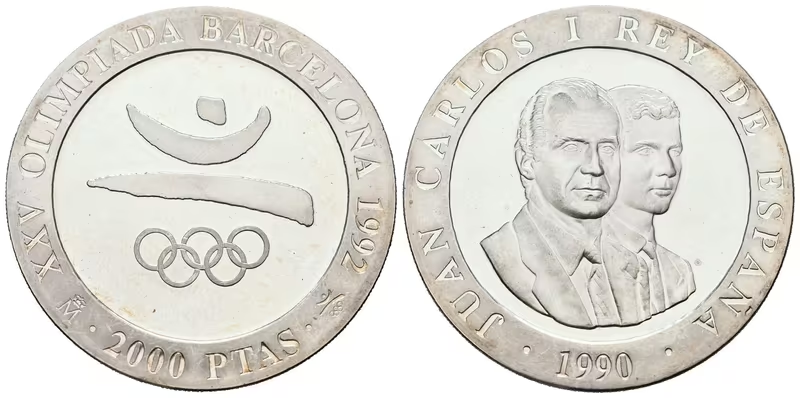
Skladem 1 ks - Code: SSPAN-C1990C
Španělsko, 2000 Pesetas 1990 - Logo
Španělské království, Juan Carlos I. (1975-2014) 2000 Pesetas 1990 - Logo, KM# 859 Ag (.925), 40 mm (27 g), proof, bez kapsle. Emise: 130 993 ks. Hrana: vroubkovaná. Mincovna: Královská mincovna v Madridu - Španělsko. Pamětní neoběžná mince, vydaná k…
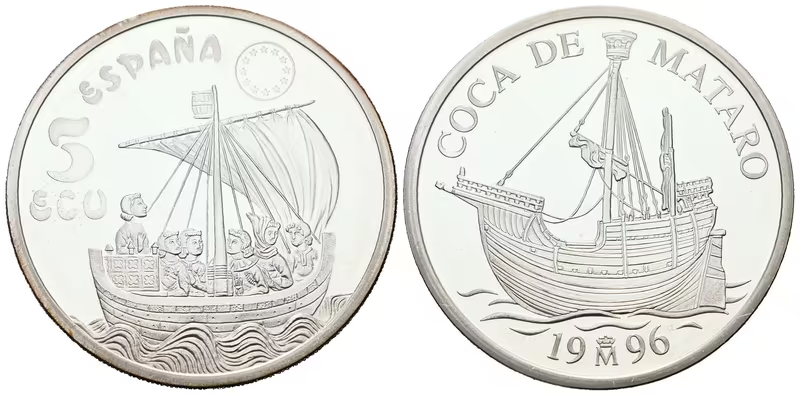
Skladem 1 ks - Code: SSPAN-Z1996
Španělsko, 5 ECU 1996 - Coca de Mataro
Španělské království, Juan Carlos I. (1975-2014) 5 ECU 1996 - Coca de Mataro, X# M17 Ag (.925), 42 mm (33 g), proof. V kapsli. Emise: 43 802 ks. Mincovna: Královská mincovna v Madridu - Španělsko. Fiktivní platidlo / Fantasy mince; pamětní - série…
Skladem 1 ks