The House of Habsburg-Lorraine
The Habsburg-Lorraine dynasty (1736–1918) was the last ruling dynasty of the Austrian Empire and of Austria-Hungary, which arose from the marriage of Maria Theresa of Habsburg with Francis Stephen of Lorraine and became famous as one of the most powerful European monarchies ruling a vast central and eastern European realm, but came to an end after defeat…
The dynasty arose in 1736 with the marriage of the Archduchess Maria Theresa to Francis Stephen, Duke of Lorraine, which ended the male line of the Habsburgs. Charles VI's Pragmatic Sanction secured Maria Theresa's inheritance of the Austrian lands, but the European powers questioned the female succession, which led to the War of the Austrian Succession (1740–1748).
Maria Theresa (1740–1780) became the founder of the new dynasty and one of the greatest Austrian sovereigns. She faced attacks from Prussia, France and Bavaria, but managed to defend the majority of her holdings and to reform the monarchy. Her husband Francis I was elected Emperor of the Holy Roman Empire, by which the Habsburg-Lorraine dynasty acquired the imperial crown.
The Enlightenment reforms under Joseph II (1780–1790) represented an attempt at modernising the monarchy on rational principles. Joseph abolished serfdom, introduced religious toleration and reorganised the administration, but his radical reforms provoked the resistance of the conservative estates and had to be partly rescinded.
The Napoleonic Wars (1792–1815) brought an existential crisis for the monarchy. Francis II/I had to face French expansion, lost the title of Emperor of the Holy Roman Empire in 1806, but proclaimed himself Emperor of Austria. The coalitions against Napoleon ultimately prevailed, and the Congress of Vienna in 1815 restored Austrian power in Europe.
The Biedermeier and pre-March eras characterised the reign of Francis I and Ferdinand V as a period of political reaction but cultural flourishing. Metternich's system suppressed liberal and national movements, but the monarchy experienced economic growth and peaceful prosperity until the revolutions of 1848.
History
The Revolution of 1848–1849 shook the monarchy and forced Ferdinand V to abdicate in favour of the young Francis Joseph I. The new emperor suppressed the revolutions but had to carry out constitutional reforms and gradually to liberalise the system. The loss of Lombardy and later of Venetia weakened the Austrian position in Italy.
The Austro-Hungarian Compromise of 1867 transformed the absolutist empire into a dualist monarchy. Francis Joseph I became Emperor of Austria and King of Hungary in a personal union. This reform stabilised the monarchy and enabled economic flourishing, but did not resolve the problem of the other nationalities.
The long reign of Francis Joseph I (1848–1916) brought modernisation, industrialisation and cultural flourishing, but also growing national problems. The Sarajevo assassination of the heir to the throne, Francis Ferdinand, in 1914, set off the chain of events leading to the First World War.
The First World War (1914–1918) meant the end of the monarchy. Charles I, the last Habsburg-Lorraine emperor, attempted a separate peace and the federalisation of the monarchy, but it was too late. Military defeat and national revolutions led to the disintegration of the monarchy and the proclamation of republics in the Austrian lands.
The fall of the monarchy in November 1918 ended more than 650 years of Habsburg rule in central Europe. Charles I abdicated, but did not renounce his claims to the throne. The Habsburg-Lorraine dynasty continues to this day in exile, while its former lands have become independent republics.
The Habsburg-Lorraine dynasty in numismatics
The coins of the Habsburg-Lorraine dynasty document the 182-year reign of the last Austrian emperors and represent one of the most extensive European numismatic collections. The portraits of the emperors from Maria Theresa to Charles I reflect the development of artistic styles from Baroque to Art Nouveau and document the political changes from absolutism to constitutional monarchy.
Characteristic motifs are the Habsburg coat of arms with the double-headed eagle, the Austro-Hungarian crowns and the titles in the various languages of the monarchy. The coins of Maria Theresa and Joseph II bear Enlightenment symbols and Classicist design, while the later issues document the Romantic and Historicist artistic currents of the 19th century.
The thalers and ducats of Maria Theresa rank among the most famous European coins and were an internationally recognised trade currency right into the 20th century. The design with the portrait of the empress and the Habsburg coat of arms became the standard for Austrian coins and influenced the numismatics of the whole of central Europe.
Commemorative coins for important anniversaries and events document dynastic history—coronations, weddings, jubilees and deaths of members of the imperial family. The issue marking the 60th jubilee of Francis Joseph I in 1908 represents the high point of Austro-Hungarian coinage with magnificently executed portraits and allegorical motifs.
In our auction and shop
- Code: XB1300-0408
Chaurova sbírka - Habsbursko-lotrinská dynastie a její zakladatelé (1740-1918)
Jan Boublík České, moravské a slezské mince 10. - 20. století - Habsbursko-lotrinská dynastie a její zakladatelé (1740 - 1918) Praha 2014, 272 stran, vázané
- Code: RX-RAK-001
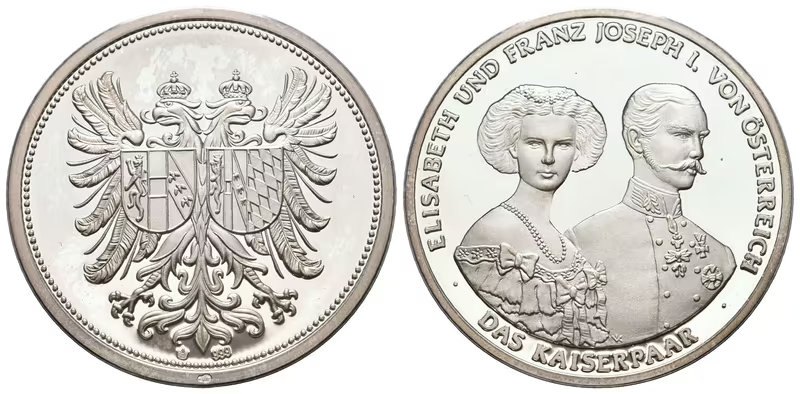
Rakousko, medaile - Císařský pár - Elisabeth a František Josef I.
Rakouské císařství - habsbursko-lotrinská dynastie Medaile - Císařský pár - Elisabeth a František Josef I. Ag (.999), 35 mm (15 g), v kapsli. Stav mince odpovídá fotografii. Jedná se o druhotný prodej. (Možná oxidace, atd.. ! - VIZ FOTOGRAFIE !)