Imam
The imam is an Islamic religious leader who leads prayers in the mosque, but in Shia Islam he also represents the spiritual and political successor of the Prophet Muhammad with divine authority and infallibility. This important title has different meanings in the Sunni and Shia traditions, from the simple prayer-leader to the charismatic ruler of the fait…
The term imam comes from the Arabic root amma - to lead, to stand at the head. In early Islam it designated the person leading the communal prayer (salat). Muhammad was the first imam of the Muslim community (umma). After his death in 632 a dispute over succession arose - the Sunnis recognised Abu Bakr as caliph, the Shias Ali ibn Abi Talib as the legitimate imam. This schism defined the two main branches of Islam.
The Sunni tradition understands the imam primarily liturgically - as the prayer-leader in the mosque, who must know the Quran and ritual prescriptions. Each mosque has its imam, large mosques a chief imam (imam-khatib) for the Friday sermon. The Imam al-haramayn leads the prayers in the two sacred mosques of Mecca and Medina. The four founders of the legal schools - Abu Hanifa, Malik, ash-Shafi'i, Ahmad ibn Hanbal - bear the title imam as scholars.
The Shia doctrine of the imamate (imama) is more complex. Twelve imams form a chain of legitimate successors of Muhammad: Ali, Hasan, Husayn, up to Muhammad al-Mahdi, who has been in occultation since 874. The imams have isma - infallibility and sinlessness, ilm - divine knowledge, walaya - spiritual authority. They are intermediaries between God and the faithful, interpreters of the esoteric meaning of the Quran. Their suffering and martyrdom is a central theme of Shia piety.
History and significance
The Isma'ilis recognise seven imams; after the sixth imam Ja'far as-Sadiq, Isma'il follows instead of Musa. The Fatimid dynasty in Egypt (909-1171) ruled as imam-caliphs. The current Aga Khan IV is the 49th imam of the Nizari Isma'ilis. The Zaydi imams ruled in Yemen until the revolution of 1962. The Druze believe that the Fatimid caliph al-Hakim was the last imam and an incarnation of the divine.
Political imamates arose in various periods. The Imamate of Oman (751-1959) elected Ibadi imams as religious-political leaders. The Caucasian Imamate (1828-1859) led jihad against Russia under the imams Ghazi Muhammad and Shamil. Khomeini renewed the concept of the rule of the jurist (vilayat-e faqih) as deputy of the hidden imam in the Islamic Republic of Iran in 1979.
Sunni coinage mentions imams above all in titulatures. The Abbasid caliphs used the title imam alongside amir al-mu'minin. Al-Ma'mun struck dirhams with the inscription "imam of justice". The Almohads in the Maghreb stressed the title imam al-umma. The Ottoman sultans occasionally used imam in the sense of leader of the faithful.
Imams on coins
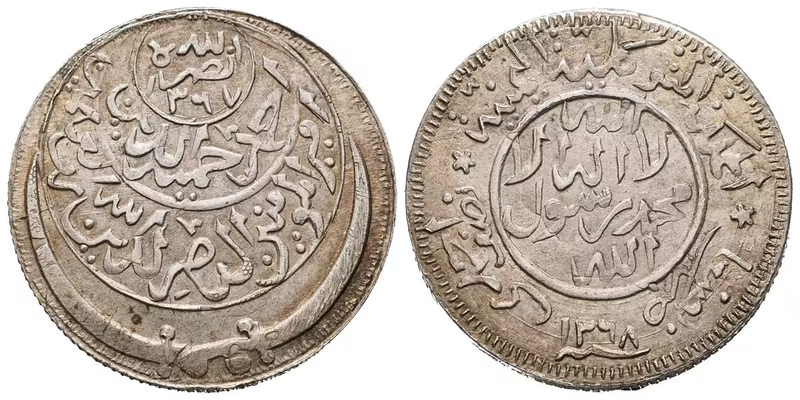
Shia dynasties explicitly referred to the imams. Fatimid dinars bore the genealogies of caliph-imams back to Ali. Safavid coins in Persia listed the names of the twelve imams in a circle around the shah's name. The Zaydi imams in Yemen struck silver riyals with their own names and the title imam al-muttaqin. Qajar strikes depicted the lion and the sun - the symbol of Ali.
The calligraphy of the names of the imams has a sacred meaning. Panjtan-i pak - the five holy ones (Muhammad, Ali, Fatima, Hasan, Husayn) on Persian coins. Ali wali Allah (Ali is the friend of God) on Shia strikes. Ya Ali madad (O Ali, help) as an invocation on Isma'ili coins. A square with the names of the four rightly-guided caliphs on Sunni coins.
The imam in his liturgical function leads the five daily prayers facing Mecca (qibla). At the Friday prayer (jumu'a) he delivers the khutba - a sermon on religious and social matters. Tarawih - special night prayers during Ramadan. Leading of funeral prayers (janaza) and wedding ceremonies (nikah). Recitation of the Quran with correct intonation (tajwid).
Spiritual authority of the imams
The Shia imam has a cosmic function. He is hujjat Allah - the proof of God on earth, without whom the world would perish. Bab - the gate to divine knowledge. Qutb - the axis of the universe around which creation turns. The imam is mazlum - oppressed, but also mansur - the victorious eschatological restorer. The hidden imam Mahdi will return at the end of times to establish justice.
The educational role of the imam includes teaching in the madrasa - the Islamic school attached to the mosque. The exposition of fiqh - Islamic law according to the relevant school. The issuing of fatwas - legal opinions on current questions. The memorisation and transmission of hadiths. Some imams are muftis or qadis with legal authority.
In our auction and shop
- Code: SJEM-D1948
Jemen, ½ Ahmadi Riyal AH 1367 (AD 1948)
Jemen, Imam Ahmad Al-Nasir bin Jahja, AH 1367 - 1381(AD 1948 - 1962) 1/2 Ahmadi Riyal AH 1367 (1948), KM.16.1, krásná zachovalost, ražební lesk, krásně vyražený