Jeff Bezos
Jeff Bezos is an American entrepreneur and visionary who founded Amazon and transformed it from an online bookshop into the world's largest e-commerce and cloud company. His obsession with customer experience and long-term thinking changed the way people shop, and his company Blue Origin seeks to democratise space flight.
Jeffrey Preston Bezos was born on 12 January 1964 in Albuquerque, New Mexico, as the son of seventeen-year-old high-school student Jacklyn Gise and his biological father Ted Jorgensen, who left the family when Jeff was barely two. His mother later married the Cuban immigrant Miguel Bezos, who adopted the boy and became his true father. The family moved often because of Miguel's work as an engineer at Exxon, which taught the young Jeff adaptability and the ability to quickly form new relationships.
Bezos's childhood was significantly shaped by his grandfather Lawrence Preston Gise, a former senior official of the Atomic Energy Commission, who owned a ranch in Texas. Every summer Jeff spent long months there, where he learned self-sufficiency, repaired tractors, castrated cattle and solved practical problems with limited resources. His grandfather instilled in him the values of hard work, ingenuity and faith in technological progress, which became the foundation of his entrepreneurial philosophy.
From an early age Bezos showed extraordinary intelligence and an interest in science and technology, setting up a laboratory in the garage where he conducted experiments and built various inventions, including a solar cooker and an alarm intended to keep his younger siblings out of his room. His parents supported his curiosity, although his mother recalls how she had to buy components at Radio Shack of whose purpose she had no idea. At school he excelled in mathematics and physics, became valedictorian of his class and a National Merit Scholar.
At Princeton University Bezos originally studied physics with the ambition of becoming a theoretical physicist, but after confronting still more talented students he switched to electrical engineering and computer science. His thesis dealt with the creation of a network for telecommunications, which foreshadowed his later interest in building infrastructure. After graduating in 1986 he turned down offers from Intel and Bell Labs and instead joined the start-up Fitel, which was developing a network for international commerce, where he first encountered the potential of linking technology and commerce.
His Wall Street career began at Bankers Trust, where he became the youngest vice-president in the company's history, and continued at the fund D. E. Shaw & Co., where in his thirties he directed the development of automated trading systems. It was here in 1994 that he came across the statistic that internet usage was growing by 2,300% per year, which led him to analyse which products would be most advantageous to sell online. He chose books as the ideal product because of standardisation, low prices and the enormous catalogue that no physical bookshop could accommodate.
History
The decision to leave a lucrative Wall Street career and found an online bookshop was regarded by many as madness, but Bezos applied his "regret minimisation framework" — he imagined himself at the age of eighty and realised that he would regret not seizing the opportunity of the internet revolution. With his wife MacKenzie, who supported him and believed in his vision, they set out by car across America to Seattle; during the journey Bezos was writing the business plan while MacKenzie drove.
Amazon.com was founded on 5 July 1994 in the garage of a rented house in Bellevue near Seattle, where Bezos personally packed and shipped the first orders. He chose the name Amazon because it began with A (an advantage in alphabetical lists), evoked something exotic and vast like the world's largest river, and the logo with an arrow from A to Z symbolised the ambition to sell everything. Amazon sold its first book in July 1995, and within two months was achieving sales of $20,000 a week, surpassing the most optimistic projections.
Although Amazon grew exponentially, it did not generate profit until 2001, since Bezos reinvested all income into growth and infrastructure. This strategy provoked criticism from investors and analysts, who labelled the company "Amazon.bomb" during the bursting of the dot-com bubble in 2000, when shares fell by 90%. Bezos, however, believed in his long-term vision and rejected pressures for short-term profitability, repeating the mantra "It is still Day One" and that Amazon was only at the beginning of its journey.
The breakthrough was diversification beyond books into electronics, toys and gradually all categories of goods, transforming Amazon from a bookshop into "the store that sells everything". Revolutionary was the Amazon Prime programme launched in 2005, which for an annual fee offered unlimited express delivery, thereby changing customer expectations and creating an ecosystem of loyalty. The Kindle e-reader, introduced in 2007, disrupted Amazon's own book business, but Bezos knew that it was better to cannibalise oneself than to wait for the competition.
Bezos's most brilliant move was Amazon Web Services (AWS), the cloud infrastructure which arose from the internal need for scalable IT systems. What began as a side project in 2006 became the most profitable division of Amazon, which powers half the internet, including Netflix, Airbnb and NASA. AWS demonstrated Bezos's ability to see opportunities where others see only costs, and to create new markets by transforming internal competencies into external services.
Business philosophy and principles
In 2013 Bezos shocked the media world by buying the Washington Post for $250 million from his own funds, not through Amazon. His investment in digital transformation and investigative journalism returned the newspaper to profitability and prestige, although his ownership raises questions about conflicts of interest. At the same time Bezos founded Blue Origin, a space company with the vision of enabling millions of people to live and work in space, which he considers his most important work.
His divorce from MacKenzie in 2019 after 25 years of marriage was the most expensive in history, with MacKenzie receiving 25% of their joint Amazon shares worth $38 billion. Bezos's relationship with television presenter Lauren Sanchez and the scandal over stolen intimate photographs damaged his carefully built image but did not affect his business. In 2021 Bezos resigned as CEO of Amazon in order to devote himself to Blue Origin, the Bezos Earth Fund and other projects.
Bezos's philosophy is based on absolute obsession with the customer, long-term thinking and willingness to experiment and to fail, which he summarised in the principles "Customer Obsession", "Think Big" and "Bias for Action". His conviction that in business there are only two strategies — low price or differentiation — led to the creation of Amazon, which paradoxically offers both through scale and technological superiority. He believes that most decisions are reversible (two-way doors) and should be made quickly, while only a few critical decisions (one-way doors) require deep analysis.
His "Day 1" mentality concept means maintaining a start-up culture even in a company with a million employees, where speed of decision-making and experimentation takes precedence over perfection. Bezos champions a "disagree and commit" culture, in which even if you disagree with a decision, you fully support it once it is made. His meetings begin with silent reading of six-page narrative memos instead of PowerPoint presentations, because he believes that writing compels clear thinking.
Bezos's approach to innovation consists in working backwards from the customer — instead of asking "what can we produce with what we have?", he asks "what does the customer need and how can we create it?" Every new product begins with a fictional press release announcing its launch, which forces teams to think from the customer's perspective. His willingness to invest billions in projects with uncertain returns such as Alexa or Amazon Go demonstrated his belief in long-term value over short-term profit.
In our auction and shop
- Code: RX-USA-004New
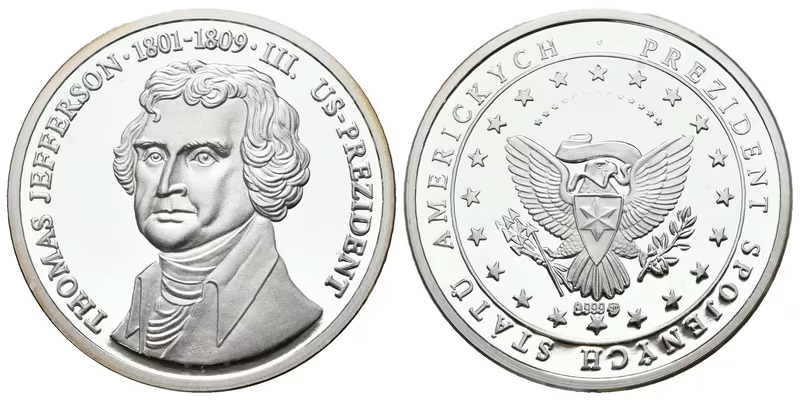
USA, medaile - Thomas Jefferson, III. prezident USA (1801-1809), portrét + státní znak USA
Soukromá ražba - série Prezidenti USA Medaile - Thomas Jefferson, III. prezident USA (1801-1809), portrét + státní znak USA Ag (.999), 30 mm (8,6 g), v kapsli. Stav mince odpovídá fotografii. Jedná se o druhotný prodej. (Možná oxidace, atd.. ! - VIZ…
Skladem 1 ks - Code: RX-USA-005New
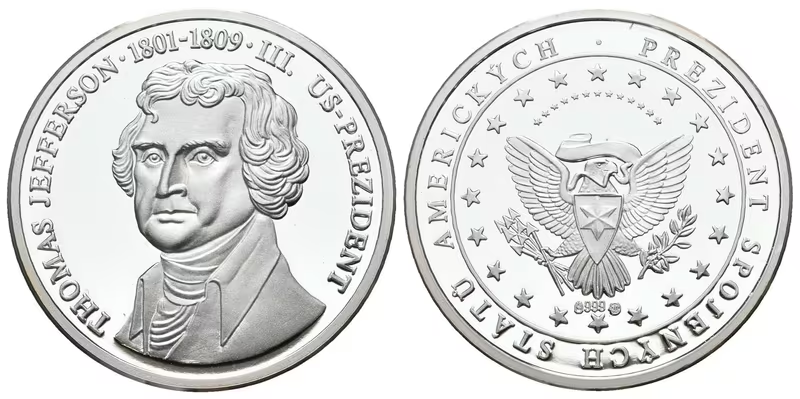
USA, medaile - Thomas Jefferson, III. prezident USA, prezidentský znak
Soukromá ražba - série Prezidenti USA Medaile - Thomas Jefferson, III. prezident USA, prezidentský znak Ag (.999), 30 mm (8,6 g), v kapsli. Stav mince odpovídá fotografii. Jedná se o druhotný prodej. (Možná oxidace, atd.. ! - VIZ FOTOGRAFIE !)
Skladem 1 ks - Code: SUSB-X2007
USA, Sada stříbrných a pamětních oběžných mincí 2007 PROOF - American Legacy Collection
Sada mincí PROOF (American Legacy Collection) obsahuje: PROOF sadu oběžných mincí 2007 1 Cent až 1/2 Dollar, Sadu 1 Dollar PROOF - Prezidenti Washington, Adams, Jefferson a Madison. 5x 1/4 Dollar 2007 - Montana, Washington, Idaho, Wyoming, Utah, obecný…
Skladem 1 ks - Code: SUSA-SP1993CP
USA, 1 Dollar 1993 - Thomas Jefferson
1 Dollar 1993 P - 250. výročí narození Thomase Jeffersona (Thomas Jefferson - 250th Birth Anniversary), KM. 249 Ag 0,900, 38,1 mm (26,73 g)